GoalKeeper
Raise the glass to progress
Team
(she/her)

(she/her)
(she/her)

(he/him)
(he/him)
Problem and Design Overview
It is often difficult for people to reduce their alcohol use, even when they genuinely want to cut back, because drinking can become habitual and socially reinforced. Existing tools for managing consumption are often too tedious or backfire by creating guilt-driven cycles of motivation and relapse. Additionally, people are not interested in manual tracking that involves high effort, but are more interested in support that helps them stay connected to their long-term goals.
Our design, GoalKeeper, is a customizable Koozie for folks who continue drinking after college. This offers a convenient way for users to automatically track their drinking, create goals, and manage habits with friends through a companion social app. You can work together with friends to reflect on and share progress while staying motivated. The main purpose of the Koozie is to encourage mindful drinking in conjunction with a sustained connection to personal and social goals.
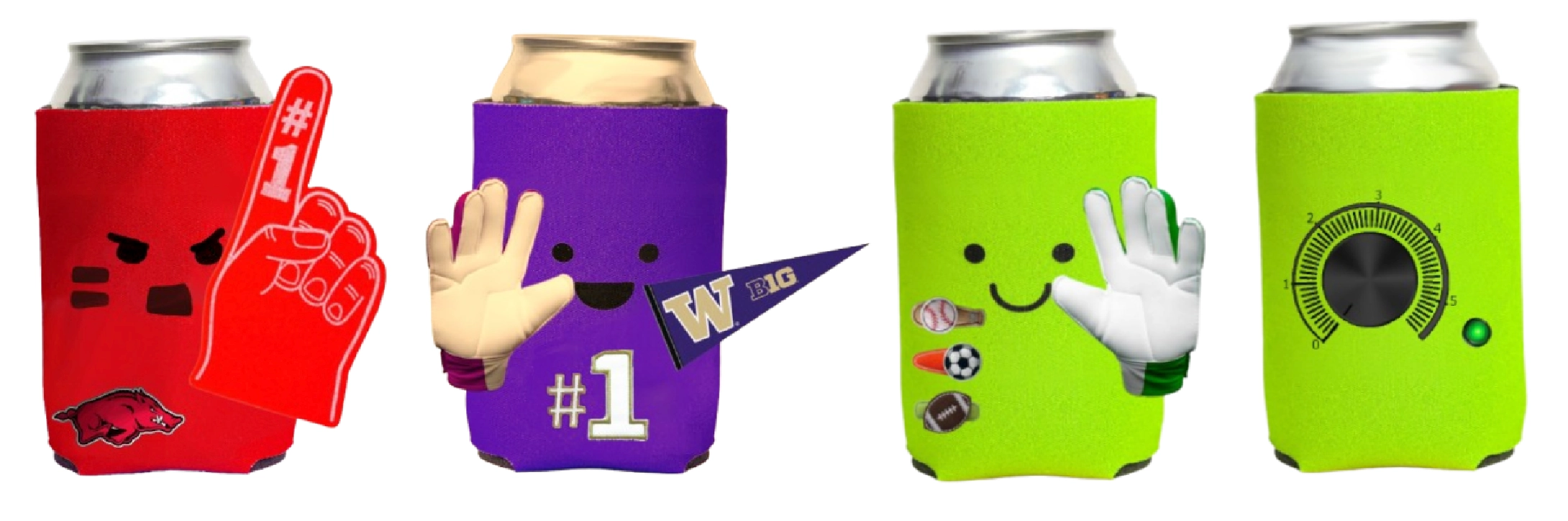
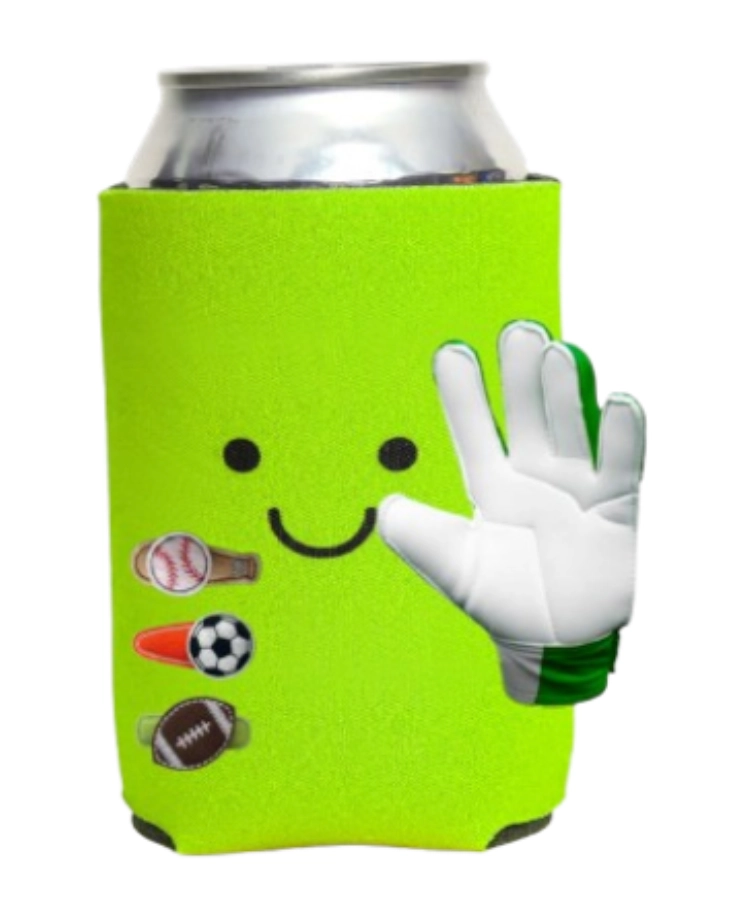
Koozie designs with different colors.
Design Walkthrough
Since koozies are already common in social and sports settings, especially among folks who continue drinking after college, our design reframes the koozie as a tool for mindful drinking. It’s non-invasive, convenient, and fun to use. Paired with a companion app, the koozie’s main task is to help users set and maintain personal drinking goals to reduce their usage. A simple dial on the back allows the user to set the number of standard drinks in their can or glass. During an event, the koozie detects when a drink is placed inside through a built-in weight sensor. It syncs this information to the app, offering personalized feedback while also serving as a visual reminder of the user’s goal in real time.
After an event, the app presents progress through clear, color-coded indicators and sends supportive notifications that celebrate small wins. Users can monitor their habits over time, hold each other accountable, check in on friends who need support, and view personal milestones through the Celebration Board. We focus on encouraging self-reflection and intentional drinking to help users perpetuate the habits they want to keep for the long term.
Set, Track, and Manage Drinking Goals
First, users can specify a goal in-app for how much they plan to drink during a given time period. On the dial at the back of the koozie, they initialize the typical number of standard drinks in their beverage(s) of choice.
During a drinking event, users place their beverage inside the GoalKeeper koozie, which automatically adds the specified number of standard drinks to an ongoing tally tracked throughout the day. The koozie then sends this drink information to the user’s phone via Bluetooth. The koozie serves as a visual reminder of a user’s goal as they actively drink to help them keep their commitment. On the friends page, each user can monitor their friends who are currently drinking and encourage them to stick to their goals in real time. If a friend is over their limit, you can quickly press the message button, which is a UI shortcut to their preferred Messaging App, and check in to offer support.
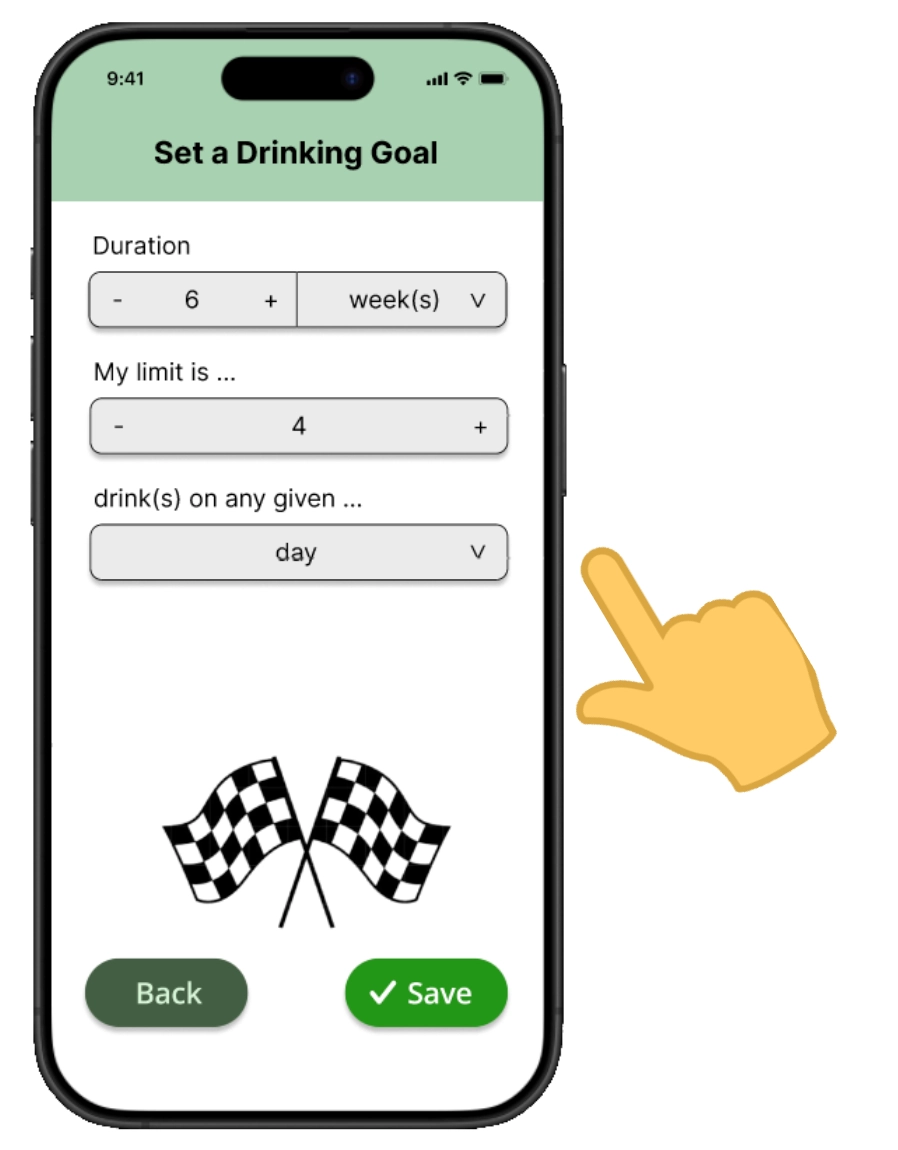
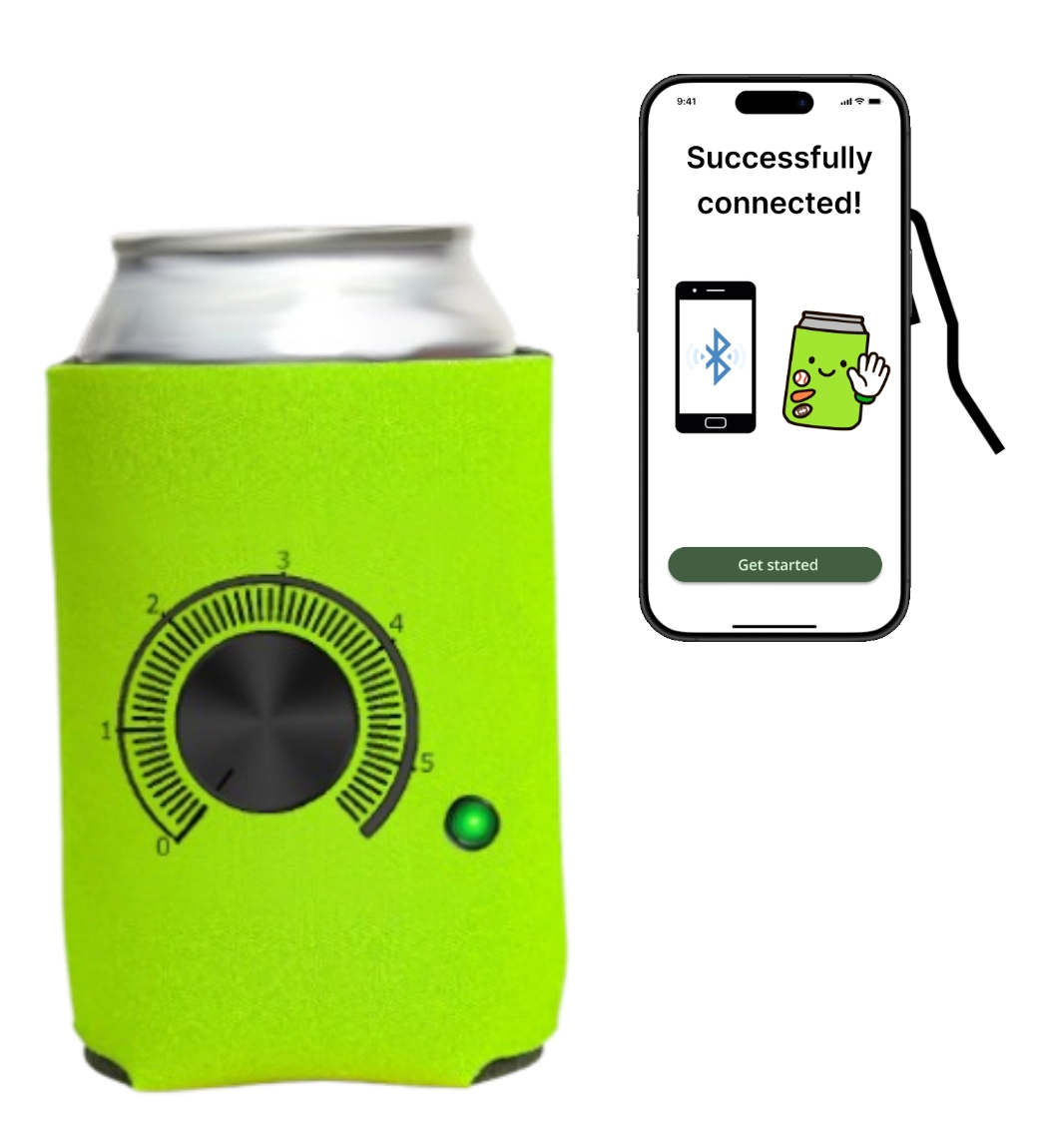
After specifying the goal in App, user can use the koozie during drinking sessions once connected via Bluetooth.
After an event, the app stores the koozie drink info and creates a report on the Progress page. When the user clicks the Progress button, they can view their drinking habits over time, indicated by different colors (red means they’ve exceeded the limit, while green means they are still under the limit). During and after their goal, the users will receive regular, tailored push notifications that motivate and encourage them to share their progress in the app. At any time, users may share their progress with friends and celebrate achievements together. After the goal is over, the user can update their goal or set a new one in the Set a Goal page.
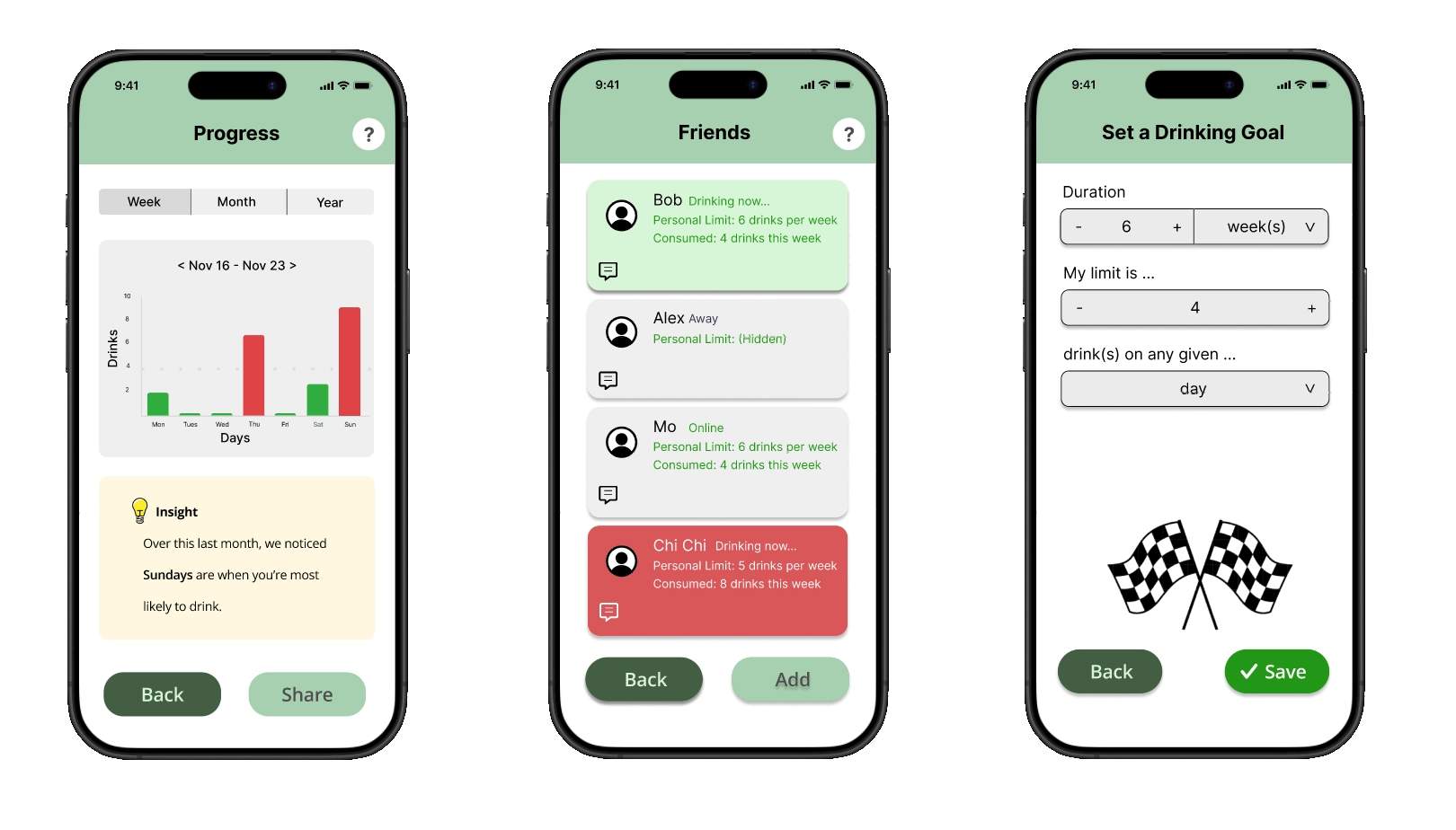
Users can track their drinking progress and communicate with friends on companion App.
Encourage Self-Reflection and Intentional Drinking
During the goal tracking period set by the user, the app analyzes the progress data and sends notifications with tailored motivational prompts to the user, whether they’ve achieved the goal or not. These notifications also encourage them to interact with the app’s Celebration Board to post their highlights after completing the goal. Users can reward their personal efforts by posting these achievements and looking back on past snapshots, which helps them reflect & plan for their next goal. Everything is kept private to the user, but they always have the option to share their achievements with friends. This allows the user to reinforce their commitment and feel motivated to drink intentionally through genuine social encouragement.
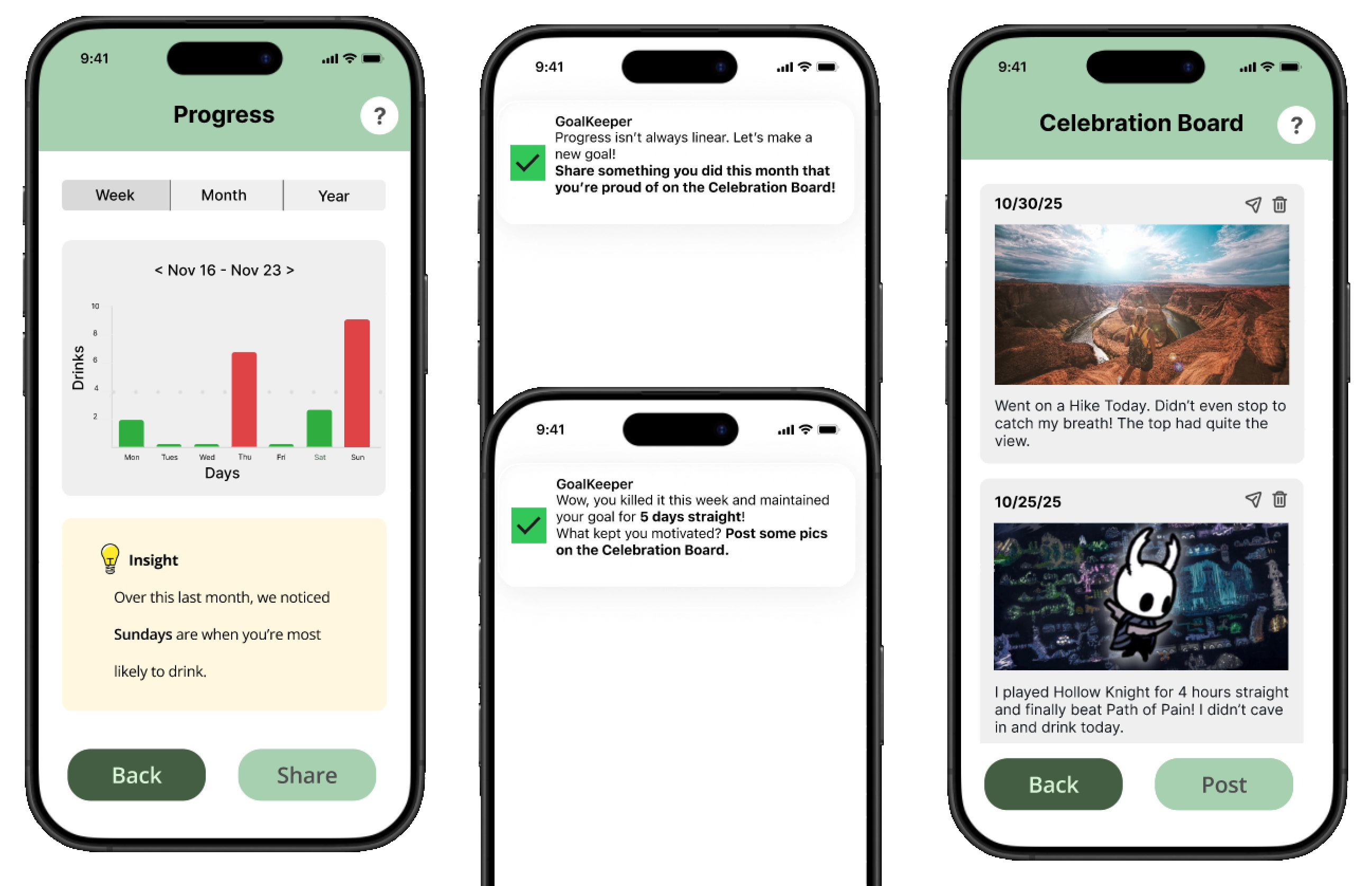
The app prompts user notifications on goal completion and encourage them to use celebration board.
Design Research and Key Insights
The goal of our design research was to gain a deeper understanding of accountability in people’s drinking habits and the factors that influence or distract them from self-tracking. We ultimately decided to design for college graduate students who aim to be more aware of their drinking habits. To gain insights into their drinking experiences, we conducted several interviews with some friends who had a background with alcohol usage.
Passive Drink Tracking
We found that people prefer tracking methods that require little to no effort from the user. In particular, many noted that as you get more intoxicated, it becomes increasingly more difficult to remember to track. The main implication of this for our design was that efficiency of tracking is far more important than accuracy, an important perspective that eliminated many potential design options.
Socially Motivated Tracking
We found that people are more motivated to track their drinking habits when there is social reinforcement. Current solutions, with an abundance of precise statistics, end up being more demotivating and negatively focused on failed goals. In our design research, participants frequently mentioned that they ask their friends to hold them accountable for their drinking habits. In social drinking contexts, the ability to monitor one’s drinking with friends was also a significant appeal. Based on this feedback, we focused on creating a core social environment that emphasizes success and personal achievements, while encouraging users to maintain their goals. This is manifested in our friends’ system and celebration board.
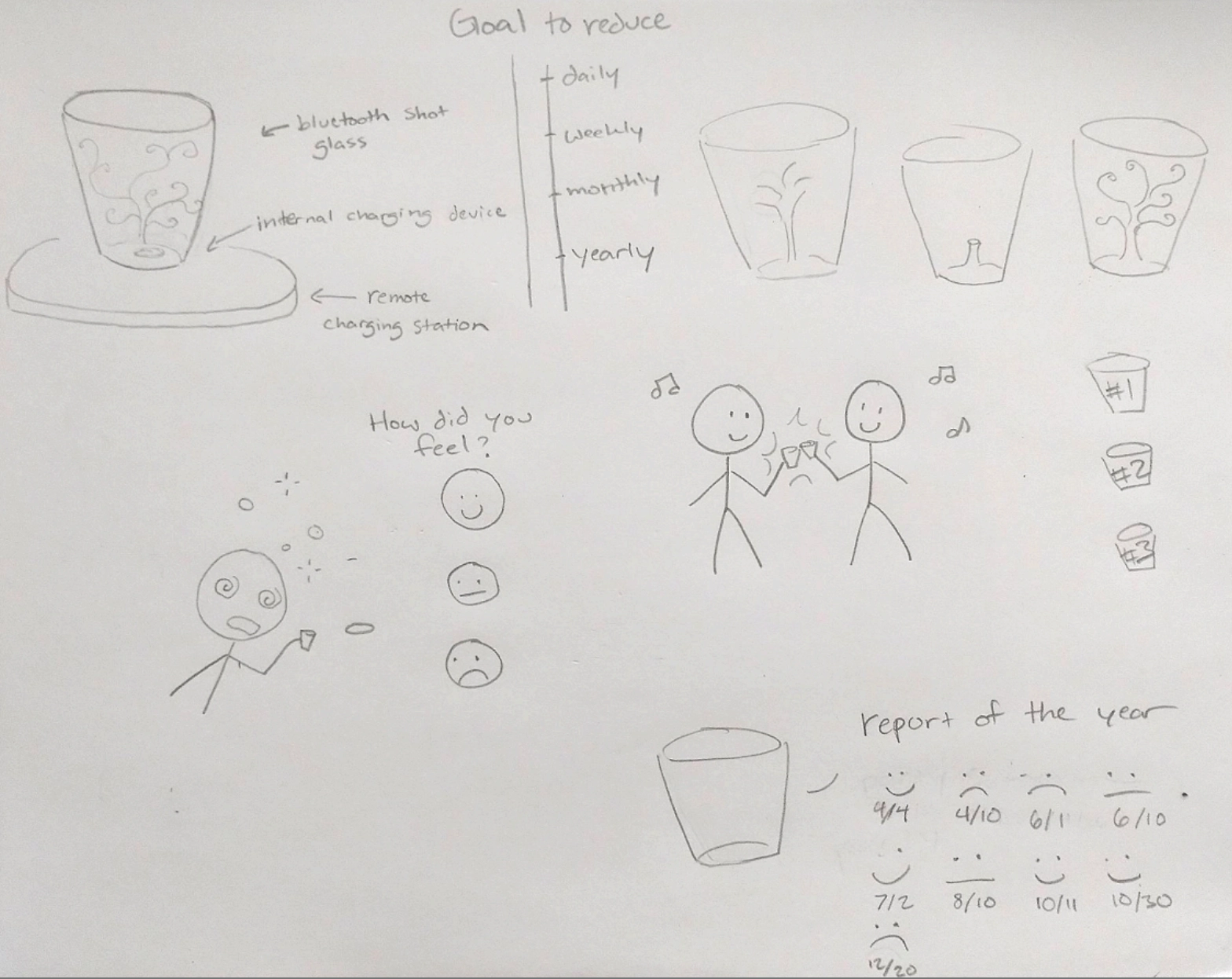
In the early low-fidality design stages, we focused heavily on the social aspect of drinking.
Prioritizing Privacy
Early on in our design research, we also learned that users who were interested in tracking their alcohol usage were concerned about an extra device collecting an excessive amount of personal information or one that was too invasive to use regularly. We cycled through various forms, including a BAC sweatband, a drink buddy, and a drink-sensing shot glass, until we settled on our automated Koozie and app. In our koozie, the only thing that’s being tracked is whether you’ve placed a drink in the koozie and how many standard drinks you have had per day, according to the simple weight sensor and dial. In-app, we prioritize privacy: the user’s progress, goals, and achievements are by default private unless intentionally shared.
Iterative Design and Key Insights
Our initial paper prototype had several issues brought up by heuristic evaluations with the visibility of system status and missing help resources. The usability tests revealed similar issues where users didn’t know how to interact with our koozie because there was a lack of documentation. The digital mockup also provided an opportunity to refine the app's aesthetics, which was the area that saw the most improvement during our final design iterations. As we iterated on our design, we found that our participants found the help documentation unclear, logging drink amounts was confusing, and we had competitive features that took away from our supportive and celebratory intention. To address these problems, we improved the introductory walkthrough and added additional help buttons to provide quick guidance throughout the app, improved the input system to make tracking more intuitive and accurate, and added the celebration board, which centers around personal progress and encourages a shared community experience. These changes, directly informed by participant feedback, played a pivotal role in evolving our design to effectively meet user needs.
Clarifying Help Documentation
For our initial prototype, we included an intro tutorial on how to use the koozie, but it was all text and included a great deal of unnecessary information that was not directly important for setup. During our usability testing, one of the testers completely skipped these intro instructions because they were too long and wordy, and thus was confused using the app. Another tester did not understand the instructions and couldn’t figure out how to work the koozie. This was clearly a major problem. To fix it, we made the instructions much more intuitive by removing all information that was not absolutely necessary for understanding the use of the koozie. We also added pictures to remove any remaining confusion. We turned the vague tutorial into a clear walkthrough on how to connect the koozie to ensure users feel guided through the initial experience. Then, to explain the app use in more detail, we added a help button in the top corner of most screens that explained how to use the features currently available to the user on that screen.
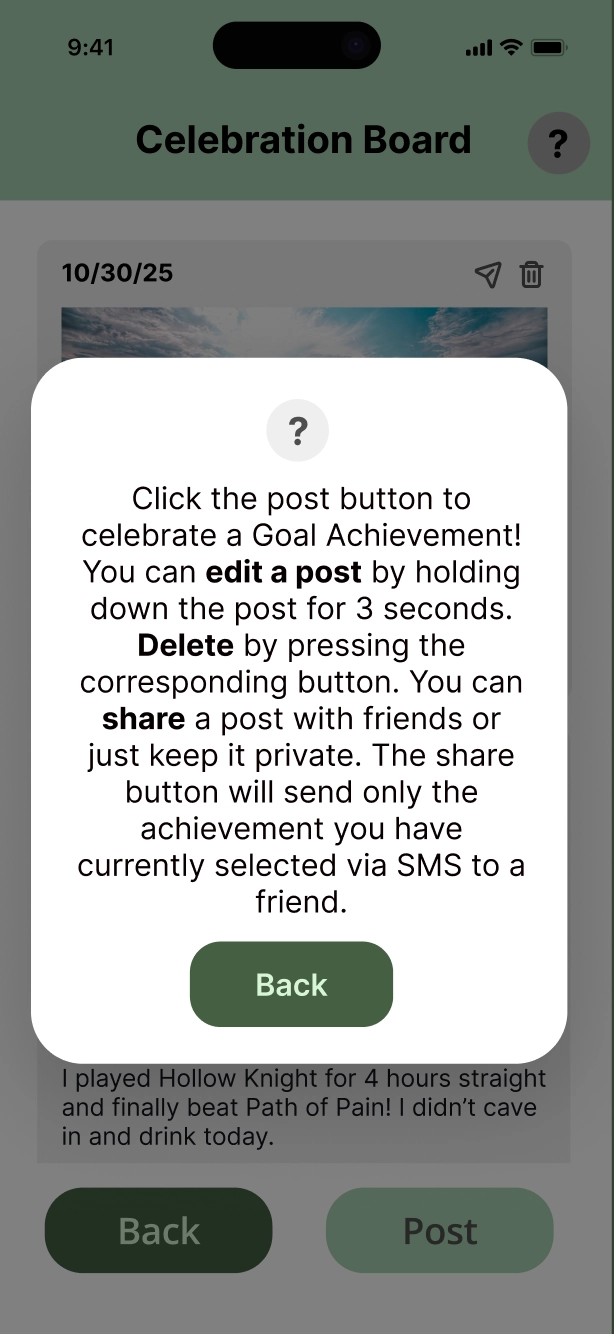
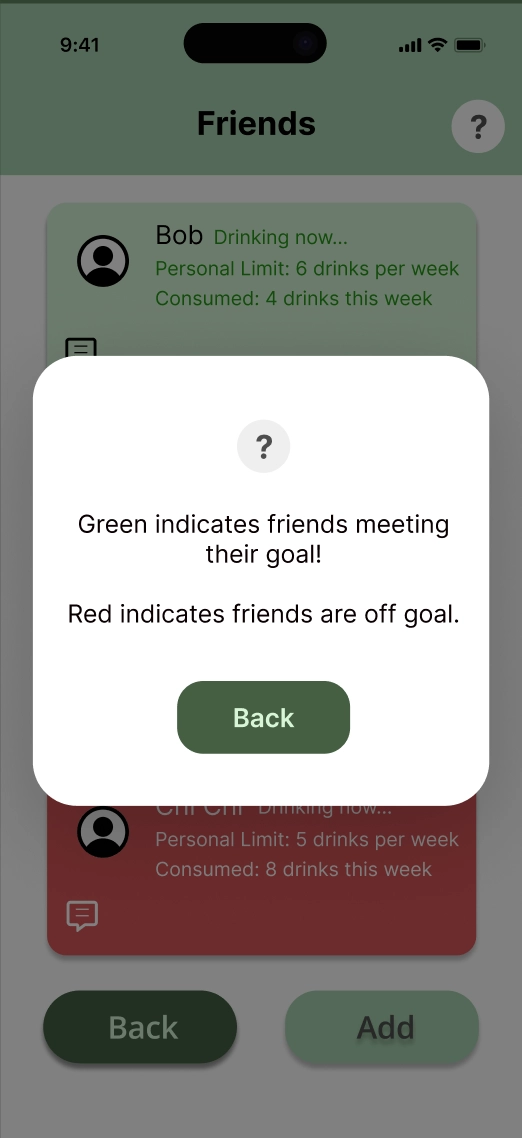
Extra information on the Help Page.
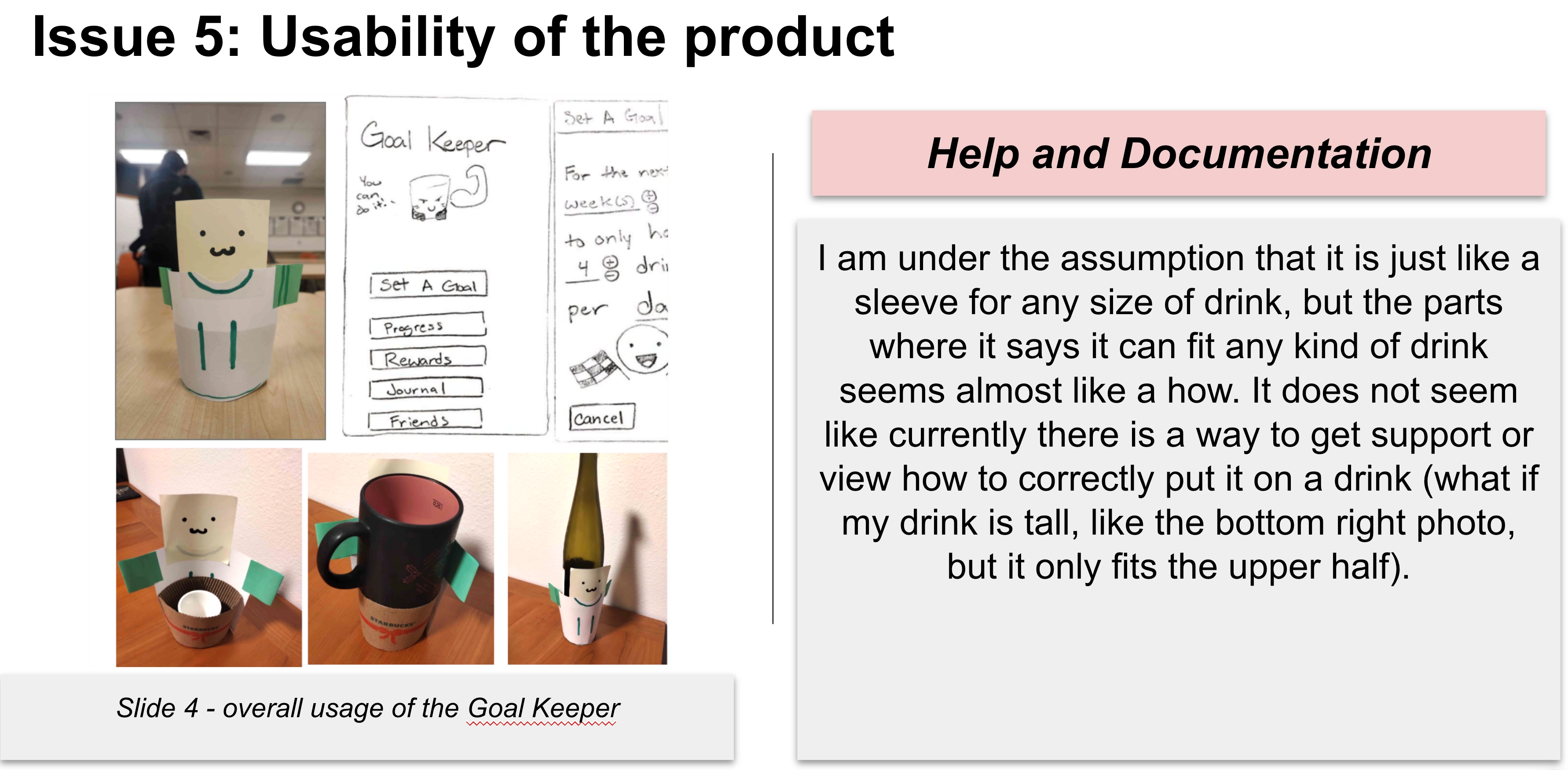
In the heuristic Evaluation, we got some feedback that the documentation of koozie was unclear.
Standard Drink Amount
For our first prototype, the koozie featured a dial that allowed the user to select the type of drink, such as beer, wine, cocktails, etc. We thought that this would be a good way to standardize input among different types of beverages. However, many of our heuristic evaluators were confused as to how “one drink” would be calculated. They raised a point that a drink with a much higher ABV would not be equivalent to a drink with a low ABV. A participant shared that some beers are counted as 2 standard drinks due to their higher alcohol content. Some evaluators are also concerned about how partially empty drinks will be calculated, as it may be the case that people share drinks with their friends or refill their cups halfway. With these issues in mind, we changed the dial from selecting types of beverages to selecting the estimated number of standard drinks (decimals allowed). This way, it is both simpler to set the amount of alcohol you plan to drink and more accurate than the previous system.
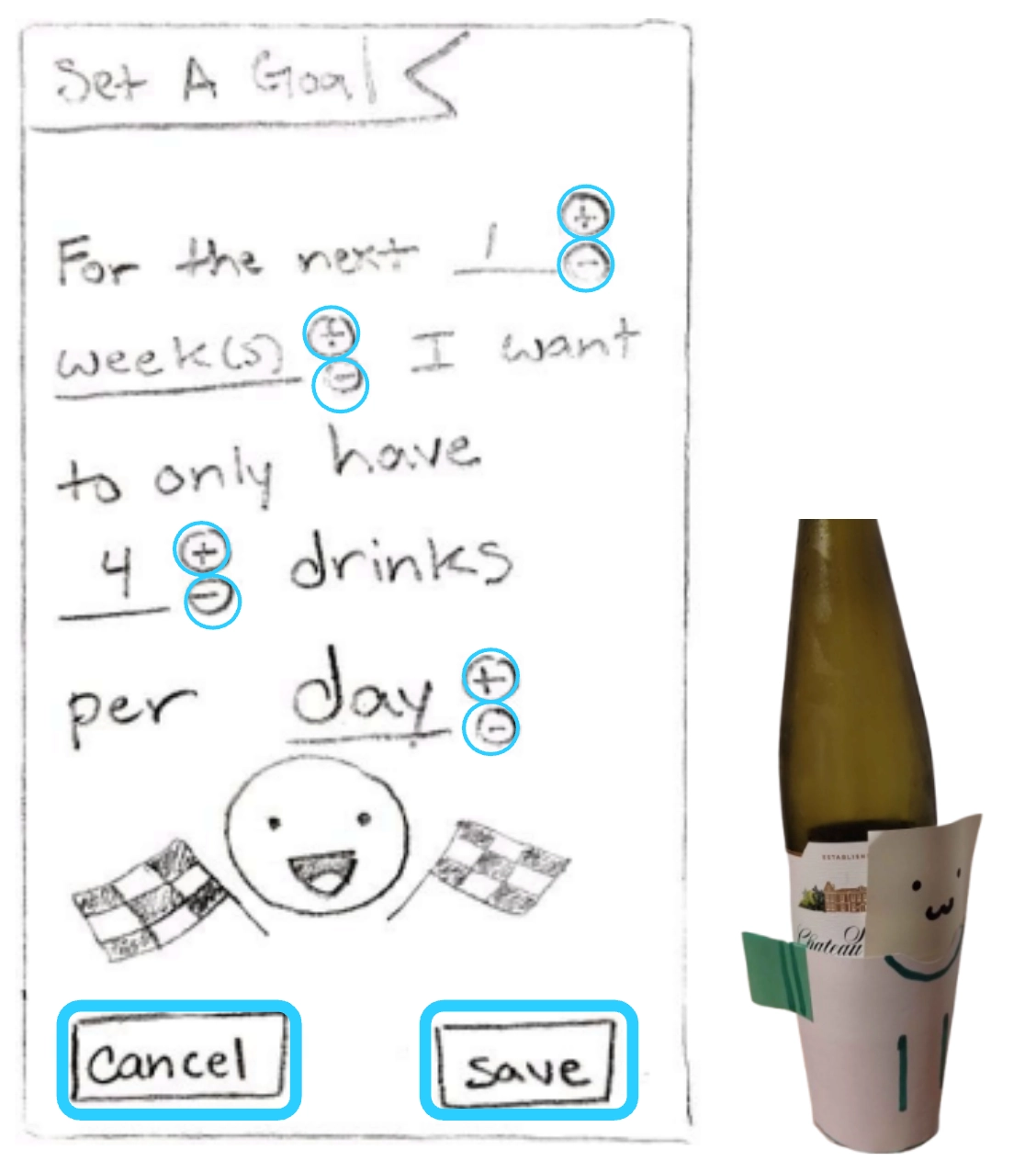
On the "Set Goal" page, the meaning of "Drink" was unclear to user.
Shifting From Competition to Celebration
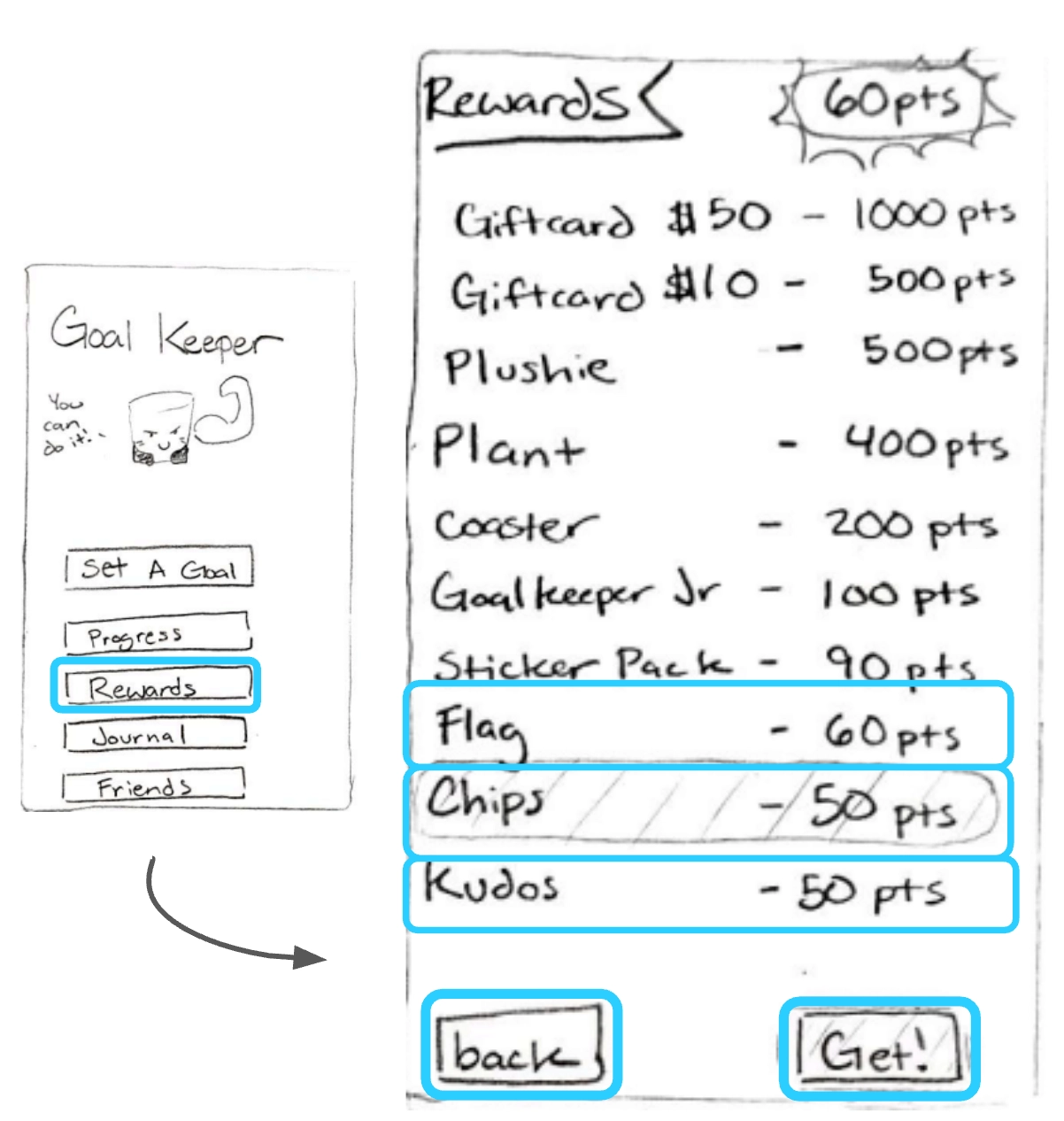
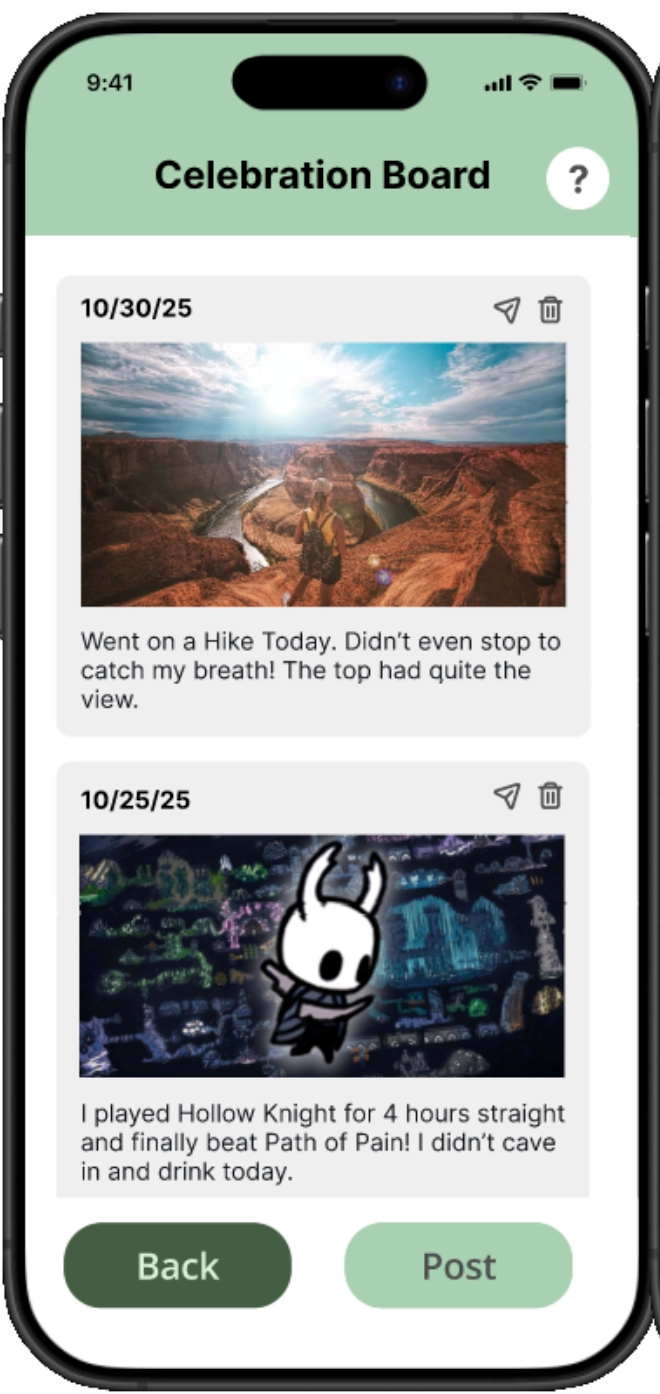
We shifted the design from Rewards system to Celebration Board.
In the very early stages of our design, we had a leaderboard that was meant to encourage playful competition among friends. However, some raised concerns that consistently ranking low could feel discouraging and shameful. We then explored a rewards system so users can benefit regardless of their performance, though this shifted the focus towards external incentives rather than the personal sense of accomplishment that we wanted to establish. In light of this, we transitioned the rewards system into a celebration board. This approach enables users to post and revisit personal milestones that are meaningful to them. This approach acknowledges that everyone’s goals are different and allows users to share achievements with friends, fostering encouragement and progress rather than comparison.