CSE 331: Implementing an abstract data type
Course motto: Your job is to deliver code that you know works.
A specification is written about the abstract state, the queue as the client thinks of it. An implementation is written about the concrete state, its fields. The specification says what every method must do, but in abstract terms: the students waiting, front first. The body does its work in concrete terms: a list, a set. So between the promise and the code there is a gap, and nothing yet says how to cross it: which values of the fields are allowed, which abstract state a value of the fields stands for, and so whether a body does what its specification says. This lecture closes the gap with two additions: a claim about the concrete state, the representation invariant, and a function from the concrete state to the abstract state, the abstraction function. Together they say what it means for a method, and then a class, to be correct, and they show why no code outside the class may reach the fields.
FastQueue: a faster join
Recall Wednesday's half sheet: a queue that keeps the students
twice, in a list for the order and in a set, so that join's
check for a student already waiting asks the set instead of
walking the list. A HashSet answers in "constant
time", however long the queue.1 Here is that class,
FastQueue. Its check is faster. But now two fields hold the
same students, and every change to one has to be made to the
other.
1 2 3 4 5 6 7 8 9 10 11 12 13 14 15 16 17 18 19 20 21 22 23 24 25 26 27 28 29 30 31 32 33 34 35 36 37 38 39 40 41 42 43 44 45 46 47 48 49 50 51 52 53 54 55 56 57 58 59 60 61 62 63 64 65 66 67 68 69 70 71 72 73 74 75 | |
The field queue, on line 14, holds what ListQueue's list
held: the students waiting, front first. The field members, on
line 16, is new: a set of the same students. For now, read past
the private method on lines 36 to 43, and the calls to it in
every constructor and method. The section
Checking the representation invariant with checkRep
comes back to them. Here is what each public method does with
the two fields:
sizereturns the size of the set, on line 47.joinasks the set whether the student is already waiting, on line 52. Then it adds the student to both fields: at the back of the list on line 55, and to the set on line 56.nextremoves the first student from the list on line 65, and the same student from the set on line 66.waitingreturns a copy of the list on line 73, asListQueue's did.
The second constructor, lines 26 to 34, makes a queue from a list of NetIDs that the client passes. The section Copy in, copy out comes back to it too.
Notice that join's check, on line 52, never walks the list.
(The private method we read past does walk it, twice in each
join. The section
Checking the representation invariant with checkRep
comes back to that cost.)
Is FastQueue right? Wednesday's five tests are a place to start.
They are specification-based, so each passes on every correct
implementation of HelpQueue. The name of no class that
implements HelpQueue appears in HelpQueueTest.java. As on
Wednesday, a subclass says which class to test:
public class FastQueueSpecTest extends HelpQueueTest {
    HelpQueue emptyQueue() {
        return new FastQueue();
    }
}
One more file, FastQueueTest.java, holds a sixth test, of the
second constructor. The section Copy in, copy
out shows it. Compile FastQueue.java and its
two test classes with Lecture 10's HelpQueue.java and
HelpQueueTest.java. Then select both FastQueueSpecTest and
FastQueueTest, as Lecture 10 ran ListQueueSpecTest.
JUnit starts six tests, and none fails: the five from Wednesday on
a FastQueue, and the test of the constructor.
The five tests did not change at all. Each uses only what
HelpQueue promises, and nothing HelpQueue promises mentions a
list or a set. So the fields could change from one list to a
list and a set, and a test, or a client, that keeps to the
interface did not have to change with them. In
Reading 3, David Parnas builds one
system twice. In his second version, each module hides one design
decision from the rest of the program, so that a change to the
decision changes that module alone.2 The decision
HelpQueue hides is how the queue is kept. Today we kept the
queue a second way. Since the fields are private, every line that
reads or changes them is in FastQueue.java.
Lecture 10 asked whether ListQueue and LinkedQueue are
the same or different. They are different classes,
with different fields and bodies. To a client that relies only on
HelpQueue's specifications, they are the same. FastQueue adds
a third answer: it is different in something the specification
never mentions, how long join's check for the student takes. A
client that relies only on HelpQueue's specifications can
switch to FastQueue and change nothing but the line that makes
the queue.
Now look again at the fields. Lines 13 and 15 say what each field
holds, as LinkedQueue's comment on its fields did. The three
comment lines after them, lines 17 to 19, are new. ListQueue had
nothing like them. Those three lines are today's subject.
FastQueue keeps the students twice, so its two fields have to
agree: each method that changes one field has to change the
other to match. Two fields that have to agree is the lecture's
first problem.
Which method is wrong?
Here is a game. The next few pages show FastQueue with one line
missing, and two of Wednesday's tests failing on it. The question is
the one in this section's title: which method is wrong? The missing
line: suppose that when you wrote next, you forgot line 66, the
line that removes the student from the set. Here is the heart of
next, from FastQueue.java, with the missing line struck out:
| FastQueue.java | |
|---|---|
62 63 64 65 66 | |
| FastQueue.java | |
|---|---|
68 69 | |
To run it, take FastQueue.java and leave line 66,
members.remove(front), blank. Blank every checkRep(); line
too, in each constructor and method, since we are
still reading past that private method. Blank lines keep every
other line at its number, so the line numbers below are
FastQueue.java's.
Run Wednesday's five tests and the test of the constructor against FastQueue.java without line 66, as before. JUnit starts six tests, and two fail. In JUnit's report, the five tests' lines read:
│  │  ├─ nextOnAnEmptyQueueThrows() ✔
│  │  ├─ waitingIsACopy() ✔
│  │  ├─ nobodyIsInTheQueueTwice() ✔
│  │  ├─ aStudentWhoLeftMayComeBack() ✘ ada is in the queue
│  │  └─ studentsAreServedInTheOrderTheyJoined() ✘ expected: <1> but was: <2>
Let's follow each failing test through the fields. Here is the first:
| HelpQueueTest.java | |
|---|---|
33 34 35 36 37 38 39 40 | |
The test joins ada, on its line 36. In FastQueue, line 55 adds
ada to the list, and line 56 adds ada to the set, so the field
queue is [ada] and members is {ada} (square brackets for a
list, braces for a set; the test's own variable queue is the
whole FastQueue). Next, the test calls next. Line 65 removes
ada from the list, so queue is []. Line 66 is blank, so
members is still {ada}. Finally, the test joins ada again. Line
52 asks the set whether ada is in the queue. members.contains
returns true, so line 53 throws: "ada is in the queue". But
nobody is waiting! The test expected the second join to add ada.
It never reached its assertion.
Here is the second:
| HelpQueueTest.java | |
|---|---|
13 14 15 16 17 18 19 20 21 22 | |
The test joins ada and bob, so the field queue is [ada, bob]
and members is {ada, bob}. next removes ada from the list and
returns "ada", so queue is [bob]. Again the set is unchanged:
members is still {ada, bob}. waiting copies the list, so it
returns [bob]. That assertion passes. Then size returns the size
of the set, on line 47, which is 2. So the last assertion fails:
expected: <1> but was: <2>.
On both runs, the client saw behavior that breaks a specification:
join threw though ada was not in the queue, and size returned 2
with one student waiting. So FastQueue without line 66 is wrong.
But here is the question: which method's code is wrong? Not
necessarily the method whose call misbehaved! The last method to run
can be written perfectly and still give a wrong answer, if an earlier
method left the fields in a state it was never meant to see. join
and size each ran on fields that next had just left. So: next,
join, or size?
Each answer is right under one reading of what the fields hold:
- If
membersmay hold students who have left, thennextis fine.joinis wrong to trust the set on line 52, andsizeis wrong to count the set on line 47. Each should ask the list instead. - If
membersholds exactly the students inqueue, thenjoinandsizeare fine, since the set and the list name the same students.nextis wrong, since it leaves ada in the set after taking ada out of the list.
Nothing javac checks decides between the two readings. Under either reading, the three methods have the same lines. javac accepts them.
Here is a sharper question. Which part of next's specification does
removing line 66 break? Here it is, lines 20 to 26 of Lecture 10's
HelpQueue.java:
| HelpQueue.java | |
|---|---|
20 21 22 23 24 25 26 | |
The answer is nowhere! The list queue holds the students waiting,
front first, as the comment on line 13 says. When the list is empty,
line 63 throws NoSuchElementException. Otherwise, line 65 removes
the first student from the list, and line 68 returns that student's
NetID. Those are all the cases, and in each next without line 66
does what the specification promises. The second test even checks the
removal: after next returned "ada", waiting returned [bob]. So
FastQueue without line 66 is wrong, and yet its next satisfies
its specification.
What removing line 66 breaks is a claim about the concrete
state, the comment on lines 17 and 18: "no NetID is in queue
twice, and members holds exactly the NetIDs in queue". The
comment picks the second reading. With line 66 gone, next
leaves members holding a NetID that is not in queue, so the
claim is false after the
call. Nothing goes wrong during that call. The failure shows up
later, in a method that assumed the claim: join on line 52 and
size on line 47 each take the set to be exactly the students in
the list. So the tests caught wrong answers from join and
size. next changed one field and forgot the other, and the
cost showed up a call later, in another method.
Here is the problem in two sentences. A specification is written about the abstract state, so it says nothing about how the fields must agree with one another. When the fields drift apart and a client sees a promise broken, nothing in the specification says which method's code is wrong; the representation invariant does.
Representation invariants
Definition: representation invariant
A representation invariant (RI) of a class is a claim about its fields that is true of every object of the class whenever no method of the class is running.
The constructor makes it true. Every method may assume it when
called and must make it true again before it returns. An
implementation should document its representation invariant
with a comment like // RI: ... beside the fields.
In the example from the previous section, lines 17 and 18 of
FastQueue.java make a claim of this kind. join and size may
assume the RI when they are called, so they are right to trust
the set. next must make the RI true again before it returns,
and without line 66 it does not. So next is the method that is
wrong.
The RI is not Wednesday's abstract invariant, though both definitions say "whenever no method ... is running". The two claims differ in what each is about:
- The abstract invariant was a claim about the abstract
state, the students waiting: a student is in the queue at most
once. It is there for
the client's benefit.
HelpQueue's specifications keep it true, so a client can rely on the abstract invariant with any class that satisfies them. - The RI is a claim about
FastQueue's concrete state, the values of its fieldsqueueandmembers. It is there for the implementer's benefit. Each class has its own, and not every class needs one written down:ListQueueandLinkedQueuehave nomembersto keep in step, and neither has an RI comment. Wednesday's "at most once" does not appear inFastQueue's. Its first half says that no NetID is in the listqueuetwice, a claim about a field that a client never sees.
Whenever no method of the class is running says when the RI
has to be true. Lecture 8's loop invariant was placed
the same way: its definition puts the claim at the point where the
loop checks its condition, and nowhere inside the body. In
Lecture 8's sum, the invariant includes
s = a[0] + ... + a[i - 1]. sum's line 17 adds a[i] to s,
so s becomes the sum of the first i + 1 elements. So between
sum's lines 17 and 18, that claim is false unless a[i] is 0.
sum's line 18 adds 1 to i, and the invariant is true again at
the next condition check.
The RI is not always true either. It is true between every two
calls to the class's methods, and it may be false inside a method.
Even in FastQueue.java as written, the RI is false between line 65
and line 66: the list has lost the front, and the set still has
it. Line 66 makes the RI true again before next returns.
A claim written in a comment is one that a method can forget, as
next without line 66 did, so the next section turns the RI into
code.
Checking the representation invariant with checkRep
The RI on lines 17 and 18 is a claim about two fields. Java can
compute each part of the claim from the fields' values. So the
class can check its own RI, and throw an exception each time it
finds the RI false. This section introduces the method that does
that: checkRep, the private method on lines 36 to 43.
| FastQueue.java | |
|---|---|
36 37 38 39 40 41 42 43 | |
Each if checks one clause of the RI. Line 37 checks the second
clause, that members holds exactly the NetIDs in queue.
new HashSet<String>(queue) makes a set of the NetIDs in the list,
and equals compares that set with members. If the two sets
differ, line 38 throws, with the message
"members is not the queue".
Line 40 checks the first clause, that no NetID is in queue twice.
A set drops a repeat: the set of [ada, ada] is {ada}. So a list
with a repeat is longer than its set. By line 40, line 37 has
passed, so members is the set of the list. If the list is longer
than members, line 41 throws, with the message
"someone is in queue twice". If neither check fails, checkRep
returns and does nothing else.
Lines 38 and 41 both throw IllegalStateException. Java's
documentation says that this exception signals "that a method has
been invoked at an illegal or inappropriate time".3 Every
method of FastQueue may assume the RI when it is called. So a
call to any of them while the RI is false comes at such a time.
FastQueue's checkRep checks FastQueue's RI. Any class with
an RI can have one:
Definition: checkRep
A checkRep method of a class checks the class's
representation invariant in code: it reads the fields,
computes each clause of the RI from them, and throws an
exception if any clause is false.
It is private, since it is the implementer's check and not part of the specification, and it changes no field.
This is Lecture 6's defensive programming, turned
on the class's own fields. There, a method with a precondition was
under no obligation to check it, and checked it anyway, as a good
citizen. Here, every method may assume the RI when it is called,
and FastQueue checks it anyway. The check costs something and
promises nothing to the client. What it buys is a failure in the
method that made the mistake, on the call that made it.
Now let's go back to the forgetful next. This time, the copy of
FastQueue.java blanks line 66 alone, and keeps every checkRep();
line. Run the six tests against it, as before. JUnit starts six
tests, and the same two fail: aStudentWhoLeftMayComeBack and
studentsAreServedInTheOrderTheyJoined. But each now fails with
the same message, "members is not the queue". Under each failure,
JUnit prints a stack trace. Its first lines are the same for both
tests:
    => java.lang.IllegalStateException: members is not the queue
       FastQueue.checkRep(FastQueue.java:38)
       FastQueue.next(FastQueue.java:67)
Follow the first test again. It joins ada, so the field queue
is [ada] and members is {ada}. Then it calls next. Line 61's
check passes.
Line 65 removes ada from the list, so queue is []. Line 66 is
blank, so members is still {ada}. Then line 67 calls checkRep.
On line 37, the set of the list is {}, which is not {ada}, so line
38 throws. The exception leaves next before line 68 can return.
The test stops in its first call to next, and never reaches its
second join. The second test stops the same way: after its first
next, queue is [bob] and members is {ada, bob}, so line 67's
check throws.
Compare the two reports. Without the checks, the failures showed
up in join and size, the two methods that were right. A reader
of that report would likely start looking in the wrong place. With
the checks, the stack trace names next, on line 67, the call
that made the RI false. The exception is thrown on line 38, inside
the checkRep that line 67 calls. The message tells which clause
of the RI is false. So the report points at the method that is
wrong, and at the moment it went wrong.
Which methods should call checkRep, and where? The course's code
quality guide gives a rule, in its section
checkRep. The rule uses a word the notes have not:
a method that changes the object, as join and next change the
queue, is a mutator. The guide says to call checkRep in
three places:
- at the end of the constructor;
- at the beginning and end of every mutator method;
- at the beginning of every non-mutator method.
FastQueue keeps the rule. Each constructor checks once, at its
end: line 24, and line 33. join and next are mutators, so each
checks twice: join on lines 51 and 57, and next on lines 61 and
67. size and waiting change nothing, so each checks once, at
its start: size on line 46, and waiting on line 72.
Why these places and no others? A method that changes nothing
leaves the fields as they were, so it cannot make the RI false.
So a non-mutator does not check at its end. A constructor is
different. When a constructor starts, queue and members are
both null. So the RI is false, and a checkRep at the start
would throw. The constructor may not assume the RI. It must make
the RI true. Every method after it may assume what the call before
it left. So the RI a method assumes at its start was checked
already, at the end of the last call that changed the object.
Then why check at the start at all? The section Copy in, copy out answers that.
The guide's list says nothing of private methods, but one kind of method should not check: a private one. Only the class's own code can call a private method. So a private method may be called in the middle of another method, with the RI false, as it is between lines 65 and 66. A check at the start of such a method could throw though nothing is wrong.
Now the cost that the section FastQueue: a faster join
put off. Line 37 builds a new set from the whole list, at every call
to checkRep. With two hundred students waiting, that set gets two
hundred NetIDs. A join calls checkRep twice, so each join walks
the list twice, though its own check on line 52 never does.
ListQueue's join walked the list at most once. So FastQueue as
written does more work in each join than ListQueue does. Its
join is fast only once the checks are off.
The code quality guide's section
Defensive programming says which checks to keep.
In production (the program as its users run it), check only the
fast parts of the RI. A flag turns on the slow parts during
debugging and testing. This lecture is debugging and testing, and
the checks caught the forgetful next on its own call, on line
67. So it keeps every check on.
Here is a question to answer yourself. The half sheet's first
question asks: on what line of join does the RI become false,
and when does it become true again? Read lines 50 to 58 with the
RI's two clauses in hand, as the section
Representation invariants read
next. Exercise 2, in the section Exercises, comes
back to it.
The RI says which values of queue and members are allowed. It
does not say what those values mean: which abstract state a list
and a set stand for. The next section changes the fields, and
asks what they stand for.
A faster next
FastQueue made join faster, and left next as it was. Its
next removes the front student with queue.remove(0), on line 65
of FastQueue.java, just as line 24 of ListQueue.java does. An
ArrayList keeps its elements in an array, in order. So when
remove takes out the first element, it moves every element after
it one place to the left, to close the gap.4 With two
hundred students waiting, each next moves the other hundred
and ninety-nine. So the longer the queue, the longer each next
takes to run.
No element comes after the last one, so removing the last
element of an ArrayList moves nothing. So let's keep the queue
in two lists, and add to or remove from each list only at its end:
joinadds the student at the end of one list, the inbox.nextremoves the student at the end of the other list, the outbox. The outbox holds the front of the queue last, so its last student is the next one served.- When the outbox runs dry,
nextrefills it, moving the inbox over in reverse. The student who joined first lands at the end of the outbox.
Between joining and being served, each student is moved from the
inbox to the outbox once. The set stays, for join's check. (The
class's comment, on line 8, calls the two lists stacks. A
stack is a collection that is added to and taken from at one
end only, so the last one in is the first one out.) Here is that
class, FasterQueue:
1 2 3 4 5 6 7 8 9 10 11 12 13 14 15 16 17 18 19 20 21 22 23 24 25 26 27 28 29 30 31 32 33 34 35 36 37 38 39 40 41 42 43 44 45 46 47 48 49 50 51 52 53 54 55 56 57 58 59 60 61 62 63 64 65 66 67 68 69 70 71 72 73 74 75 76 77 78 79 80 81 82 83 84 85 86 87 88 89 90 91 92 93 94 95 | |
The fields and their comments are on lines 13 to 18:
inbox, on line 14, holds the students who joined since the last refill, oldest first.outbox, on line 16, holds the students ahead of them, with the front of the queue last.members, on line 18, holds the same students as the two lists together, asFastQueue's set did.
The four comment lines after the fields, lines 19 to 22, come back below. Here is what each public method does with the three fields:
sizereturns the size of the set, on line 54, as inFastQueue.joinasks the set whether the student is already waiting, on line 59. Then it adds the student at the end of the inbox on line 62, and to the set on line 63.nextthrows on line 70 if the set is empty. Lines 72 to 79 are the refill. If the outbox is empty, the loop on lines 75 to 77 walks the inbox from its last student to its first, adding each at the end of the outbox. Line 78 then empties the inbox. Either way, line 80 removes the last student of the outbox, and line 81 removes the same student from the set.waitingbuilds a new list. The loop on lines 89 to 91 adds the students in the outbox, from last to first. Then line 92 adds the students in the inbox, in their own order.
The checks are still on. As the section
Checking the representation invariant with checkRep
found for FastQueue, each call to checkRep walks the whole
queue, so neither join nor next in FasterQueue is fast
until the checks are off.
HelpQueue did not change, so Wednesday's five tests did not
change either. One more subclass says which class to test:
public class FasterQueueSpecTest extends HelpQueueTest {
    HelpQueue emptyQueue() {
        return new FasterQueue();
    }
}
FasterQueueTest.java holds a sixth test. It joins three students, serves one, asks who is waiting, and serves the other two:
    @Test
    void threeStudentsAreServedInTheOrderTheyJoined() {
        FasterQueue queue = new FasterQueue();
        queue.join("ada");
        queue.join("bob");
        queue.join("eve");
        assertEquals("ada", queue.next());
        assertEquals(List.of("bob", "eve"), queue.waiting());
        assertEquals("bob", queue.next());
        assertEquals("eve", queue.next());
    }
Compile FasterQueue.java and its two test classes with Lecture
10's HelpQueue.java and HelpQueueTest.java, as before. Then select
both FasterQueueSpecTest and FasterQueueTest. JUnit starts six
tests, and none fails.
The fields changed, so the RI did too. Lines 19 and 20 say that
no NetID is in inbox or outbox twice, or in both, and that
members holds exactly the NetIDs in inbox and outbox.
checkRep, on lines 41 to 50, checks it as FastQueue's did.
Line 44 compares members with the set of NetIDs in both lists.
Line 47 compares the size of members with the sizes of the two
lists added together.
The fields changed, and so did the gap from the top of these
notes. next's specification, on line 22 of HelpQueue.java, says
that it removes the student at the front of the queue. In
ListQueue and FastQueue, the list queue was the students
waiting, front first, so the front was queue.get(0), and the
gap between the specification's words and the fields was one
step. In FasterQueue, no field is the queue. The inbox holds
only the students who joined since the last refill. The outbox
holds the rest, backwards. Which student is at the front? Which
queue do these fields stand for at all? The specification cannot
say, since it never mentions a field. The fields cannot say,
since they are two lists and a set.
Abstraction functions
Definition: abstraction function
The abstraction function (AF) of a class maps each value of the fields that the representation invariant allows to the abstract state it stands for.
The AF is a mathematical function, not code. An implementation
should document its abstraction function with a comment like
// AF(this) = ... beside the fields.
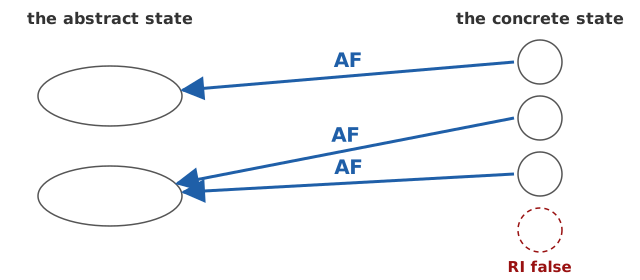
In the example from the previous section, what crosses the gap is a
function from the concrete state to the abstract state, and
FasterQueue's comment on lines 21 and 22 gives it: the queue is the
students in outbox, last to first, then the students in inbox,
first to last. That is today's second addition. Let's read
FasterQueue's fields by its AF as students come and go. Start with
a new FasterQueue, and join ada, bob, and eve. Each join adds to
the inbox on line 62 and to the set on line 63. So inbox is [ada,
bob, eve], outbox is [], and members is {ada, bob, eve}. The
outbox holds nobody, and the inbox, first to last, is ada, bob, eve.
So these fields stand for the queue ada, bob, eve, the order the
three joined.
Now call next. The outbox is empty, so the loop on lines 75 to 77
adds eve, then bob, then ada to the outbox. Line 78 empties the
inbox. Line 80 removes ada, the last student of the outbox,
and line 81 removes ada from the set. So inbox is [], outbox is
[eve, bob], and members is {bob, eve}. The outbox, last to first,
is bob, eve, and the inbox adds nobody. So these fields stand for
the queue bob, eve. That is right: ada was served, and bob is at
the front.
The comment on lines 21 and 22 says, for each value of the fields:
if the fields look like this, here is what the client should be
thinking. A client of this queue, after the one next, should be
thinking bob, eve.
Other values of the fields stand for the same queue. Here is
another way to reach bob, eve. ada and bob join, so inbox is
[ada, bob]. next moves them over in reverse, so outbox is [bob,
ada], and serves ada, so outbox is [bob] and inbox is []. Then
eve joins. Now inbox is [eve], outbox is [bob], and members
is {bob, eve}. The outbox, last to first, is bob, and then the
inbox adds eve. So these fields stand for bob, eve too. In all,
three values of the fields stand for the queue bob, eve. They
differ in how many students, counted from the front, the outbox
holds: none, bob alone, or both. (With none, inbox is [bob, eve]
and outbox is [].) The drawing below shows two of them.
So the comment goes one way, from the concrete state to the abstract state. Given the fields, the comment names one queue. Given the queue bob, eve, no one value of the fields is the value for it. So no function goes back the other way, from the queue to the fields.
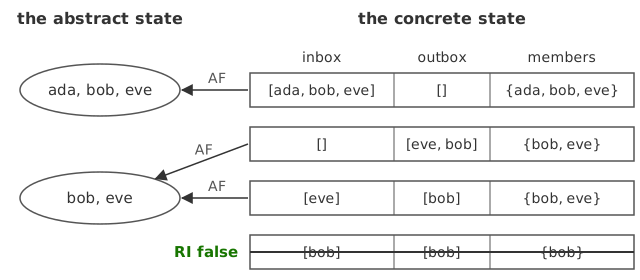
Two queues, three values of the fields.
The definition says that the AF is not code, and the comment on
lines 21 and 22 shows why. It reads like a function: given this,
it says what queue this stands for. But a function in Java
returns a Java value. A queue of students is the abstract
state, and no Java method returns that. So the comment describes
a mathematical function. The client does
not know the fields, so the client cannot read it. The function is
the implementer's alone, and every method relies on it. By the
comment, for one, the end of the inbox is the back of the queue,
so join adds there.
Here is what three of the definition's phrases mean:
- That the representation invariant allows says where the AF
is defined: only on values of the fields that the RI allows.
Take fields where
inboxis [bob],outboxis [bob], andmembersis {bob}. bob is in both lists, so the RI is false. Read by lines 21 and 22, these fields would be the queue bob, bob. But a student is in the queue at most once, so no queue is bob, bob. These fields stand for nothing, and the AF need not say what they mean. - A mathematical function, not code rules out reading the
comment as a method. No method of
FasterQueuecomputes the AF. (waitingcomes close: it lists the students in the order that lines 21 and 22 give. But what it returns is a Java list, a value in the program, and not the queue itself.) - A comment like
// AF(this) = ...is the form of lines 21 and 22.thisis the object whose fields the AF maps.
The fields bob, bob show a requirement that every RI must meet.
Whenever the RI is true of the fields, the abstract state they
stand for must satisfy the type's abstract invariant: a student
is in the queue at most once. Written with AI for the abstract
invariant: RI(this) implies AI(AF(this)).
FasterQueue's RI meets it. No NetID is in either list twice, or
in both, so the queue that lines 21 and 22 read off the two lists
has each student at most once. An RI that allowed the fields bob,
bob would let the fields stand for a queue no client can be
promised.
Now look back at FastQueue. Its line 19 is a comment of the same
form:
| FastQueue.java | |
|---|---|
19 | |
FastQueue's AF is the queue of the students in queue, front
first. members plays no part in it. By the RI, the set holds
the same students as the list. So the set adds nothing to which
queue the fields stand for. No rule says that every field appears
in the AF. That line has been on today's program sheet since the
lecture began, and until now we read past it. The field queue
was the queue, so nothing needed saying.
In FasterQueue, something does need saying. Here is a draft
that shows why. Recall waiting, lines 86 to 94:
| FasterQueue.java | |
|---|---|
86 87 88 89 90 91 92 93 94 | |
The loop on lines 89 to 91 walks the outbox from last to first.
Our draft copies the outbox as stored instead. It is a copy of
FasterQueue.java whose three lines 89 to 91 are replaced by one,
list.addAll(outbox);. So the draft's waiting adds the outbox
first to last, then the inbox. Before you run the six tests
against the draft, predict which fail.
JUnit starts six tests, and one fails:
threeStudentsAreServedInTheOrderTheyJoined, with
"expected: <[bob, eve]> but was: <[eve, bob]>". Wednesday's five
all pass.
Why do the five pass? Let's follow
studentsAreServedInTheOrderTheyJoined through the draft's
fields. The test joins ada and bob, so inbox is [ada, bob] and
outbox is []. The draft's waiting adds the empty outbox, then
the inbox, and returns [ada, bob]. That assertion passes. Then
next moves the inbox over in reverse, so outbox is [bob, ada],
and serves ada, so outbox is [bob]. The draft's waiting adds
the outbox as stored, and returns [bob]. A list of one student has
no order to get wrong, so that assertion passes too. size
returns 1, and the test passes. None of the five tests has more
than one student in the outbox when it calls waiting.
The sixth test does. It joins ada, bob, and eve, and serves ada.
As in the walk above, outbox is then [eve, bob]. The draft's
waiting returns the outbox as stored, [eve, bob]. The queue is
bob, eve, so the test expected [bob, eve].
Nothing in waiting's specification mentions an outbox. The
specification is in abstract terms: it promises "the students
waiting, front first, in a new list". So the specification says
that the list must be front first. It does not say where in the
fields the front is. The AF on lines 21 and 22 says where. By the
AF, the outbox stands for its students last to first, so its last
student is the front. The
draft handed the outbox's students out first to last. The failing
test is one run on which the draft returned the wrong list. The
AF tells us what
the draft got wrong: it read the outbox in the wrong order.
The section Which method is wrong? asked
a question like this one. There, a claim about the fields, the RI,
decided which method was wrong. Here, the AF decides what a wrong
answer from waiting is: any list other than the students of the
queue the fields stand for, front first.
With the RI and the AF both in hand, the next section says what it means for a method to be correct.
What correct means for an ADT method
Let's put FasterQueue's size beside its specification. Here
is the specification, lines 9 and 10 of Lecture 10's HelpQueue.java:
| HelpQueue.java | |
|---|---|
9 10 | |
The body does its work on line 54 of FasterQueue.java,
return members.size();. The specification promises the number
of students waiting. The body returns the size of a set. Nothing
in either line mentions the other.
This is the gap the paragraph at the top of these notes
described. size's specification is in abstract terms.
HelpQueue.java has no fields, so no line of it mentions one.
size's body is in concrete terms. No line of the body mentions
the queue of students. One thing translates between the two: the
abstraction function, from the concrete state to the abstract
state. By the AF on lines 21 and 22,
the fields stand for a queue of students. The specification is
about that queue.
So what do we check? In Lecture 7, a method satisfies its
specification exactly when the triple of its
specification around its body is valid, and every call that
begins with the precondition true terminates. Lecture 10 asked
the same of an implementation: the fields may change,
as long as each method still satisfies its specification.
But for a method of an ADT, the specification's claims do not
meet the body's. size's postcondition is a claim about the
abstract state, the students waiting. The claims between the
body's lines are about the concrete state: inbox, outbox, and
members. So the triple to check is the
specification's translation, read through the AF:
- The precondition
PbecomesP(AF(this)):Pis true of the abstract state that the fields stand for. That isPwith the abstract state replaced byAF(this), the substitution of Lecture 7's rules for an assignment. - The postcondition
QbecomesQ(AF(this_0), AF(this)), wherethis_0is the object as it was when the method was called. A postcondition may compare two states.next's does: the queue after the call is the queue before it with its front removed. SoQtakes the abstract state from before the call and the one after. Lecture 7's rule for an assignment wrotex0for a variable's old value.this_0does the same for an object.
One more claim goes in, at both ends. The constructor made the RI true, and every earlier call left it true. So before the body, the method may assume the RI. The next call will assume the RI too. So after the body, the method owes it. Here is the whole condition, as a rule:
Rule: a method of an abstract data type is correct
A method with precondition P and postcondition Q, written
about the abstract state, is correct exactly when the Hoare
triple
{{ RI and P(AF(this)) }}
the method's body
{{ RI and Q(AF(this_0), AF(this)) }}
is valid and every call that begins with the precondition true
terminates, where RI is the representation invariant, AF is
the abstraction function, and this_0 is the object as it was
when the method was called. The body may assume the invariant and
the precondition, and must leave the invariant true and the
postcondition true of what the fields now stand for.
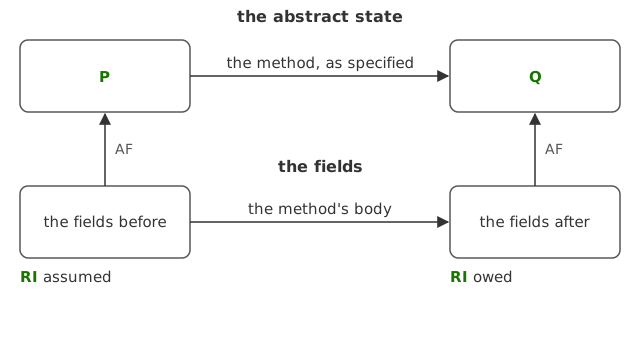
The rule's triple has two parts that Lecture 7's triples did not,
both this lecture's: the RI, a claim about the concrete state,
and the AF, the function from the concrete state to the abstract
state. The rule's last sentence, may assume and must leave,
is the second paragraph of the RI's definition in the triple's
shape. The RI that every method may assume when called sits in
the precondition. The RI that every method must make true again
before it returns sits in the postcondition. Correct is the word
for a method that meets the rule. Each loop in FastQueue.java and
FasterQueue.java counts i down to 0, and no method calls itself.
So every method in this lecture terminates.
So, as in Lecture 7, the triple is the whole question: a correct
method satisfies its specification, as long as no code outside
the class changes its fields (the section
Copy in, copy out comes back to this).
The translation is the new work. Once the triple is written about
the fields, the argument is Lecture 7's forward reasoning, as
before. Let's argue size on FasterQueue. size has no
precondition, so P is true, and the triple's first claim is
the RI alone. Here is size's body, lines 52 to 55 of
FasterQueue.java, with claims between its lines:
public int size() {
    {{ RI }}
    checkRep();
    {{ RI }}
    {{ no NetID is in inbox or outbox twice, or in both, and
       members holds exactly the NetIDs in inbox and outbox }}
    {{ members.size() = inbox.size() + outbox.size() }}
    {{ members.size() = the number of students in AF(this) }}
    return members.size();
}
Read the claims in order. With no line between them, each claim after line 53 follows from the one above it, by Lecture 7's rule of consequence:
- Line 53 calls
checkRep, which changes no field. The RI is true, so neither of its checks throws. So the RI is still true after line 53. - The next claim is the RI written out, as lines 19 and 20 of FasterQueue.java state it.
- No NetID is in the two lists twice, so the two lists hold
inbox.size() + outbox.size()NetIDs in all, each once.membersholds exactly those NetIDs, somembers.size()is that sum. - By the AF, the queue is the students in
outbox, last to first, then the students ininbox, first to last. So the queue has one student for each NetID in the two lists, andmembers.size()is the number of students inAF(this).
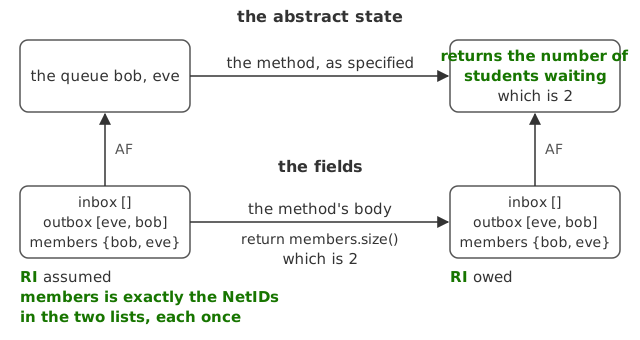
Line 54 returns members.size(). No line of size changes a
field, so AF(this) is AF(this_0). So the value returned is
the number of students waiting when size was called. Line 9
promises exactly that number. The queue is as it was, as a method
with no @modifies must leave it. The fields are unchanged too,
so the RI is still true when size returns. Both halves of the
rule's last claim are true, so size is correct.
next has more cases, so let's take one, the refill. Suppose
someone is waiting. By the RI and the AF, as for size,
members holds one NetID for each student waiting. So members
is not empty, and line 70 does not throw. Suppose too that the
outbox is empty, so lines 75 to 78 run. An empty outbox adds
nobody to the queue. So by the AF, AF(this_0) is the students
in the inbox, first to last. The inbox is not empty. The loop
on lines 75 to 77 adds the inbox's students to the outbox from
last to first. Line 78 empties the inbox. So the outbox is the old
inbox reversed. Read last to first, as the AF reads it, the outbox
is the old inbox first to last. So after line 78, AF(this) is
still the queue AF(this_0). The lists hold the same NetIDs as
before, each once, so the RI is still true. Line 80 removes the
outbox's last student, which is the old inbox's first: the front
of the queue. That student was in the lists once, so now the
student is in neither. Line 81 removes the same student from the
set. So the RI is true when next returns. (The calls to
checkRep on lines 68 and 82 change no field.) AF(this) is now
AF(this_0) with its front removed, and line 83 returns that
student's NetID. That is what next's @effects and @return
promise. So in the refill case, next meets the rule too.
Now take the forgetful next from the section
Which method is wrong?, FastQueue's
next with line 66 blank, and try to argue it by the rule.
Suppose someone is waiting, so line 63 does not throw. Before
line 65, the RI says that members holds exactly the NetIDs in
queue, and that no NetID is in queue twice. Line 65 removes
the front from the list. The front was in the list once, so it
is no longer in queue. Line 66 is blank, so members still
holds the student the list lost. So at the end of next,
members holds a NetID that is not in queue. So the RI is
false, and the argument stops in next, at the line we left
blank. The tests in that section only reported failures, in
join and size, a call later. Reasoning finds the mistake
in the method that made it.
The section Abstraction functions looked
back at FastQueue's AF on line 19, in which members plays no
part. With that AF, the queue is the list queue, read front first,
so reading the specification through the AF changes nothing. So the
section Which method is wrong? was this
rule at work, with an AF that reads the queue straight off one field.
There, read through that AF, the draft's next did what its
specification promised. The RI alone decided that next was wrong.
Exercise 2, in the section Exercises, asks you to argue
by the rule that FastQueue's join is correct.
The call before a method left the RI true, so the rule lets the method assume the RI at its start. That reason assumes that only the class's own methods ran between the two calls. The next section is about what else can run between two calls.
Copy in, copy out
Let's start with a question that Monday's lecture put off: why
does Book's messages return a copy? Here is Book again,
lines 97 to 115 of Lecture 9's Guestbook.java:
| Guestbook.java | |
|---|---|
97 98 99 100 101 102 103 104 105 106 107 108 109 110 111 112 113 114 115 | |
And here is the second of Lecture 9's two tests:
    @Test
    void messagesIsACopy() {
        Book book = new Book();
        book.add("Ada", "hello world");
        List<String> copy = book.messages();
        copy.add("Eve: not posted");
        assertEquals(List.of("Ada: hello world"), book.messages());
    }
The test passes on Guestbook.java. Lecture 9 then changed line
113 to return messages;, so that messages returns the book's
own list. Run the test on that version, and it fails: "expected:
<[Ada: hello world]> but was: <[Ada: hello world, Eve: not
posted]>". The test's copy was not a copy at all. It was the
list in the field messages. So when the test called copy.add,
it put a message in the book without calling add.
Now we have the words for what went wrong. The list in the field
messages is Book's representation. The specifications of
add and messages promise things about the abstract state, the
messages posted.
The field is where those messages are kept. Handing out the list
lets code outside Book change the field. So every promise in
the specifications of add and messages can be broken by code
that Book does not control, such as the test's copy.add.
That version of Book handed its own list out. A class can also
take a list in. FastQueue's second constructor, lines 26 to 34,
makes a queue from a list of NetIDs that the client passes:
| FastQueue.java | |
|---|---|
26 27 28 29 30 31 32 33 34 | |
Line 26 asks the client for a list with no NetID twice, since
with one the RI could not be made true, and line 33 would throw
an exception that the specification never promised. Line 31
makes a new ArrayList holding the same NetIDs in the same
order, and keeps that instead of the client's list. The
comment on lines 29 and 30 says why: "so that the client cannot
change the queue through the list it passed". (Line
32 makes a new set, so members is the queue's own as well.)
FastQueueTest.java checks the copy. Its one test plays the
client: it builds a queue from its list, adds a NetID to its
list, and asks the queue who is waiting. The drawing after the
test follows the test through a draft that keeps the client's
list, and then through line 31 as written.
    @Test
    void aQueueMadeFromAListIsItsOwn() {
        List<String> netids = new ArrayList<String>(List.of("ada"));
        FastQueue queue = new FastQueue(netids);
        netids.add("eve");
        assertEquals(List.of("ada"), queue.waiting());
    }
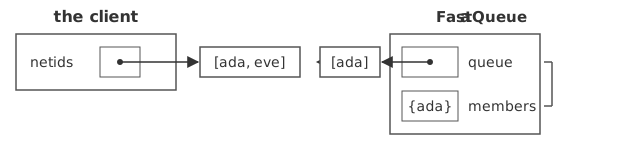
- After
new FastQueue(netids)with line 31 asqueue = netids, the client's variable and the queue's field name one list. netids.add("eve")changed the queue's field through the client's name, and no method ofFastQueueran.- With line 31 as written,
new ArrayList<String>(netids), the queue holds its own list, and the client's add changes only the client's.
The test passes on FastQueue.java, as the section
FastQueue: a faster join reported. Now for the draft.
It is a copy of FastQueue.java with line 31 replaced by
queue = netids;, so the queue keeps the client's own list.
Before you run the six tests against it, predict which fails.
JUnit starts six tests, and one fails:
aQueueMadeFromAListIsItsOwn, with "members is not the queue".
Let's follow the test through the draft's fields. Line 11 of
FastQueueTest.java makes the list [ada], and the test's variable
netids refers to it. Line 12 calls the constructor. The draft's
line 31 stores that same list in queue. Line 32 makes members
the set {ada}. So the RI is true, and line 33's check passes.
But the test's netids and the field queue are now two names
for one list. Line 13 of the test adds eve through the
client's name, so the one list is now [ada, eve]. members is
still {ada}. So members no longer holds exactly the NetIDs in
queue: the RI is false. Line 14 calls waiting. At the start
of waiting, line 72 calls checkRep, and line 38 throws
"members is not the queue". No method of FastQueue ran between
the constructor's return and that call. The fields are private.
Yet the list in queue changed.
When two names refer to one object, as netids and the field
queue do here, that is aliasing. Each name is an alias of
the other. Lecture 10 met aliasing without the name, in the
second reading of "returns the students waiting".
Under that reading, waiting hands out the queue's own list, so
the client and the queue share one list. The draft's constructor
makes the same sharing, with the list going the other way, from
the client to the queue.
Lecture 7's arguments never met aliasing. Its
rule for an assignment says that after an
assignment to x, a fact about another variable is still true.
Every variable in Lecture 7's methods held a number. A number has
no second name, so no line could change one variable through
another. A list can have two names. Line 13 of the test changes
netids, and a fact about another variable, the RI about the
field queue, turned false. Line 13 is a call, not an
assignment, but the question is the same: can a line change a
fact about a variable it does not name?
Now suppose that no client of the draft ever touches a list
again after passing it to the constructor. Then no run of those
clients goes wrong. Even so, the implementer can no longer reason
about FastQueue alone. To know that the RI is true at the start
of a method, the implementer must read every client that ever
passes a list to the constructor. Each new client brings more
code to read. For a class with many clients, that reading may
never be done. Lecture 10's Shortcut made the same
demand through a public field. Here the field is private. The
demand is back anyway. So the draft has a bug even if no run
goes wrong.
The way out is line 31 as written. The queue keeps its own list,
and the client's add changes only the client's.
waiting hands out a list, as messages does. So the mistake in
that version of Book can happen in FastQueue too. Here is a
second draft: a copy of FastQueue.java with line 73 replaced by
return queue;, so waiting returns the queue's own list. Which
test fails now? JUnit starts six tests, and one fails:
waitingIsACopy, with "members is not the queue". Here is that
test, from Lecture 10's HelpQueueTest.java:
    @Test
    void waitingIsACopy() {
        HelpQueue queue = emptyQueue();
        queue.join("ada");
        List<String> copy = queue.waiting();
        copy.add("eve");
        assertEquals(List.of("ada"), queue.waiting());
    }
The test joins ada, so the field queue is [ada] and members
is {ada}. The draft's waiting returns the list in queue
itself, so the test's copy and the field queue are aliases.
The test's copy.add("eve") makes that one list [ada, eve].
members is
still {ada}, so the RI is false. Then the test calls waiting
again, for assertEquals to compare. Line 72 calls checkRep,
and line 38 throws before assertEquals can run.
The half sheet's second question asks why FastQueue calls
checkRep at the start of a method, and not only at the end. The
section
Checking the representation invariant with checkRep
found that the RI a method assumes at its start was checked
already, at the end of the last call that changed the object.
Now we can say why the start check is there anyway. Between two
calls, code that is not the class's may have changed the fields,
through an alias. The change comes after the method returns, so a
check at the end of that method cannot see it. So checkRep runs
at the start of a method too. The check at the start catches the
change on the next call, as line 72 did in both drafts, rather
than in some wrong answer later. The code quality
guide's section checkRep gives the same reason.
Each draft gave code outside FastQueue a reference to a list in
its fields. This definition names that mistake:
Definition: representation exposure
Representation exposure is a reference, held by code outside a class, to a changeable object among the class's fields. Through it, that code can change the fields without calling any method of the class, so the representation invariant and every specification can be broken by code the class does not control. To prevent it, copy in a changeable object a client passes that becomes part of the fields, and copy out a changeable field that a method returns.
Here is what the definition's words mean:
- A reference to a changeable object needs both of its
parts. First, the object must be changeable. Java's
documentation says that "Strings are constant; their values
cannot be changed after they are created".5 So a method
that returns a
Stringfield exposes nothing. The client holds a reference to the field's string, but no method ofStringcan change the string through it. Second, the client must hold a reference.intis a primitive type, which holds a plain value, so a method that returns anintfield hands the client a copy of the number. Nothing the client does to that number reaches the field. So exposure needs a reference that the client can change the fields through. - Copy in and copy out are the two fixes we saw. Copy in is
line 31: the constructor keeps a new list, not the client's.
Copy out is line 73, and line 113 in
Book: the method returns a new list, not the field's. The code quality guide's section Avoid representation exposure asks for both.
Look back at the draft that keeps the client's list. Only its
constructor differs from
FastQueue.java, and only on line 31. That constructor still
leaves the RI true. So an argument by the rule of the section
What correct means for an ADT method, for any method of
FastQueue.java, is right for the draft too. Yet in the draft,
waiting threw an exception that its specification never
mentions. So a method that is correct by the rule satisfies its
specification only when no code outside the class changes the
fields between calls. For a class as a whole, then, we count one
more thing as part of being correct. A class is correct when
every method is correct by the rule and the class has no
representation exposure.
Exercises
Each answer is folded under its question. Write yours first.
1. Here is the start of one more class that implements
HelpQueue. Like ListQueue, it keeps the queue in one list. But
this list holds the students in reverse order, the back of the
queue first:
public class ReverseQueue implements HelpQueue {
    // The students waiting, back first.
    private List<String> queue = new ArrayList<String>();
Write its representation invariant and its abstraction function,
as comments in the form // RI: ... and // AF(this) = ...,
beside the field. Then
write its next, which has to satisfy next's specification,
lines 20 to 26 of Lecture 10's HelpQueue.java:
| HelpQueue.java | |
|---|---|
20 21 22 23 24 25 26 | |
Answer
-
The RI is that no NetID is in
queuetwice. The class has one field, so nothing has to agree with it. What is left is the first clause ofFastQueue's RI. The AF reads the list from its last element to its first:ReverseQueue.java// RI: no NetID is in queue twice. // AF(this) = the help queue of the students in queue, last to first.Without the RI, a list such as [ada, bob, ada] would be read by the AF as the queue ada, bob, ada. A student is in the queue at most once, so no queue is ada, bob, ada.
-
nextremoves the last element of the list. By the AF, the last element ofqueueis the front of the queue:ReverseQueue.javapublic String next() { if (queue.isEmpty()) { throw new NoSuchElementException("nobody is waiting"); } return queue.remove(queue.size() - 1); }An empty list stands for an empty queue, so
nextthrows exactly when the specification says to. Otherwise, the list loses its last element. Read last to first, what remains is the old queue without its front.nextreturns that student's NetID. Removing an element adds no repeat, so the RI is still true whennextreturns. -
The same line was a bug on Wednesday. Lecture 10's exercise 2 put
return queue.remove(queue.size() - 1);inListQueue'snext, and thatnextserved from the back of the queue. InReverseQueue, the same line serves the front. The two classes have the same field. Their AFs read it in opposite orders. So the AF decides whether the line is right. -
The rest of the class follows the AF too. In ReverseQueue.java,
joinadds the student at the start of the list,queue.add(0, netid), since by the AF the first element is the back.waitingcopies the list into a new one from last to first. Through a subclass whoseemptyQueuereturnsnew ReverseQueue(), JUnit runs Wednesday's five tests on the class. It starts five tests, and none fails.
2. Argue that FastQueue's join is correct, by the rule in
the section What correct means for an ADT method: start
from
the RI and join's precondition before line 51, and end with the
RI and join's postcondition after line 57, as that section
argued size. Here is join's specification, lines 12 to 18 of
Lecture 10's HelpQueue.java:
| HelpQueue.java | |
|---|---|
12 13 14 15 16 17 18 | |
Here are the RI and the AF, lines 17 to 19 of FastQueue.java:
| FastQueue.java | |
|---|---|
17 18 19 | |
And here is join, lines 50 to 58:
| FastQueue.java | |
|---|---|
50 51 52 53 54 55 56 57 58 | |
Your argument also answers the half sheet's first question: on
what line of join does the RI become false, and when does it
become true again?
Answer
-
The triple has two cases at its end. The specification has no
@requires, soPistrue, and the triple's first claim is the RI alone. The postcondition is@effectsand@throwstogether. If the student is inAF(this_0),jointhrowsIllegalArgumentException, andAF(this)isAF(this_0). Otherwise,AF(this)isAF(this_0)with the student added at the back. Here is the body with claims between its lines. Writethis_0.queueandthis_0.membersfor the two fields' values whenjoinwas called:public void join(String netid) { {{ RI }} checkRep(); {{ RI }} if (members.contains(netid)) { {{ RI, and netid is in members }} {{ RI, netid is in AF(this), and no field has changed }} throw new IllegalArgumentException(netid + " is in the queue"); } {{ RI, and netid is not in members }} queue.add(netid); {{ the RI is true of this_0, netid is not in this_0.members, members is this_0.members, and queue is this_0.queue with netid at the end }} members.add(netid); {{ the RI is true of this_0, netid is not in this_0.members, members is this_0.members with netid added, and queue is this_0.queue with netid at the end }} checkRep(); {{ RI, and AF(this) is AF(this_0) with netid at the back }} } -
Line 51 changes nothing. The RI is true, so neither of
checkRep's checks throws.checkRepchanges no field. -
Line 53 throws exactly when the student is waiting. By the RI,
membersholds exactly the NetIDs inqueue. By the AF on line 19, the NetIDs inqueueare the students in the queue. Somembers.contains(netid)is true exactly when the student is inAF(this_0), the case in which@throwspromises the exception. No line before the throw changes a field. So the RI is still true, andAF(this)isAF(this_0), the queue unchanged. -
The RI is false between lines 55 and 56. Line 55 adds the student at the end of the list. The set is as it was, so it lacks the NetID that the list just gained.
nexthas the same gap between lines 65 and 66, the other way around: there, the list loses the front before the set does. -
After line 56, the RI is true again. The student was not in
this_0.members. So, by the RI, true ofthis_0, the student was not inthis_0.queueeither. So the new list has no repeat. The old set held exactly the NetIDs of the old list. Each gained the one NetID, somembersholds exactly the NetIDs inqueue. -
AF(this)isAF(this_0)with the student at the back. By the AF on line 19, the list is read front first, so its end is the back of the queue. Line 55 put the student there. That is what@effectspromises. The RI is true, so line 57'scheckRepdoes not throw. It changes no field. Both cases end in the rule's last claim, sojoinis correct. -
The claims between the lines answer the half sheet's first question. After line 55,
queueholds the student andmembersdoes not, so the RI's second clause is false: the RI becomes false on line 55. Line 56 adds the student tomembers, and the RI is true again after it, before line 57 checks it and line 58 returns. In words:After
joinreturns,queueis its old value with the student at the end.membersis its old value with the student added. The student was not waiting before, so the RI is true again.
3. Here is a draft of FastQueue's next that takes the
front out of the set before taking it out of the list. It is a
copy of FastQueue.java with lines 65 and 66 replaced, so every
line keeps its number:
| FastQueue.java | |
|---|---|
60 61 62 63 64 65 66 67 68 69 | |
The RI and the AF are lines 17 to 19 of FastQueue.java, shown in
exercise 2, and next's specification is lines 20 to 26 of
HelpQueue.java, shown in exercise 1. queue.get(0) returns the
first element of the list and leaves the list as it was. Is the
RI false at any point inside the draft's next? Does checkRep
catch anything? Is the method correct? Predict what the six tests
report against the draft before you run them.
Answer
-
The RI is false between lines 65 and 66. Line 65 takes the front out of the set, and the list still holds it. So
memberslacks a NetID that is inqueue. In FastQueue.java's ownnext, the RI is false at the same spot, the other way around: its list has lost the front, and its set still has it. -
checkRepcatches nothing. It runs on lines 61 and 67 only. The call before left the RI true, so the check on line 61 passes. At line 67 the RI is true again, as the next bullet argues. No check runs between lines 65 and 66. Against the draft, JUnit starts six tests, and none fails. -
The method is correct. By the AF, nobody is waiting exactly when the list is empty. Then line 63 throws before any field changes. Otherwise, the list has a first element, so
queue.get(0)on line 65 has a student to return. By the RI, that student is inmembers, and line 65 removes the student from the set. Line 66 removes the same student from the list. The student was in the list once, so the student is now in neither field. Somembersagain holds exactly the NetIDs inqueue. The RI is true at line 67. Read front first, the list isAF(this_0)without its front. Line 68 returns the front's NetID. That is whatnext's specification promises. -
The rule says nothing about the middle of a method. Its triple puts the RI before the body and after it. Between the two, any line may leave the RI false, as long as a later line makes it true again before the method returns. FastQueue.java's
nextand thejoinof exercise 2 each do just that.
4. LinkedQueue, from Wednesday, keeps a chain of nodes. Here
are its fields, lines 17 to 20 of Lecture 10's LinkedQueue.java:
| LinkedQueue.java | |
|---|---|
17 18 19 20 | |
And here is its next, lines 48 to 60:
| LinkedQueue.java | |
|---|---|
48 49 50 51 52 53 54 55 56 57 58 59 60 | |
LinkedQueue has a representation invariant that no // RI:
comment states. Lines 17 and 18 give part of it. In full: back
is the last node of the chain from front, both are null
exactly when nobody is waiting, and no NetID is in the chain
twice. Write it as an // RI: comment. What must next do
to keep it? Then write ListQueue's RI, for its one field, line 7
of ListQueue.java:
| ListQueue.java | |
|---|---|
7 | |
What could a checkRep in ListQueue check, and what not?
Answer
-
The RI is a claim about
frontandback. "Nobody is waiting" is about the abstract state. The RI is about the concrete state.LinkedQueue's AF, also never written down, reads the queue off the chain fromfront, first to last. So nobody is waiting exactly whenfrontisnull. The comment can say that with the fields alone:LinkedQueue.java// RI: front and back are both null, or neither is. If neither // is, back is the last node of the chain from front. No // NetID is in the chain twice.A chain that loops back on itself has no last node, so the second sentence rules out that chain too.
-
nextmust setbacktonullwhen the chain empties. Lines 56 to 58 do that. Take a queue with ada alone, sofrontandbackboth refer to ada's node. Line 55 movesfrontto the node after it, which isnull. Without lines 56 to 58,backwould still be ada's old node, and the RI would be false. Then suppose ada joins again.join's loop starts fromfront, which isnull, so it finds nobody.backis notnull, sojoinhooks the new node after the old one and makes the new nodeback.frontis stillnull, so the chain fromfrontis empty. ada is not waiting after all. With lines 56 to 58 in place, both fields arenull. So the RI is true. When the chain does not empty, line 55 moves onlyfront. Sobackis still the last node. -
ListQueue's RI is that no NetID is inqueuetwice. It is the first clause ofFastQueue's, and the whole ofReverseQueue's in exercise 1:ListQueue.javaprivate List<String> queue = new ArrayList<String>(); // RI: no NetID is in queue twice. -
A
checkRepcould check the list for a repeat. It could compare the size ofqueuewith the size ofnew HashSet<String>(queue). FastQueue.java makes the same comparison in two steps: line 37 findsmembersequal to that set, and line 40 compares the sizes. -
It could not check that the list is the queue. The queue itself is the abstract state, and no Java value holds it. So no
checkRepcan compare the list with it, inListQueueor inFastQueue, whose line 37 compares only the set with the list. Whetherqueueholds the students in the order they joined depends on what every method did to the list. An argument by the rule, one method at a time, is what checks it.
5. Here are the RI and the AF, lines 19 to 22 of FasterQueue.java:
| FasterQueue.java | |
|---|---|
19 20 21 22 | |
And here is its next, lines 67 to 84:
| FasterQueue.java | |
|---|---|
67 68 69 70 71 72 73 74 75 76 77 78 79 80 81 82 83 84 | |
Call next with inbox [ada, bob, eve], outbox [], and
members {ada, bob, eve}, so the refill runs. Write the fields and
AF(this) at three points:
- just before the loop on lines 75 to 77;
- just after the refill ends, on line 78;
- just after both removes, on lines 80 and 81.
Check that the first two are the same queue. Then one more: what
is AF(this) just after line 77, before line 78 runs?
Answer
-
Before line 75, the queue is ada, bob, eve. The fields are as given. The outbox adds nobody, and the inbox, first to last, is ada, bob, eve.
-
After line 78, the queue is ada, bob, eve again. The loop adds eve, then bob, then ada to the outbox, and line 78 empties the inbox. So
inboxis [],outboxis [eve, bob, ada], andmembersis {ada, bob, eve}. Read last to first, the outbox is ada, bob, eve, and the inbox adds nobody. Each NetID is in the two lists once, so the RI is true. The refill changed two fields and leftAF(this)as it was. So the first two queues are the same. -
After line 81, the queue is bob, eve. Line 80 removes ada, the last student of the outbox, and line 81 removes ada from the set. So
inboxis [],outboxis [eve, bob], andmembersis {bob, eve}. The outbox, last to first, is bob, eve. That is the old queue without its front. Line 83 returns "ada". Between lines 80 and 81,membersstill holds ada, so the RI is false there, as it is inFastQueuebetween lines 65 and 66. -
After line 77,
AF(this)has no value. The loop has filled the outbox, and line 78 has not yet emptied the inbox. Soinboxis [ada, bob, eve] andoutboxis [eve, bob, ada]. Each student is in both lists, so the RI is false. Read by lines 21 and 22, these fields would be ada, bob, eve, ada, bob, eve. No queue holds a student twice. The AF is defined only on values of the fields that the RI allows, so these fields stand for nothing. Line 78 makes the RI true again beforenextreturns, as the rule asks.
Further reading
- The invariant and the function, and reasoning with them. Barbara Liskov and John Guttag, Program Development in Java (2001), chapter 5, "Data Abstraction", sections 5.5 to 5.7. Section 5.5, "Aids to Understanding Implementations", takes the abstraction function and then the representation invariant, the other order from this lecture's. Section 5.6, "Properties of Data Abstraction Implementations", has a part on exposing the rep, the book's phrase for representation exposure. Section 5.7, "Reasoning about Data Abstractions", covers preserving the rep invariant and reasoning about operations, the work of the section What correct means for an ADT method.
- Copy in, copy out. Joshua Bloch, Effective Java, third edition (2018), chapter 8, "Methods", item 50, "Make defensive copies when needed". The item's defensive copies are the copies that the section Copy in, copy out makes.
-
The documentation of
HashSetin Java 25 makes the promise foradd,remove,contains, andsize, "assuming the hash function disperses the elements properly among the buckets". ↩ -
David L. Parnas, "On the Criteria To Be Used in Decomposing Systems into Modules", Communications of the ACM (1972). Each module of his second decomposition is "characterized by its knowledge of a design decision which it hides from all others". ↩
-
The documentation of
IllegalStateExceptionin Java 25. ↩ -
The documentation of
ArrayList'sremove(int)in Java 25 says that it shifts "any subsequent elements to the left". ↩