CSE 331: Reasoning and Floyd-Hoare logic
Course motto: Your job is to deliver code that you know works.
From three tests to every run
Here is a short method with its specification, and three tests:
6 7 8 9 10 11 12 13 14 15 16 17 18 19 20 21 | |
@Test
void allZero() {
    assertEquals(0, Seconds.seconds(0, 0, 0));
}

@Test
void oneOfEach() {
    assertEquals(3661, Seconds.seconds(1, 1, 1));
}

@Test
void ninetyMinutes() {
    assertEquals(5400, Seconds.seconds(0, 90, 0));
}
All three pass. With no if and no loop, every test runs every
line, so by
our list for when to stop testing
these three tests are enough: the list asks for at least two that
between them run every statement. So are we done? Is seconds
right?
Think about what the specification promises: an answer for every
allowed input, every choice of non-negative h, m, and s.
That is far more inputs than we could ever run, and so far we
have tested just three of them. A passing test tells you only
about its own run. Testing can never confirm a claim about every
run when there are too many inputs to test. To know that
seconds satisfies its specification, we need
the third of our three ways
of gaining knowledge, reasoning: we argue from the code itself
that the method satisfies its specification on every run.
We start with code that has no loops. The idea is simple: write down what is true after each line, and name the rule that justifies each step, so that anyone can check the argument without trusting you.
What is true after each line
Let's reason about seconds by asking, at each point, what we
know about the variables. When the program runs, a line changes
the values of the variables. When we reason, a line changes what
we know about those values, and the claims record what we know.
A client must make the precondition true, so we may assume it at the top.
A claim sits in double braces beside the code it is about. The
braces are not Java (the program never executes them), and what
they hold is math, not code. In a claim, = means equals, !=
means not equal, and we combine facts with and, or, and
not. A Java condition goes into a claim in this notation, so
a == b in the code is a = b in a claim. Here is the method
again, with a claim after each line.
static long seconds(int h, int m, int s) {
    {{ 0 <= h and 0 <= m and 0 <= s }}
    long t = h;
    {{ 0 <= h and 0 <= m and 0 <= s and t = h }}
    t = t * 60 + m;
    {{ 0 <= h and 0 <= m and 0 <= s and t = 60 * h + m }}
    t = t * 60 + s;
    {{ 0 <= h and 0 <= m and 0 <= s and
       t = 3600 * h + 60 * m + s }}
    return t;
}
Read the claims in order, each against the line above it. The line numbers are the first listing's.
- Line 17 sets
ttoh. A declaration that gives a value is an assignment. Nothing abouth,m, orschanged, so the precondition is still true, and nowt = his true too. - Line 18 changes
t, sot = his no longer true after it. The new value oftis the old value times 60, plusm, and the old value wash. So after line 18,t = 60 * h + m. - Line 19 does the same with
s. The old value was60 * h + m, so after line 19,t = 3600 * h + 60 * m + s.
The @return clause says which value is returned, and line 20
returns t, so at the return the postcondition is a claim
about t. The last claim says that t is exactly what the
postcondition promises. So every run that starts with the
precondition true returns 3600 * h + 60 * m + s, and we showed
that for every allowed input without running the method once:
seconds satisfies its specification.
The claims treat * and + as the operations on the integers,
the whole numbers you learned in school, positive, negative, and
zero. Java's int is not quite that: it
wraps around at
the top of its range, and the seconds in 596524 hours already
pass it, so seconds returns a long. Its inputs are int
values, so every value computed on the way stays far below a
long's top, no line wraps, and the claims may use integer
arithmetic. Exercise 5 returns an int instead, with the clause
its specification then needs.
Going from a claim before a line, through the line, to a claim after it is forward reasoning. Each step used a rule. With the rules written down, anyone can check each step of an argument against them, and a step that breaks a rule is a mistake in the argument. Such an argument is a proof.
A claim at a point
The claims above are assertions, an idea from the first week of the course. Here is a refined version of the definition: its second paragraph now says exactly when the claim has to be true.
Definition: assertion
An assertion is a true or false claim about the program's state (the values of variables and memory) at a particular point in the program.
An assertion holds if the claim is true each time a run reaches its point. If a run ever reaches the point with the claim false, the assertion does not hold.
Each time a run reaches its point says when the claim has to be
true. In seconds, every assertion sits at a point that every
run reaches exactly once, so the clause makes no difference
there. A point inside a branch is different: only the runs that
take the branch reach it, so a claim there is about only those
runs. A point inside a loop can be reached many times on one run,
and a claim there has to be true every time.
A specification promises nothing on a call that breaks its precondition. The assertions in a method's body follow the same rule: an assertion there is about the calls that begin with the precondition true, and a call that breaks the precondition does not count against it. This is also why forward reasoning can take the precondition as its first claim, for free: every call we reason about begins with it true.
A triple
Each step of the argument had the same shape: a claim before a piece of code, the code, and a claim after.
Definition: Hoare triple
A Hoare triple {{ P }} code {{ Q }} is a claim P, called
its precondition, a piece of code, and a claim Q, called
its postcondition.
The triple is valid if every terminating run of the
code from a state in which P is true ends in a state
in which Q is true.
A run terminates when it ends, and the definition asks nothing of a run that never does. For code with loops, whether it terminates is a separate question.
Our rule from the first week was about this shape: if P holds at
its point and the triple is valid, then Q holds at its point.
Robert Floyd and Tony Hoare worked out how to reason this way in
the late 1960s, so the triple, the rules below, and the arguments
built from them are Floyd-Hoare logic.1
A method
satisfies its specification
if every call that begins with the precondition true ends with
the postcondition true. Read the method's body as a triple, with
the precondition before the body and the postcondition after it,
and this becomes: a method satisfies its specification exactly
when that triple is valid and every call that begins with the
precondition true terminates. Every method in this lecture
terminates, so the question is only whether the triple is valid,
and for seconds the argument above showed that it is.
A triple can be about any piece of code, even a single line. Here are six triples about one line each, with their verdicts and the reasons for them:
{{ true }} x = 5; {{ x = 5 }}- Whatever the state was, the line makes
x5. Valid.
- Whatever the state was, the line makes
{{ x = 3 }} y = x + 1; {{ y = 4 }}- From any state where
xis 3, the line makesy4. Valid.
- From any state where
{{ x = 3 }} y = x + 1; {{ 0 < y }}- The line makes
y4, and 4 is positive. Valid too: a postcondition may say less than all that is true afterward.
- The line makes
{{ true }} y = x + 1; {{ y = 4 }}trueallows the state wherexis 0, and from that state the line makesy1. A run from that state is a counterexample, so the triple is not valid.
{{ 0 < x }} x = x - 1; {{ 0 < x }}- The precondition allows the state where
xis 1, and from that state the line makesx0. Not valid: a valid triple needs the postcondition true after a run from every state the precondition allows.
- The precondition allows the state where
{{ false }} x = 0; {{ x = 1 }}- No state makes
falsetrue, so the definition asks nothing of the postcondition. Valid. A valid triple says nothing about the runs the precondition rules out, as a specification says nothing about a call that breaks its precondition.
- No state makes
A triple's code may also be empty: {{ P }} {{ Q }}, two claims at
the same point. Running no code leaves the state as it was, so this
triple is valid exactly when Q is true in every state where P is
true: P implies Q, or in
the words we used for specifications,
P is stronger than Q and Q is weaker than P. The last
step of the argument about seconds was an empty triple: the
claim after line 19 contains t = 3600 * h + 60 * m + s, and
that is the postcondition, so the claim implies it.
Claims written one under another at a point are empty triples, one after another, so they read as a chain of implications: each claim implies the claim below it. For example, after line 17:
{{ 0 <= h and 0 <= m and 0 <= s and t = h }}
{{ 0 <= h and t = h }}
{{ 0 <= t }}
The second claim keeps two facts of the first, and the third follows from the second. A rule below, the rule of consequence, lets us write such a pair at any point.
Stronger claims say more
Many claims hold at the same point. After line 17, t = h holds.
So do 0 <= t and true, the claim that is true in every state
and so holds at every point. In the argument above, each claim
said all we knew about the variables.
Think of a claim as the set of states in which it is true. Then P
implies Q means that P's set is inside Q's, as in the figure.
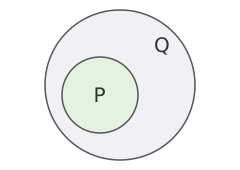
For example, 0 <= h and t = h implies 0 <= t: in every state
where the first claim is true, t equals a non-negative h, so
the stronger claim has the smaller set. "Stronger" sounds bigger,
so this is easy to get backward. A claim with a smaller set rules
out more states, so that claim says more about the state the
program is in. The weakest claim of all is true, which is true
in every state and says nothing. The strongest is false, which
is true in no state.
Among the claims that hold at a point, one implies all the others: it describes exactly the states that runs reaching the point can be in, and it is the strongest claim at that point.
Why insist on the strongest? Because a weaker claim may not be
enough to reach the postcondition. Suppose that after line 18 we
had written 0 <= t. It holds there, but it tells us nothing
more about t, so after line 19 we could not say what t is in
terms of h, m, and s, and the postcondition needs exactly
that. The claim after line 18 dropped the fact t = 60 * h + m,
so this argument fails even though the method satisfies its
specification. Forward reasoning keeps the strongest claim at
every step, and weakens a claim only where it is checked against
a claim someone wrote, such as the postcondition, which may say
less.
Two directions
Forward reasoning fills in the claim after some code, given the claim before it:
{{ P }}
code
{{ ? }}
Forward reasoning finds the strongest claim that makes the triple
valid, the strongest postcondition of the code from P.
Backward reasoning fills in the claim before some code, given the claim after it:
{{ ? }}
code
{{ Q }}
Backward reasoning finds the weakest claim that makes the triple
valid, the least that has to be true beforehand for Q to be true
afterward: the weakest precondition of the code for Q. Why
the weakest? A stronger claim would rule out some states from
which the code reaches Q, and an argument that asks more of the
precondition than the code needs may then fail on a method that
satisfies its specification. The weakest claim is the right
choice here for the same reason the strongest was the right
choice going forward.
Either direction turns the question "is this triple valid?" into
an implication. Given {{ P }} code {{ Q }}:
- Reason forward from
Pto the strongest claimRafter the code. The triple{{ P }} code {{ R }}is valid because we foundRthat way, and every stateRallows is a state some run fromPends in. So the original triple is valid exactly whenRimpliesQ. - Or reason backward from
Qto the weakest claimRbefore the code. The triple{{ R }} code {{ Q }}is valid because we foundRthat way, and every state outsideRis a state from which some run missesQ. So the original triple is valid exactly whenPimpliesR.
The rules below say how a claim moves through an assignment, a
sequence of lines, and an if. The first is the rule for an
assignment, the only kind of line seconds has before its return.
The rules for an assignment
Each rule below is a schematic: a triple laid out as it would sit in a program, with letters for the parts that change from one use to the next. Here is the forward rule for an assignment:
Rule: assignment, forward
{{ P }}
x = e;
{{ P[x ↦ x0] and x = e[x ↦ x0] }}
x is any variable, and e is any expression that changes
no variable. P[x ↦ x0] is P with every x replaced by
x0, a fresh name for the value x had before the line: a
name that neither the program nor any claim uses. The claim after
the line is the strongest that makes the triple valid.
The rule says two things. First, everything P said is still
true, once we write x0 for the old value of x. That includes
a fact about another variable: if P says w = x + 1, the claim
after the line says w = x0 + 1. Second, the new value of x
is e, computed from the old values. Here is the rule on lines
18 and 19 of seconds, starting from t = h, the one fact in
the claim after line 17 that mentions t. The rule leaves the
other facts as they are:
{{ t = h }}
t = t * 60 + m;
{{ t0 = h and t = t0 * 60 + m }}
t = t * 60 + s;
{{ t0 = h and t1 = t0 * 60 + m and t = t1 * 60 + s }}
At line 19 the rule renames t again. Since t0 is taken, the
fresh name is t1. Each use of the rule picks a fresh name,
t0, then t1, then t2, so no two old values share a name.
The facts chain back to h: since t0 is h, t1 is
h * 60 + m, so t is (h * 60 + m) * 60 + s, which multiplies
out to the 3600 * h + 60 * m + s we wrote after line 19.
Two habits keep the fresh names out of the claims we write:
- If
Pandenever mentionx, nothing has to be renamed. The claim after the line isP and x = e. Line 17 was this case:t = hjoined the precondition. - If we can write the old value of
xwithoutx0, put that expression forx0in every other fact. Then only the fact we read the expression from still mentionsx0. That fact says nothing about the state, so we drop it. Line 18 was this case, withhfort0, which givest = h * 60 + m, thet = 60 * h + mwe wrote. Afterx = x + 1, the old value isx - 1. Exercise 1 works such a case.
The backward rule for an assignment is simpler:
Rule: assignment, backward
{{ Q[x ↦ e] }}
x = e;
{{ Q }}
x is any variable, and e is any expression that changes
no variable. Q[x ↦ e] is Q with every x replaced by
e. The claim before the line is the weakest that makes the
triple valid.
We build the claim before the line from the claim after it, so
read this rule from the bottom up. e is what x is about to
become, so whatever Q claims about x after the line had better
be true of e before it. Before the line, x still has its old
value, so the claim before the line can call that value x, and
the rule needs no new name: it is just a substitution.
Let's reason backward through seconds from its postcondition.
Before line 19, replacing t by t * 60 + s:
{{ t * 60 + s = 3600 * h + 60 * m + s }}
t = t * 60 + s;
{{ t = 3600 * h + 60 * m + s }}
Before line 18, replacing t by t * 60 + m in that claim:
{{ (t * 60 + m) * 60 + s = 3600 * h + 60 * m + s }}
t = t * 60 + m;
{{ t * 60 + s = 3600 * h + 60 * m + s }}
And before line 17, replacing t by h:
{{ (h * 60 + m) * 60 + s = 3600 * h + 60 * m + s }}
long t = h;
{{ (t * 60 + m) * 60 + s = 3600 * h + 60 * m + s }}
Both sides of the claim at the top are the same number, so that claim is true in every state. In particular the precondition implies it, and the method's triple is valid.
Forward reasoning gave the same verdict by a different route. Backward reasoning took less work: three substitutions and one check, with no thought about which facts stay true across a line. On the other hand, the claims grew with each substitution, and we simplified them only at the end.
Neither argument used the precondition's three facts about h,
m, and s. They say what a duration is, and nothing in the body
depends on them. A precondition can carry a fact that no argument
about the body uses. Exercises 2 and 5 use these three facts.
The two directions can also meet in the middle. Reason forward
through the first lines and backward through the rest. The
triple is valid exactly when the claim forward reasoning gives at
the meeting point implies the claim backward reasoning gives
there. On seconds, forward through line 17 gives the
precondition and t = h. Backward through lines 18 and 19 gives
the claim before line 18 above, and the first implies the second.
We write such a check as a calculation, one step to a line, with
the fact a step uses beside it:
(t * 60 + m) * 60 + s = (h * 60 + m) * 60 + s     since t = h
                      = 3600 * h + 60 * m + s
The backward claim's left side comes out as its right side, so
the claim is true wherever t = h.
The rule for a sequence
We reason about two pieces of code in a row one at a time, through a claim at the point between them:
Rule: sequence
{{ P }}
first
{{ R }}
second
{{ Q }}
The triple around both pieces of code is valid exactly when
some claim R at the point between them makes both halves
valid: {{ P }} first {{ R }} and {{ R }} second {{ Q }}.
The schematic does not say what R is. Forward reasoning chooses R
as the strongest claim after the first piece of code. When we
reasoned forward through seconds, R for lines 18 and 19 was the
claim after line 18,
0 <= h and 0 <= m and 0 <= s and t = 60 * h + m, and each half
was valid by the forward rule for an assignment.
Backward reasoning chooses R as the weakest claim before the
second piece of code. Here are the same two lines backward from
the postcondition, where R is the claim between them and each
half is valid by the backward rule:
{{ (t * 60 + m) * 60 + s = 3600 * h + 60 * m + s }}
t = t * 60 + m;
{{ t * 60 + s = 3600 * h + 60 * m + s }}
t = t * 60 + s;
{{ t = 3600 * h + 60 * m + s }}
The two Rs are different claims, because forward reasoning keeps
all that is true at the point and backward reasoning keeps only
what has to be true there. Either one works: the rule asks only
for some R that makes both halves valid.
Each argument about seconds, forward and backward, used this
rule twice: at the two points between its three assignments.
The rule of consequence
Forward through seconds, the rules gave the claim after
line 19, but the claim we had to reach was the postcondition.
Backward, they gave the claim at the top, but we had to start
from the precondition. In general, each rule for an assignment
gives one claim, the strongest after the line or the weakest
before it. A specification may promise less than the strongest
claim, or ask more than the weakest, so the claim we have to
reach is often a different claim.
To connect the two claims, the rule of consequence uses the empty triple: two claims at one point with no code between them, valid exactly when the upper implies the lower. We may write such a pair at any point, so we can check a triple by writing claims of our own beside the claims we were given:
Rule: consequence
{{ P }}
{{ A }}
code
{{ B }}
{{ Q }}
The triple {{ P }} code {{ Q }} is valid if P implies A,
{{ A }} code {{ B }} is valid, and B implies Q.
To see which way the implications point, follow a run down the schematic, as the figure does:
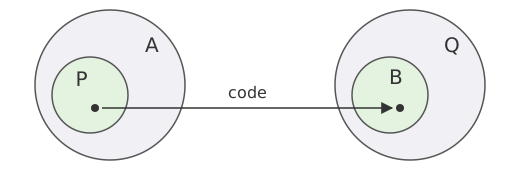
The run starts in a state where P is true, so A is true there
too. The code takes the run to a state where B is true, so Q is
true there too. To show a triple valid, then, it is enough to show
that a triple with a weaker precondition and a stronger
postcondition is valid: a triple that assumes less and promises more.
We have used this rule already. The forward argument about
seconds ended with it: the postcondition is one of the facts in
the claim after line 19, so that implication only drops facts.
The check where the two directions met used it too,
and that implication took arithmetic: the calculation
that substituted h for t.
The rules for an assignment and a sequence produce claims mechanically: a substitution, a fact added, a claim carried through. This rule's two implications are not mechanical: they involve no code, and we check them with arithmetic and logic. They are where an argument can go wrong, if we believe an implication that is false.
Stronger for whom
The rule of consequence lets a triple that assumes less and promises more stand in for the one we need. For a method call, that means we can swap in a stronger specification, one with a weaker precondition and a stronger postcondition. But then who wants a stronger claim? The precondition and the postcondition are promises made by different parties, so the answer depends on where the claim sits:
- The precondition is the client's promise. The client must make it true before every call, and the implementer may assume it. A stronger precondition gives the client more to make true and the implementer fewer states to handle.
- The postcondition is the implementer's promise. The implementer must make it true at every return, and the client may rely on it. A stronger postcondition gives the implementer more to deliver and the client more to rely on.
A weaker claim does the reverse, so each party wants its own promise weak and the other party's strong:
| precondition | postcondition | |
|---|---|---|
| stronger, the smaller set |
🙁 the client 🙂 the implementer |
🙂 the client 🙁 the implementer |
| weaker, the bigger set |
🙂 the client 🙁 the implementer |
🙁 the client 🙂 the implementer |
So a stronger specification favors the client on both sides: the client smiles at its weaker precondition and at its stronger postcondition. Which strength is right is still a design choice. As we said when choosing between specifications, a good specification rules out exactly the implementations its clients cannot use.
Across a call
The rule of consequence also checks what a method's specification asks of the code that calls it. We have reasoned across a call before, with the method's specification as the call's triple: the precondition before the call, the call, and the postcondition after. When the method satisfies its specification, that triple is valid, so the argument never reads a line of the method's body. To use the triple, we show that the claim before the call implies the method's precondition: that implication is how an argument checks that the client keeps its promise. After the call, the postcondition is part of what we know, and the rule for a sequence carries it on, for example to the precondition of the next call.
Swap in a method with a stronger specification, and the argument about the calling code still holds. Its precondition is weaker, so the claim before the call still implies it. Its postcondition is stronger, so it still implies what the argument after the call needs.
The rule for a conditional
Now let's reason about code with an if. Here is abs, which
returns the absolute value of its argument. (The precondition
rules out -2147483648, whose negation is too big for an int.)
9 10 11 12 13 14 15 16 17 18 19 20 21 | |
What is true after the if? A run takes one branch or the other,
and we reason without running the code, so we cannot know which.
The claim after the if has to cover both branches. If the true
branch ran, n was negative and n = -n made it positive. If
the false branch ran, n was already at least 0. So after the
if we know 0 < n or 0 <= n, which is just 0 <= n.
The rule for a conditional works the same way for any if:
Rule: conditional
{{ P }}
if (b) {
    {{ P and b }}
    first
    {{ A }}
} else {
    {{ P and not b }}
    second
    {{ B }}
}
{{ A or B }}
{{ Q }}
b is the if's condition. A is the strongest claim after
the true branch, and B after the false branch, so A or B is
the strongest claim after the if. The triple
{{ P }} if ... {{ Q }} is valid exactly when A or B implies
Q, that is, when both A and B imply Q.
Every run that enters the true branch found b true, and every
run that enters the false branch found b false. So those facts
hold at the top of their branches, and the argument often needs
them. An if with no else still has a false branch, as we saw
with branch coverage,
and that branch is empty, so B is P and not b in those cases.
Is 0 <= n enough to show the postcondition? No. It says only
that the returned number is non-negative, and a method that
always returned 0 would make that claim true as well. The
specification promises more: the number returned is the number
given, or its negation.
Saying that in a claim runs into a problem with names. In the
specification, n means the number the caller passed in. In a
claim after line 18, n means the value n has after that line.
On the call abs(-5), the number given is -5, and after line 18,
n is 5. The specification promises 5, the negation of -5, but
once line 18 has run, a claim written with n alone can no
longer say anything about the -5.
So we name the caller's number n0. n0 is a ghost variable:
a name used only in the claims, never in the program, for a value
the method started with.2 No line can change it, so at every
point of the argument, n0 is the number the caller passed in.
The argument starts from the claim n = n0. Read with n0 for
its n, the specification promises n0 if 0 <= n0, and -n0
if n0 < 0. The same move works whenever code changes a parameter
the specification mentions: name its value at the call.
This time the claim at the top leaves the precondition out. Its
only job is to keep n = -n from wrapping, so that the claims may
use integer arithmetic, and no claim needs it beyond that.
At line 18 the forward rule needs a name for the old value of
n. The claim before the line already says that value is n0,
so we write n0 for it and need no fresh name, just as we wrote
h for t0 in seconds. In seconds we then removed the fresh
names from the claims we wrote, but here n0 stays in every
claim, since the postcondition we have to reach mentions it.
Here is the whole argument:
static int abs(int n) {
    {{ n = n0 }}
    if (n < 0) {
        {{ n = n0 and n < 0 }}
        n = -n;
        {{ n0 < 0 and n = -n0 }}
    }
    {{ (n0 < 0 and n = -n0) or (0 <= n0 and n = n0) }}
    {{ 0 <= n and (n = n0 or n = -n0) }}
    return n;
}
The last claim is the postcondition in other words: the number
returned is non-negative, and it is the number given or its
negation. Of n0 and -n0, only one is non-negative, unless both
are 0, so together the two facts say exactly what the @return
clause says. The claim after the if implies the last claim by
the rule of consequence. In each of its cases, both facts hold:
- When
n0 < 0,n = -n0, which is positive. - When
0 <= n0,n = n0, which is non-negative.
So abs satisfies its specification.
In abs, every run comes out of the if, by one branch or the
other, and goes on to the return after it. Often a branch returns
from the method instead, and then no run comes out of that branch
at all. compare has two ifs like that:
6 7 8 9 10 11 12 13 14 15 16 17 18 19 20 21 | |
No run comes out of line 15, so only the false branch leads to
the point after the first if, and the claim there should be the
false branch's claim, P and not b. The rule for a conditional
agrees. A is the strongest claim at the end of the true branch,
and no run reaches that point. A claim holds at a point if it is
true each time a run reaches the point. At a point no run
reaches, then, every claim holds, even false, the strongest
claim of all. So A is false, and A or B is
false or (P and not b), which is P and not b.
false works the other way too. When the claim at a point implies
false, no state makes that claim true, so no run reaches the
point: reasoning has found code that never runs. Exercise 3 finds
such a point.
At each return, we check the postcondition: the claim there must
imply that the returned value is what the @return clause
promises in that case.
static int compare(int a, int b) {
    {{ true }}
    if (a < b) {
        {{ a < b }}
        return -1;
    }
    {{ b <= a }}
    if (a == b) {
        {{ b <= a and a = b }}
        return 0;
    }
    {{ b <= a and a != b }}
    return 1;
}
- At line 15,
return -1:a < b, and the specification promises -1. - At line 18,
return 0:a = b, and the specification promises 0. - At line 20,
return 1:b <= aanda != btogether sayb < a, and the specification promises 1.
So compare satisfies its specification: all three
implications are true.
Reasoning finds the mistake
When we
measured coverage,
we met methods whose tests passed while the method was wrong.
min is one of them. Here it is, with a passing test that runs
every statement:
/**
 * Picks the smaller of two numbers.
 *
 * @param a one number
 * @param b the other number
 * @return the smaller of a and b
 */
static int min(int a, int b) {
    int r = a;
    if (a <= b) {
        r = a;
    }
    return r;
}
@Test
void firstIsSmaller() {
    assertEquals(1, Min.min(1, 2));
}
A second test, min(2, 1), the one branch coverage asks for,
found the mistake. Let's find it by reasoning instead. The
specification has no precondition, so we start from true, and
reason forward:
static int min(int a, int b) {
    {{ true }}
    int r = a;
    {{ r = a }}
    if (a <= b) {
        {{ r = a and a <= b }}
        r = a;
        {{ r = a and a <= b }}
    }
    {{ (r = a and a <= b) or (r = a and b < a) }}
    {{ r = a and (a <= b or b < a) }}
    {{ r = a }}
    return r;
}
The claim after the if has two cases, and both say r = a, so
it implies the claim below, r = a and (a <= b or b < a). The
fact a <= b or b < a is true of any two numbers, so it says
nothing, and the rule of consequence lets us drop it. That leaves
r = a: on every run, the method returns a.
Now check r = a against the postcondition. The postcondition
promises the smaller number: a when a <= b, and b when
b < a. When b < a, it promises b, but r = a. So the
implication is false, and the states with b < a are exactly
where it fails. A run from any such state is a counterexample, and
min(2, 1) is such a run.
quadrant, another method from when we measured coverage, has
two ifs in a row. Its two tests run both branches of both ifs,
which completes our list for when to stop testing, and both pass:
/**
 * Gives the quadrant of a point that is on neither axis.
 *
 *          y
 *      2   |   1
 *  --------+-------- x
 *      3   |   4
 *
 * @param x the point's x coordinate
 * @param y the point's y coordinate
 * @requires x != 0 and y != 0
 * @return 1 if x > 0 and y > 0,
 *         2 if x < 0 and y > 0,
 *         3 if x < 0 and y < 0, and
 *         4 if x > 0 and y < 0
 */
static int quadrant(int x, int y) {
    int q = 1;
    if (x < 0) {
        q = 2;
    }
    if (y < 0) {
        q = q + 1;
    }
    return q;
}
@Test
void upperRight() {
    assertEquals(1, Quadrant.quadrant(1, 1));
}

@Test
void lowerLeft() {
    assertEquals(3, Quadrant.quadrant(-1, -1));
}
Let's reason forward from the precondition. After the first if,
a run has taken one branch or the other, so the claim has two
cases. At the top of the second if's true branch, y < 0 joins
each of those cases, and q = q + 1 changes q in each. After
the second if, each case has split in two, so there are four.
Since x != 0, not (x < 0) is 0 < x, and likewise for y:
static int quadrant(int x, int y) {
    {{ x != 0 and y != 0 }}
    int q = 1;
    {{ x != 0 and y != 0 and q = 1 }}
    if (x < 0) {
        {{ x < 0 and y != 0 and q = 1 }}
        q = 2;
        {{ x < 0 and y != 0 and q = 2 }}
    }
    {{ (x < 0 and y != 0 and q = 2) or
       (0 < x and y != 0 and q = 1) }}
    if (y < 0) {
        {{ (x < 0 and y < 0 and q = 2) or
           (0 < x and y < 0 and q = 1) }}
        q = q + 1;
        {{ (x < 0 and y < 0 and q = 3) or
           (0 < x and y < 0 and q = 2) }}
    }
    {{ (0 < x and 0 < y and q = 1) or
       (x < 0 and 0 < y and q = 2) or
       (x < 0 and y < 0 and q = 3) or
       (0 < x and y < 0 and q = 2) }}
    return q;
}
Now take the cases of the last claim in order, and check each
against the line of the @return clause for its quadrant:
- ✅
0 < xand0 < y: quadrant 1 is promised, andq = 1. - ✅
x < 0and0 < y: quadrant 2 is promised, andq = 2. - ✅
x < 0andy < 0: quadrant 3 is promised, andq = 3. - ❌
0 < xandy < 0: quadrant 4 is promised, andq = 2.
The implication for quadrant 4 is false: it fails exactly on
the lower right quadrant. The third test we tried then,
quadrant(1, -1), is a point there, and the method
returns 2 on it. Our list never asked for that test, so we
had to think of it ourselves.
The four cases are the four
paths through
quadrant. The two passing tests ran two of them, each on one
input. The argument checked all four, each on every input that
takes it, and so it found the mistake on a path neither passing
test ran.
Backward through a conditional
Forward reasoning through quadrant found the case that fails.
Reasoning backward from the postcondition asks a different
question: on which inputs does quadrant return what its
postcondition says? That is the weakest precondition of the body
for the postcondition. To reason backward through an if, we need
the conditional rule the other way around:
Rule: conditional, backward
{{ P }}
{{ (b and A) or (not b and B) }}
if (b) {
    {{ A }}
    first
    {{ Q }}
} else {
    {{ B }}
    second
    {{ Q }}
}
{{ Q }}
b is the if's condition. A is the weakest claim before the
true branch for Q, and B the weakest before the false branch.
A run that takes the true branch needs A, and a run that takes
the false branch needs B, so (b and A) or (not b and B) is
the weakest claim before the if. The triple
{{ P }} if ... {{ Q }} is valid exactly when P implies that
claim, that is, when P and b implies A and P and not b
implies B.
An if with no else has an empty false branch, so B is Q.
Here is quadrant backward from its postcondition, the four cases
of its @return clause written as one claim, one row per
quadrant. Each claim keeps a row for every quadrant it allows, in
the same order, so a quadrant's row can be followed from claim to
claim. Read it from the bottom up:
static int quadrant(int x, int y) {
    {{ (0 < x and 0 < y) or
       (x < 0 and 0 < y) or
       (x < 0 and y < 0) }}
    int q = 1;
    {{ (0 < x and 0 < y and q = 1) or
       (x < 0 and 0 < y) or
       (x < 0 and y < 0) or
       (0 < x and y < 0 and q = 3) }}
    if (x < 0) {
        {{ (x < 0 and 0 < y) or
           (x < 0 and y < 0) }}
        q = 2;
        {{ (0 < x and 0 < y and q = 1) or
           (x < 0 and 0 < y and q = 2) or
           (x < 0 and y < 0 and q = 2) or
           (0 < x and y < 0 and q = 3) }}
    }
    {{ (0 < x and 0 < y and q = 1) or
       (x < 0 and 0 < y and q = 2) or
       (x < 0 and y < 0 and q = 2) or
       (0 < x and y < 0 and q = 3) }}
    if (y < 0) {
        {{ (0 < x and 0 < y and q = 0) or
           (x < 0 and 0 < y and q = 1) or
           (x < 0 and y < 0 and q = 2) or
           (0 < x and y < 0 and q = 3) }}
        q = q + 1;
        {{ (0 < x and 0 < y and q = 1) or
           (x < 0 and 0 < y and q = 2) or
           (x < 0 and y < 0 and q = 3) or
           (0 < x and y < 0 and q = 4) }}
    }
    {{ (0 < x and 0 < y and q = 1) or
       (x < 0 and 0 < y and q = 2) or
       (x < 0 and y < 0 and q = 3) or
       (0 < x and y < 0 and q = 4) }}
    return q;
}
- The second
if's true branch ends where theifends, so the claim there is the claim after theif: the postcondition. - Before
q = q + 1, putq + 1forq: the rows ask forq = 0, 1, 2, or 3, one less than each quadrant's answer. From here up, a row'sqis the valueqneeds at that point, not the quadrant's number. - Before the second
if, the rule combines the branches as(b and A) or (not b and B). Quadrants 3 and 4 havey < 0, so they take the true branch, and their rows come fromA, the claim just found. Quadrants 1 and 2 take the false branch, which is empty, so their rows come fromB, the postcondition. - The first
if's true branch ends where theifends, so the claim there is the claim after theif: the claim before the secondif. - Before
q = 2, put 2 forq. The rows for quadrants 1 and 4 now ask for2 = 1and2 = 3, which are false, so they drop. That costs nothing: inputs in quadrants 1 and 4 skip this branch, and the next step takes their rows from the other one. The rows for quadrants 2 and 3 ask for2 = 2, which is true, so only their facts aboutxandyremain. - Before the first
if, the rule combines the branches again. Quadrants 2 and 3 havex < 0, so they take the true branch, and their rows come fromA, the claim just found. Quadrants 1 and 4 take the false branch, which is empty, so their rows come fromB, the claim after theif. - Before
int q = 1, put 1 forq. Quadrant 1's row asks for1 = 1, which is true, so only its facts aboutxandyremain. Quadrant 4's row asks for1 = 3, which is false: an input in quadrant 4 needsqto be 3 after this line, and the line makes it 1. Every input runs this line, so unlike the drops at step 5, this one loses inputs. What remains is the claim at the top, with rows for quadrants 1, 2, and 3.
Step 3 is delicate. Each row of the claim before an if describes
a state that has not yet taken a branch, and b decides which
branch it takes. So each quadrant's row comes from the claim of
the branch its inputs take, and the rule leaves out its row in the
other claim, even where that row looks right. A's row for
quadrant 1 asks for q = 0, which q = q + 1 would make 1, but a
state with 0 < y skips that branch and returns 0. A state in
quadrant 3 with q = 3 already makes the postcondition's row
true, but with y < 0 it runs q = q + 1 and returns 4. Every
row here fixes the signs of x and y, so the rule keeps or
leaves out whole rows. In general, b and A adds b to each case
of A that does not already say it.
The claim at the top is the weakest precondition of the body for the
postcondition: exactly the inputs on which quadrant returns what
its postcondition says. Its rows are for quadrants 1, 2, and 3. A
row that drops says that from that point, no state in its quadrant
reaches the postcondition. That matters only when runs in that
quadrant get there. Every input reaches the first line, so
quadrant 4, whose row dropped there, is a quadrant the method gets
wrong. Backward reasoning finds the inputs that get the right
answer. Any other input the precondition allows fails. The argument
does not say which lines to change to fix the method.
The triple is valid exactly when the precondition implies the
claim at the top. Here it does not. The precondition,
x != 0 and y != 0, allows quadrant 4, where every row of the
claim is false: on quadrant(1, -1), the precondition is true,
the claim is false, and the method returns 2. So the triple is not
valid. Forward reasoning found the same inputs from the other end:
it followed each path to the return and found the one that gives
the wrong answer. Backward reasoning started from the
postcondition and found the inputs that get the right answer. So,
again, the inputs that fail are the ones the precondition allows
but the claim at the top does not: here, quadrant 4.
A proof
If you took CSE 311, you wrote proofs there, about numbers and
sets. An argument that goes from what is given to what is claimed
in steps, each step justified by a rule, so that anyone can check
it without trusting its author, is a proof. The arguments for
seconds, abs, and compare are proofs. In each, what is given
is the precondition, what is claimed is the postcondition, and the
steps use the rules above. A proof that a method satisfies its
specification is a proof about every run at once. Unlike an
argument in prose, an argument built from the rules says where it
fails. Going forward, with every claim the strongest, the
implication that is false says on which inputs the method is
wrong, as it did for min and for quadrant. Going backward,
with every claim the weakest, the check against the precondition
says the same, as it did for quadrant.
Leslie Lamport says, in one of Reading 2's articles, that proving a whole program correct this way turned out to be very hard in practice and is rarely done.3 Floyd and Hoare, Lamport says, taught us that a program is a mathematical object. So a programmer can ask what a program is supposed to do, and whether they could prove that it does that.
What reasoning tells us
When we measured coverage, we said that a method whose tests complete our list, all passing, has been tested enough, and that this is still less than knowing it is correct. A test confirms a claim about its own run. The claim that the method's triple is valid, with its specification around its body, is about every run, and the rules can confirm it. So a proof that the triple is valid is the knowledge that tests fall short of. Reasoning confirms a claim about every run, though, only if the argument is right. Two things can still go wrong, and one thing the rules cannot yet do:
- A false implication. A slip in applying a mechanical rule, such as a missed substitution, shows on the page to anyone who checks the step against the rule. We check an implication with arithmetic and logic instead, and a person can believe an implication that is false. What catches such a mistake is a test: one that refutes the claim refutes the argument too. So we still test.
- Arithmetic that is not Java's. The claims are about the
integers. Java's
intwraps, so a claim that is true of the integers can be false of the program.abswithout its precondition is the example. The argument says thatn = -nmakes a negativenpositive. But 2147483648 does not fit in anint, so whennis -2147483648,n = -nleavesnat -2147483648:abs(-2147483648)returns -2147483648! The precondition keeps that one input out, so on every input it allows, Java's arithmetic agrees with the integers. Every method in this lecture either has such a clause, asabsdoes, or does no arithmetic that could wrap, assecondsdoes by computing in along. - A loop. On every run of the methods above, each line ran at
most once.
Sum's loops run their lines once for each number typed, and the rules above cannot carry a claim through a loop that may run any number of times.
Exercises
Each answer is folded under its question. Write yours first.
1. Here is a precondition, one line, and a postcondition:
{{ 1 <= n and n <= 100 }}
n = n + 3;
{{ 10 <= n * n }}
Reason forward from the precondition by the rule, then write the claim without the fresh name, and check that claim against the postcondition. Then reason backward from the postcondition, and check the precondition against the claim that the backward rule gives.
Answer
-
Forward, the claim after the line implies the postcondition. The forward rule gives the first claim after the line. Each claim implies the claim below it:
{{ 1 <= n and n <= 100 }}
n = n + 3;
{{ 1 <= n0 and n0 <= 100 and n = n0 + 3 }}
{{ 1 <= n - 3 and n - 3 <= 100 }}
{{ 4 <= n and n <= 103 }}
{{ 4 <= n }}
{{ 16 <= n * n }}
{{ 10 <= n * n }}
Counting from the top: the old value of
nis the new value minus 3, so the third claim putsn - 3forn0and dropsn = n0 + 3, the fact that gaven - 3. The fourth adds 3 to each side of both facts. The fifth drops a fact. The sixth squares both sides, since4 <= nmakesn * nat least4 * 4. The last is the postcondition, since 10 is at most 16. -
Backward, the precondition implies the claim before the line. Putting
n + 3fornin the postcondition gives the claim just above the line. Above that claim, a chain from the precondition reaches it:{{ 1 <= n and n <= 100 }} {{ 1 <= n }} {{ 4 <= n + 3 }} {{ 16 <= (n + 3) * (n + 3) }} {{ 10 <= (n + 3) * (n + 3) }} n = n + 3; {{ 10 <= n * n }}The second claim drops a fact. The third adds 3 to both sides. The fourth squares both sides. The last follows, since 10 is at most 16.
-
The triple is valid. Both implications are true. Neither check used
n <= 100. That bound keepsn + 3within anint, so the line does not wrap.
2. When does seconds return a number less than 3600? Reason
backward from the claim t < 3600 after line 19, and read the
answer off the claim at the top.
Answer
-
Three substitutions reach the top.
{{ (h * 60 + m) * 60 + s < 3600 }} long t = h; {{ (t * 60 + m) * 60 + s < 3600 }} t = t * 60 + m; {{ t * 60 + s < 3600 }} t = t * 60 + s; {{ t < 3600 }} -
secondsreturns less than 3600 exactly whenh = 0and60 * m + s < 3600. The claim at the top simplifies to3600 * h + 60 * m + s < 3600. Under the precondition,hand60 * m + sare both at least 0, sohmust be 0, and then the minutes and seconds together must come to less than an hour. Backward reasoning found the exact condition, which is more than "the hours are zero":seconds(0, 90, 0)returns 5400.
3. Here is compare with its first condition changed from
a < b to a <= b. Reason forward through it and say whether it
still satisfies its specification. If not, which inputs show that
it does not?
/**
 * Compares two numbers.
 *
 * @param a one number
 * @param b the other number
 * @return -1 if a < b, 0 if a == b, and 1 if b < a
 */
static int compare(int a, int b) {
    if (a <= b) {
        return -1;
    }
    if (a == b) {
        return 0;
    }
    return 1;
}
Answer
-
Forward reasoning gives these claims for the changed method.
static int compare(int a, int b) { {{ true }} if (a <= b) { {{ a <= b }} return -1; } {{ b < a }} if (a == b) { {{ b < a and a = b }} {{ false }} return 0; } {{ b < a }} return 1; } -
The changed method fails on equal numbers. At the first
return, the claim isa <= b. The specification promises -1 whena < band 0 whena = b. Every call witha = breaches thisreturnand returns -1, where the specification promises 0. So the changed method does not satisfy its specification, and every input witha = b, such ascompare(3, 3), shows that. - No run reaches the second
if's body. After the firstif, the claim isb < a. The body of the secondifneedsa = bas well, and no state makes both true, sob < a and a = bimpliesfalse, the claim written under it. No run reaches a point wherefalseholds, so the body runs on no input at all.
4. Repair min by giving its if an else that sets r to
b. Reason forward through the repaired method, with a claim at
the top and the bottom of each branch, and show that it satisfies
its specification.
Answer
-
Forward reasoning gives these claims for the repaired method.
static int min(int a, int b) { {{ true }} int r = a; {{ r = a }} if (a <= b) { {{ r = a and a <= b }} r = a; {{ r = a and a <= b }} } else { {{ r = a and b < a }} r = b; {{ r = b and b < a }} } {{ (r = a and a <= b) or (r = b and b < a) }} return r; } -
In both cases,
ris the smaller ofaandb. In the first casea <= bandr = a, the smaller. In the second caseb < aandr = b, the smaller. Both implications are true, so the repaired method satisfies its specification. The same argument on the originalminfailed in the caseb < a, because nothing setrtob.
5. Here is seconds again, returning an int, with the
clause its specification then needs:
/**
 * Converts a duration in hours, minutes, and seconds to seconds.
 *
 * @param h the hours
 * @param m the minutes
 * @param s the seconds
 * @requires 0 <= h, 0 <= m, and 0 <= s
 * @requires 3600 * h + 60 * m + s <= 2147483647 (fits in an int)
 * @return 3600 * h + 60 * m + s
 */
static int seconds(int h, int m, int s) {
    int t = h;
    t = t * 60 + m;
    t = t * 60 + s;
    return t;
}
The three tests pass on this version too. Reason forward through it. Does the argument use the new clause? What would go wrong without the clause? Then say how a client could check the clause before a call, and what else the method could do instead of asking for the clause.
Answer
- The argument never uses the clause. The four claims are the
claims in What is true after each line, and the check at the
returnis the same implication. The claims use integer arithmetic, but Java'sintwraps. So without the clause, a claim could be true of the integers and false of the program, as forabswithout its bound. The clause and the precondition's three facts0 <= h,0 <= m, and0 <= skeep every value computed on the way at most the answer, and the answer fits, so no line wraps. - A client checks the clause in
long. Inintarithmetic the check itself could wrap. Inlongit cannot. The client can also compute the total withMath.multiplyExactandMath.addExact, which throw instead of wrapping. An exercise in Lecture 6 used the second of them. - Two other designs. Return a
long, as the version at the top does, and the clause goes away. Or keep theint, compute withMath.multiplyExactandMath.addExact, and promise anArithmeticExceptionwhen the answer does not fit, one of Lecture 6's six ways. The argument for that design needs a case the rules above do not cover: a line that throws ends the run early, and the argument has to show the@throwspromise on that run.
Further reading
- The rules. C. A. R. Hoare, "An Axiomatic Basis for Computer Programming" (Communications of the ACM, 1969), a short paper and the source of the triple, the backward rule for an assignment, the rule for a sequence, and the rule of consequence.
- Weakest preconditions. Edsger W. Dijkstra, "Guarded Commands, Nondeterminacy and Formal Derivation of Programs" (Communications of the ACM, 1975), which treats a statement as a function from a postcondition to the weakest precondition from which the statement reaches it: the view behind backward reasoning.
- A textbook. David Gries, The Science of Programming (1981), which develops programs together with their proofs, by weakest preconditions.
-
C. A. R. Hoare, "An Axiomatic Basis for Computer Programming" (Communications of the ACM, 1969), says its treatment is essentially Robert Floyd's, applied to program texts instead of flowcharts. Floyd's "Assigning Meanings to Programs" (1967) attached a claim to each arrow of a flowchart, to hold whenever that arrow is taken, and gave the forward rule for an assignment, with
x0for the old value. ↩ -
Christopher Pulte, Hoare Logic and Model Checking, lecture 1 (University of Cambridge, 2024/2025), slides 16 to 18, shows that a postcondition for the maximum of two variables, written without their initial values, is met by a program that sets every variable to 0. Its fix is to refer to the initial values by names that never occur in the program, which it calls auxiliary variables, also ghost or logical variables. ↩
-
Leslie Lamport, "The Future of Computing: Logic or Biology" (2003), the text of a talk, and one of Reading 2's three articles. ↩