Skip to main content
Link
Menu
Expand
(external link)
Document
Search
Copy
Copied
# Design/Disability Justice Disability Justice, Design Justice and Disability Dongles cse482a: Fall 2026; Jennifer Mankoff (Last Edited: 2026-10-12). <a href="/courses/cse482a/26au/slides/accessibility.html">Live View: /slides/accessibility.html</a> Important Reminder: check zoom & captioning <a href="/courses/cse482a/26au/slides/accessibility.html"><img src="https://api.qrserver.com/v1/create-qr-code/?data=/slides/accessibility.html&size=100x100" alt="QR for /courses/cse482a/26au/slides/accessibility.html" title="" /></a> --- <div class="slide-outline" style="margin: 1em 0; padding: 1em; background: #f5f5f5; border-radius: 5px;"> <h2 style="margin-top: 0;"> Outline </h2> <ul style="list-style-type: none; padding-left: 0;"> <li><a href="#3">Class Access Norms & Syllabus</a> (Slide 3)</li> <li><a href="#14">Disability Justice</a> (Slide 14)</li> <li><a href="#52">Summary and Next Class</a> (Slide 52)</li> </ul> </div> --- class: center, middle, inverse # Announcements --- class: center, middle, inverse # Class Access Norms & Syllabus --- ## How is this class accessible? (1/3) Many disabilities benefit from flexibility in how time is spent -- - Up to two late days *per assignment* for assignment completion, no questions asked - If you need further accommodations for any reason, talk to us and consider working with [DRS](https://depts.washington.edu/uwdrs/) as well. → Where possible, we provide those as a standard part of the class. --- ## How is this class accessible? (3/3) We commit to mutually working together to make it accessible. - DRS approval is required for some accommodations (specifically, those that are not available to the entire class) - But many accommodations benefit most students. → where possible, we provide those as a standard part of the class. ??? This is a form of *disability justice* Why disability justice? because access to disability documentation and comfort with disclosure are both things that are inequitably distributed --- ## How is this class accessible? (2/3) Sometimes students with disabilities, such as chronic illness or mental health concerns may need to miss class, or avoid getting sick. - Please request the recorded video when you have an access need, a cold, flu, or suspected COVID symptoms. - Same for a disability accommodation - We will *work to ensure* you have an equal experience. Outside of this, or travel, **attend in person** --- exclude: true ## How do I receive participation credit when remote? 1. You arrange for a zoom buddy ahead of class 2. You *attend via Zoom* with the help of your zoom buddy 3. You *participate meaningfully in that day's in-class activities* 4. You *report how your participation went* using the [reporting form](https://forms.gle/3g5GXZscUgvFtES76) --- ## Access is also for the teaching staff Once you learn how to make the course more accessible to the teaching staff, please do. - Communicate through the discussion board or mailing list rather than emailing us individually - Support us and each other in creating access for the whole class --- ## A Note on Academic Integrity Don't plagiarize. If you use text, quote it and reference it. Why? UW policy and [*Citational Justice*](https://www.nature.com/articles/d41586-022-00793-1) and thus an important expression of disability justice values in our class. --- ## GAI In Your Projects Please read through the [syllabus use of AI](../syllabus.html#use-of-ai-and-generative-tools) policy - You may use GAI for coding, but must mention it in your log - Do not use generative AI to plagiarize or cheat. For example, you may not use AI to create fake data and pass that off as based on real people. - You can use it to get advice for written assignments, but **not to write them.** --- ## Engagement Points Described in [Assignments/engagement points](../engagement.html) Used to assess 20% of your grade About half go to team/class engagement (broadly defined) Remainder listed (and can be expanded if you have ideas we missed) New Ed discussion with a thread for each type, share when you have completed one --- ## Milestone 0 due today 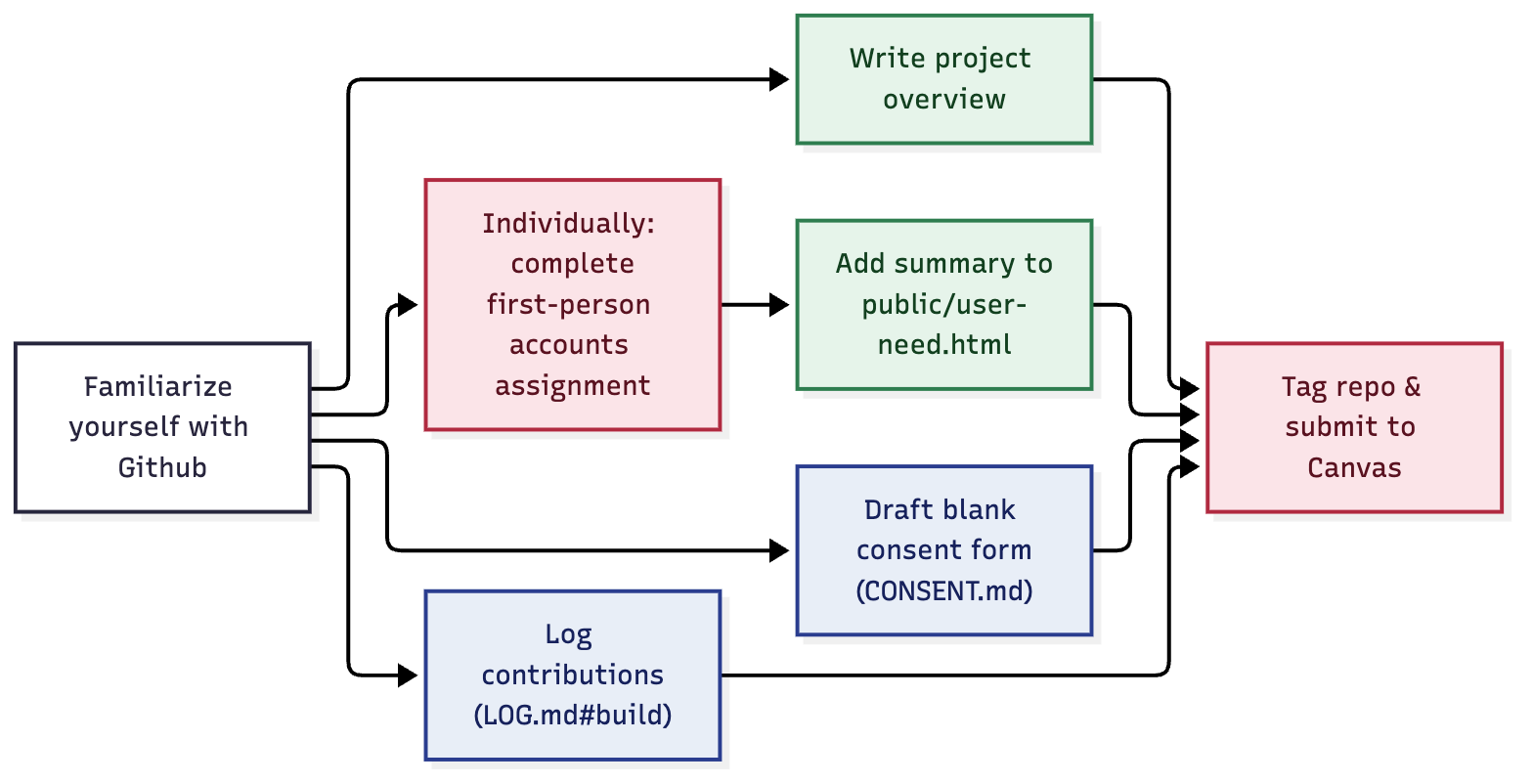 --- ## Milestone 1 due on the 19th 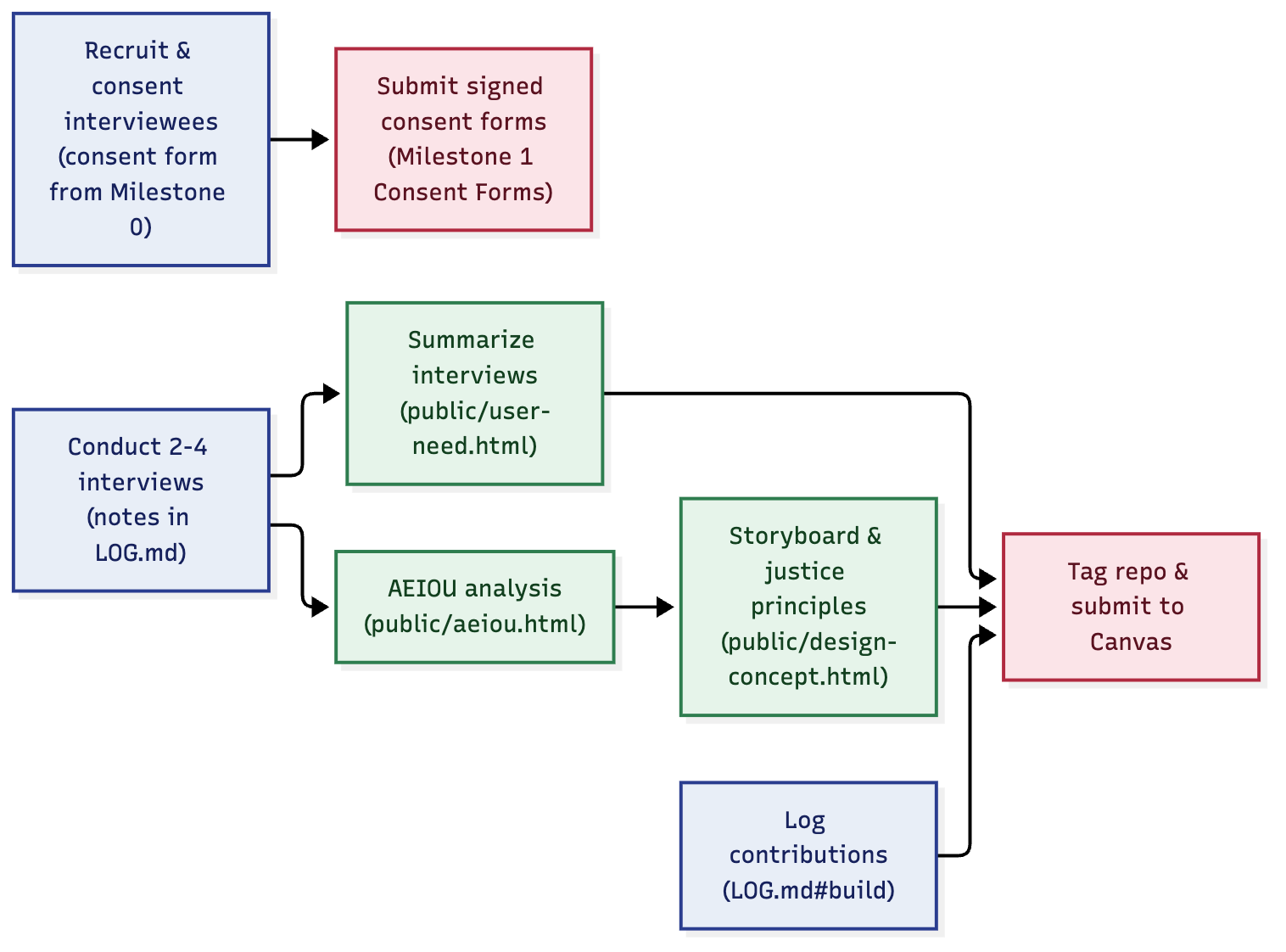 --- class: center, middle, inverse # Disability Justice --- ## Introducing Design/Disability Justice - [DDJ](/competencies/design-disability-justice/) is one of five competencies in this course ABET requirement: An ability to apply engineering design to produce solutions that meet specified needs with consideration of public health, safety, and welfare, as well as global, cultural, social, environmental, and economic factors --- ## Disability/Design Justice part 1 Is the work informed by disability perspectives? This is a big reason we learn about first person accounts and do user research ??? Does this project build on existing disability community knowledge and practices? For example is it being used to give control and improve agency to the intended users? Does it avoid ableist assumptions about what disabled people need or want or are capable of? --- ## Crip Technoscience Disability leadership via [Crip Technoscience](https://catalystjournal.org/index.php/catalyst/article/view/29607) - .quote[Disabled people are experts and designers of everyday life] - .quote[We also harness technoscience for political action, refusing to comply with demands to cure, fix, or eliminate disability] --- ## Design Justice Disability leadership via [Design Justice](https://bookish.press/tac/ComputingAndSociety) .quote[led by marginalized communities [and aims] to challenge, rather than reproduce, structural inequalities] - Originates outside of disability ([Design Justice Network](https://designjustice.org/read-the-principles)) - Can be used in concert with Disability justice. --- ## Disability Justice [Sins Invalid](https://www.sinsinvalid.org/) disability based performance project defines [10 principles of disability justice [PDF]](https://static1.squarespace.com/static/5bed3674f8370ad8c02efd9a/t/5f1f0783916d8a179c46126d/1595869064521/10_Principles_of_DJ-2ndEd.pdf) which are: Disability leadership concepts developed by Queer, BIPOC disabled people --- ## DJ Principles (1/10) 1. INTERSECTIONALITY(*) "we are many things, and they all impact us." (*) Feminist theorist Kimberlé Crenshaw coined intersectionality in 1989 to describe the experiences of Black women, who experience both racism and sexism. ??? “We do not live single issue lives” –Audre Lorde. Ableism, coupled with white supremacy, supported by capitalism, underscored by heteropatriarchy, has rendered the vast majority of the world “invalid.” --- ## Intersectionality in Design: Ensure that the things we build address multiple disabled people, with varied identities, and multiply disabled people Example in this class? (discuss) --- ## DJ Principles (2/10) 1. INTERSECTIONALITY "we are many things, and they all impact us." 2. LEADERSHIP OF THOSE MOST IMPACTED helps us stay grounded by those we serve ??? “We are led by those who most know these systems.” –Aurora Levins Morales lifting up, listening to, reading, following, and highlighting the perspectives of those who are most impacted by the systems we fight against." by centering the leadership of those most impacted, we keep ourselves grounded in real-world problems and find creative strategies for resistance. " --- ## Leadership of those most impacted Disability led decisions. When we design for people with disabilities, - People with disabilities are part of the design process (or lead it) - The needs of those MOST impacted among that subset come FIRST, then the majority follows Example: early in COVID, I brought masks to class, so no one would feel uncomfortable in the room. I still have boxes of masks and am happy to continue this --- ## DJ Principles (3/10) 1. INTERSECTIONALITY "we are many things, and they all impact us." 2. LEADERSHIP OF THOSE MOST IMPACTED helps us stay grounded by those we serve 3. ANTI-CAPITALIST POLITICS "we resist conforming to 'normative' levels of productivity in a capitalist culture" ??? In an economy that sees land and humans as components of profit, we are anti-capitalist by the nature of having non-conforming body/minds. Capitalism depends on wealth accumulation for some (the white ruling class), at the expense of others... Our worth is not dependent on what and how much we can produce. --- ## Anti-Capitalist Politics in Design When we create systems, we make them accessible even though it may cost time and money - No segregation, even if it is cheaper to implement In class: Regrades & Competency based grading is inspired by this principle ??? Consider things like disclosure and invisibility --- ## 5 competencies (ABET aligned) - Accessible Implementation - Apply WCAG 2.1 AA standards in your prototypes - Inclusive Person Centered Design - Base design decisions on first person perspectives - Accessible Communication - Create accessible documents, presentations, and posters - Design/Disability Justice - Enact positive disability principles in your design - Inclusive Experiments - Consider accessibility, ethics, and power dynamics in research --- ## Getting to excellent - On any competency, you may be rated as below competent, competent or excellent. - You can revise text that we grade in your group assignment, for most of the quarter - Most students get "competent" or below on their first try - This usually goes up on the second try. --- ## DJ Principles (4/10) 4) CROSS-MOVEMENT SOLIDARITY "Through cross-movement solidarity, we create a united front." ??? disability justice lends itself to politics of alliance. Align with racial justice, reproductive justice, queer and trans liberation, prison abolition, environmental justice, anti-police terror, Deaf activism, fat liberation, and more... challenging white disability communities around racism and challenging other movements to confront ableism. --- ## Cross-Movement Solidarity in Design Addressing accessibility isn't enough if we aren't inclusive of other identities How could this show up in the classroom? (discuss) --- ## DJ Principles (5/10) 4) CROSS-MOVEMENT SOLIDARITY "Through cross-movement solidarity, we create a united front." 5) RECOGNIZING WHOLENESS "Disabled people are whole people." ??? People have inherent worth outside of commodity relations and capitalist notions of productivity. Each person is full of history and life experience. Each person is full of history and life experience. Each person has an internal experience composed of our own thoughts, sensations, emotions, sexual fantasies, perceptions, and quirks. --- ## Recognizing Wholeness in Design We should include accessibility in all the spaces that people interact with technology, because people with disabilities exist in all of the spaces -- as authors and consumers; programmers and users; and in every area of life In your projects -- this could mean considering that TAs and instructors, not just students, might have disabilities --- ## DJ Principles (6/10) 4) CROSS-MOVEMENT SOLIDARITY "Through cross-movement solidarity, we create a united front." 5) RECOGNIZING WHOLENESS "Disabled people are whole people." 6) SUSTAINABILITY "pace ourselves, individually and collectively" ??? We pace ourselves, individually and collectively, to be sustained long term. Our embodied experiences guide us toward ongoing justice and liberation. to be sustained long-term, value the teachings of our bodies and experiences, and use them as a critical guide and reference point to help us move away from urgency and into a deep, slow, transformative, unstoppable wave of justice and liberation. --- ## Sustainability in Design We should work at a pace that includes everyone in the work, and not value the rush products to market over access What addition to our class structure would fulfill this? --- ## DJ Principles (7/10) 4) CROSS-MOVEMENT SOLIDARITY "Through cross-movement solidarity, we create a united front." 5) RECOGNIZING WHOLENESS "Disabled people are whole people." 6) SUSTAINABILITY "pace ourselves, individually and collectively" 7) COMMITMENT TO CROSS-DISABILITY SOLIDARITY "isolation undermines collective liberation" ??? even and especially those who are most often left out of political conversations. Break down the isolation between people with physical impairments, people who are sick or chronically ill, psych survivors and people with mental health disabilities, neurodiverse people, people with intellectual or developmental disabilities, Deaf people, Blind people, people with environmental injuries and chemical sensitivities, and all others who experience ableism and isolation that undermines our collective liberation. --- ## DJ Principles (8/10) 8) INTERDEPENDENCE "We work to meet each other's needs" rather than depending on state solutions ??? the liberation of all living systems and the land as integral to the liberation of our own communities, as we all share one planet. We work to meet each other’s needs as we build toward liberation, knowing that state solutions inevitably extend into further control over lives. --- ## DJ Principles (9/10) 8) INTERDEPENDENCE "We work to meet each other's needs" rather than depending on state solutions 9) COLLECTIVE ACCESS "We can share responsibility for our access needs ... balance autonomy while being in community" ??? AS brown, black and queer-bodied disabled people we bring flexibility and creative nuance that go beyond able-bodied/minded normativity, to be in community with each other. ... Access needs aren’t shameful — we all function differently depending on context and environment. Access needs can be articulated and met privately, through a collective, or in community, depending upon an individual’s needs, desires, and the capacity of the group. We can share responsibility for our access needs, we can ask that our needs be met without compromising our integrity, we can balance autonomy while being in community, we can be unafraid of our vulnerabilities, knowing our strengths are respected. --- # DJ Principles (10/10) 8) INTERDEPENDENCE "We work to meet each other's needs" rather than depending on state solutions 9) COLLECTIVE ACCESS "We can share responsibility for our access needs ... balance autonomy while being in community" 10) COLLECTIVE LIBERATION No body or mind can be left behind – only moving together can we accomplish the revolution we require. ??? We move together as people with mixed abilities, multiracial, multi-gendered, mixed class, across the sexual spectrum, with a vision that leaves no bodymind behind. --- ## Design/Disability Justice Competency You should be able to summarize and critique accessibility projects, including your own, based on how it meets or fails to meet design/disability justice principles, including non-ableist language, emphasizing agency and control, and avoiding disability dongles. --- ## Questions to ask (1/3) 1. Does this project build on existing disability community knowledge and practices? For example is it being used to give control and improve agency to the intended users? Does it avoid ableist assumptions about what disabled people need or want or are capable of? --- ## Questions to ask (2/3) 1. Does this project build on existing disability community knowledge and practices? 2. How might this project perpetuate harm against those with marginalized identities? For example does this project have, or avoid, ableist technology and language, including “disability dongles”? --- ## Questions to ask (3/3) 1. Does this project build on existing disability community knowledge and practices? 2. How might this project perpetuate harm against those with marginalized identities? 3. Is it including diverse participants with intentionality For example, does it include multiple disabled people, multiply disabled people, people from diverse disability communities? Similarly, is it engaging with all aspects of participants’ identities, rather than oversimplifying by erasing part of who they are? --- ## Case Study: ThisAbles Campaign <iframe width="560" height="315" src="https://www.youtube.com/embed/a0PA_VpLlDw?si=YadSdmVtA5yfSdsZ" title="YouTube video player" frameborder="0" allow="accelerometer; autoplay; clipboard-write; encrypted-media; gyroscope; picture-in-picture; web-share" referrerpolicy="strict-origin-when-cross-origin" allowfullscreen></iframe> --- ## More about ThisAbles .quote[IKEA’s ThisAbles won the 2019 Grand Prix for Health and Wellness [22]. However, within the company’s marketing campaign, Eldar Yusupov, the disabled copywriter for McCann Tel Aviv who conceptualized and “fought for” the project was relegated to the role of user] --- ## What DJ principles did it violate? - Leadership of those most impacted: "user" is not "leader" -- - Anti-capitalist politics: IKEA supposedly released its models, but the website (thisables.com) is gone. I found [*one* item on Thingiverse](https://www.thingiverse.com/thing:4333991) -- - Cross-movement solidarity: Not part of the campaign - Recognizing wholeness: Jokes about assembly -> no! --- ## Disability Dongle (1/2) .quote[Disability Dongle: A well intended elegant, yet useless solution to a problem we never knew we had. Disability Dongles are most often conceived of and created in design schools and at IDEO.] [Liz Jackson](https://twitter.com/elizejackson/status/1110629818234818570) --- ## Disability Dongle (2/2) - Often speculative - Sometimes "they enact normative or curative harm upon disabled users" - Emphasize quick fix over structural change ??? explain the jargon --- ## Who is (Typically) Behind Dongles? .quote[Thank you for your feedback is a signal that we have no control over how our knowledge will be used; by reframing disabled expertise and critique as “feedback,” this phrase, like IKEA’s ThisAbles campaign, relegates disabled people to the role of user and subordinates disabled knowledge to the (professional) designerly imagination. It’s a disingenuous phrase, in which “thank you” is uttered to remind us that it is actually us who should be grateful. [Disability Dongle](https://blog.castac.org/2022/04/disability-dongle/), Liz Jackson] --- ## Award bait - “Thank you for your feedback” and what it signals - Whose idea and whose credit - Hero complex (I can save you with this new technology) - Does not emphasize Agency and Control - Not Disability Led - Typically doesn't involve disabled people early, if at all --- ## Design/Disability Justice My practice is to - Emphasize agency and control - Provide for flexibility and adaptation - Support creativity and hackery - Focus on problems that disabled people care about - Include diversity --- class: center, middle, inverse # Summary and Next Class --- ## You can approach accessibility many ways - Ability-based design - Universal design - Crip Technoscience - Design for Empowerment --- ## We use Design/Disability Justice in this class Summarized in [Design/Disability Justice Competency]() Goal: Avoid disability dongles --- ## Checkins Due today: Milestone 0 - Can chat with us now about consent forms, etc Milestone 1 on the 19th - Should start recruiting users right away --- ## Next class - Lo fi prototyping
