Reading 4 and Upgrading Apps
CSE 331: Software Design and Implementation, Autumn 2026
Your job is to deliver code that you know works.
TODO
- Tomorrow: section on generics, with a project proposal workshop
- please bring a draft of your proposal to section!
- Project proposal: due Tuesday, November 24, 11:59pm
- Wednesday to Friday: no class (Thanksgiving)
- HW4: due Friday, December 4, 11:59pm
Reading 4 discussion
- Form groups of 3 or 4 with the people next to you
- Naur 1985: the program is a theory in its authors' heads
- Winters 2020: engineering is programming integrated over time
- Carlini and Regehr 2026: a C compiler written by AI, then fuzzed
Share (5 minutes)
Sooner or later you will change a program you did not write,
whether a person wrote it or a machine did.
What do you need besides the code, and can you get it?
- Each of you, in turn:
- Which article you read, and its answer
- The question you wrote for the discussion
The argument, in this course's words
- Naur: you need the theory, and no document can hand it to you
- Winters: you need the ability to change the code safely
- Carlini and Regehr: you need tests that are "nearly perfect"
- This course: specifications, tests, and arguments
- Are they the theory?
Argue (6 minutes): who is right?
- Naur: the team is gone, so the program is dead, even while it still runs
- Winters: "Stagnation is an option, but often not a wise one"
- Regehr: a model fixed 34 bugs; "there's no chance" it is correct
- If your group agrees, argue the other side, or take a case:
- Tests pass and nobody understands it: ship it? Who reads GCC?
- The team is gone, two weeks to ship: rewrite, or read and patch?
- A class project might become a real app: build for that now?
Report (a few minutes)
- A couple of groups: what did you decide, and why?
Half sheet, question 1 (3 minutes)
- The names of the others in your group
- What changed in what you think you need, besides the code
- One new point, and the article or person it came from
Upgrading Apps
Two versions of two programs
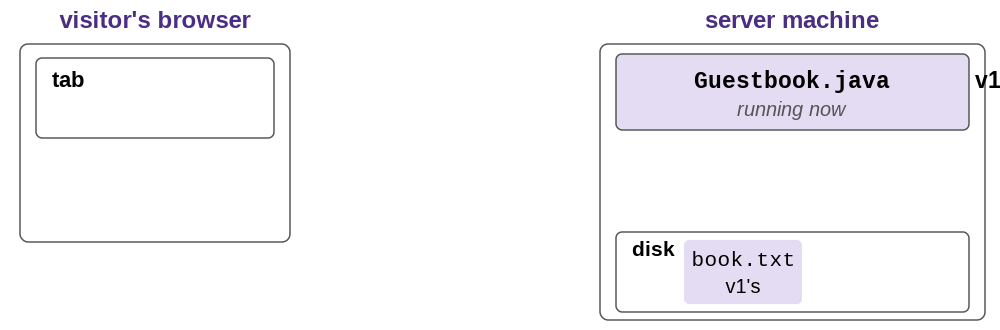
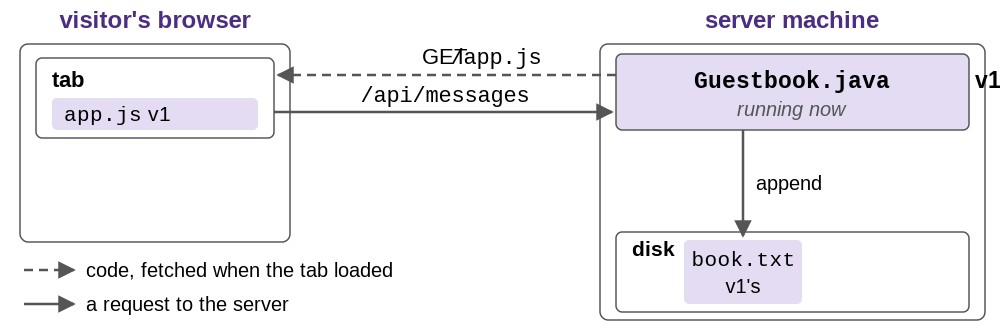
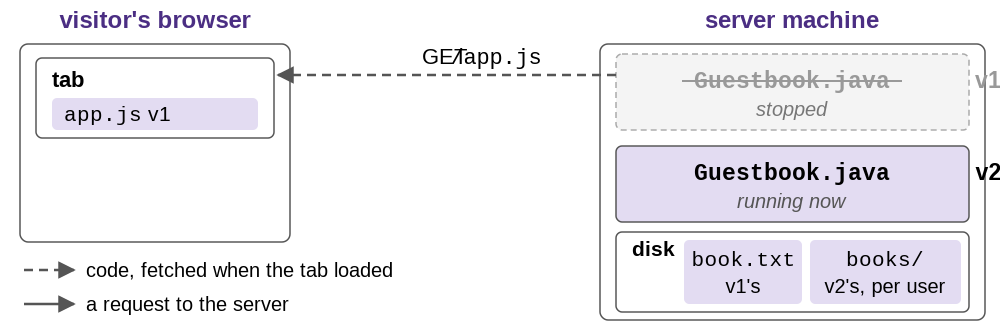
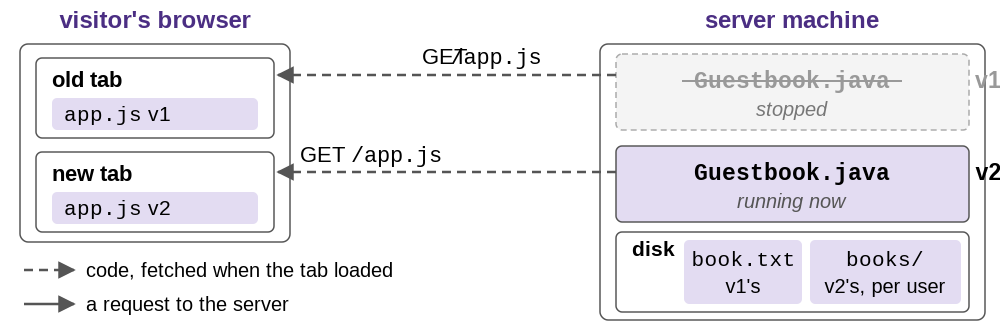
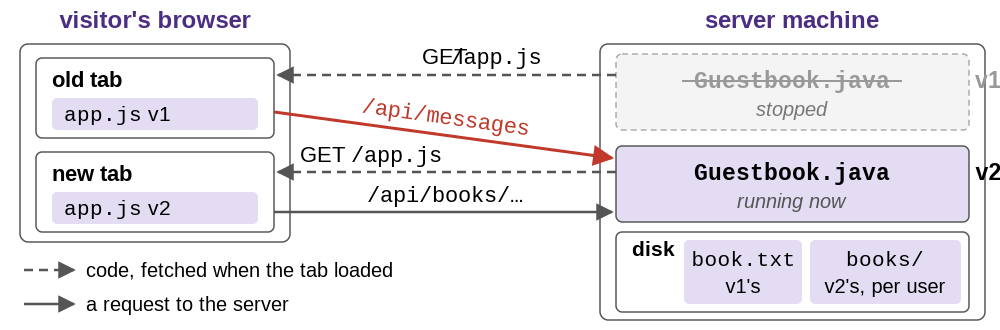
- Upgrade: stop v1, start v2, while visitors keep using the site
- The promise: a posted message is saved forever, through upgrades too
v1 writes book.txt
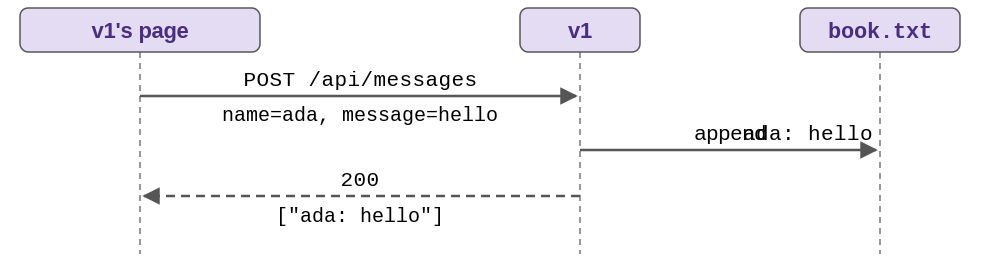
- Ada posts
hello, and bob postshi ada, from v1's page book.txtnow holds two lines:ada: helloandbob: hi ada- Then we upgrade: stop v1, and start v2 in the same directory
The old tab posts to v2
- v2 answers only v2's requests: it drops v1's
- Ada's new tab runs v2's page, and her book works
- Her old tab, opened before the upgrade, still runs v1's page
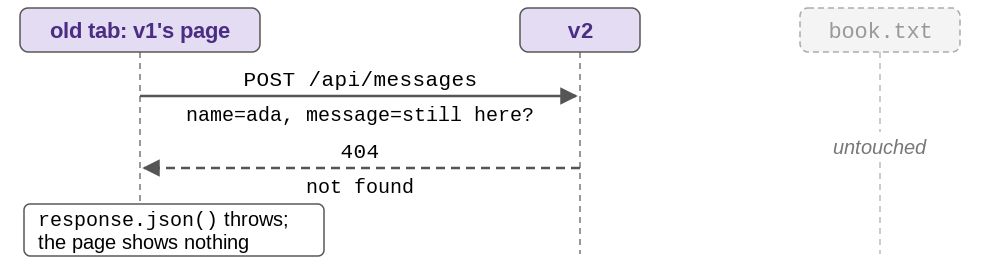
Old code and new code run at the same time
- v1 with v1's page works.
- v2 with v2's page works.
- When we upgrade, v1 and v2 will run at the same time
- broken!
The old page is a client
- The old page relies on v1's manual, as a caller on a specification
17* Four kinds of request reach the program:
18*   GET /               the page, index.html, as it is on disk
19*   GET /app.js         the page's program, app.js, as it is on disk
20*   GET /api/messages   the messages posted so far, as JSON
21*   POST /api/messages  adds the message the fields send, then the
22* messages posted so far, as JSON- The old page sends only these requests
- Which new manuals keep every promise the old page relies on?
A stronger specification breaks no client
Rule: a safe upgrade
An upgrade to a stronger specification is guaranteed not to break any clients.
- The old client constrains what the new implementation can do
Keeping v1's promises
- v2 drops v1's requests, so it is not stronger: the rule does not apply
- What if v2 answered its own requests and kept v1's, word for word?
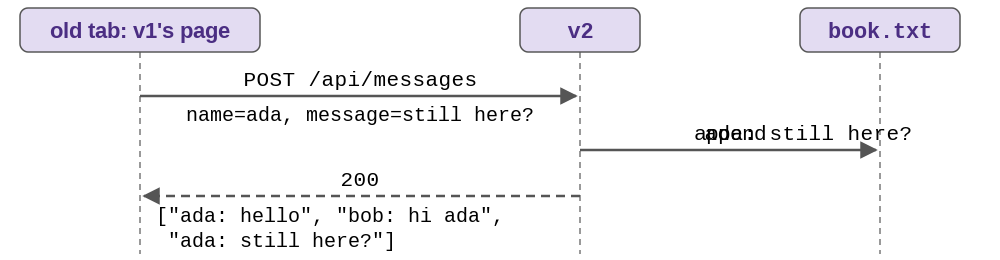
- On the old page's two requests, v2 now promises what v1 promised
- stronger or the same there: by the rule, safe for the old page
- as long as it relies only on them
What if v2 sent the old book newest first?
- One line changes in v2:
89send(exchange, 200, "application/json",
90 json(shared.messages().reversed()).getBytes(UTF_8));- Ada's tab still runs v1's page. She is about to post
still here? - She expects it at the bottom of the list, under bob's
hi ada
Half sheet, question 2
- v1's manual promises "the messages posted so far, as JSON"
- Call this v2 Reversed: it keeps that line, but sends them newest first
- The old page lists them in the order they arrive
- loaded from v1, it lists
ada: hello, thenbob: hi ada - then v1 stops, and Reversed starts in its place
- loaded from v1, it lists
- Is Reversed safe for the old page?What happens after ada posts "still here"?
The old page, newest first
- On the old page's requests, v1's promises: by the rule, safe
v1: ada is about to post
the new v2, same tab: ada clicks Post
- Her message lands on top, and bob's reply sits above what it answers
- No line of v1's manual promised that order
Hyrum's Law
With a sufficient number of users of an API, it does not matter what you promise in the contract: all observable behaviors of your system will be depended on by somebody.
- So the rule protects only the clients that rely only on the specification
- Write specifications that promise what clients rely on
- v1's manual should have said "oldest first"
Winters, "What Is Software Engineering?", Software Engineering at Google (2020)
Is v2 stronger than v1?
- No: at
GET /, v1 sent the page, and v2 sends a redirect - So the rule, read strictly, does not apply
- Safe for the old page all the same: it never sends
GET /again
Definition: requirement
A client's requirement is the part of a specification that the client relies on.
An upgrade is safe for a client that relies only on the old specificationif the new version's specification is stronger than that client's requirement.
Client, requirement, specification
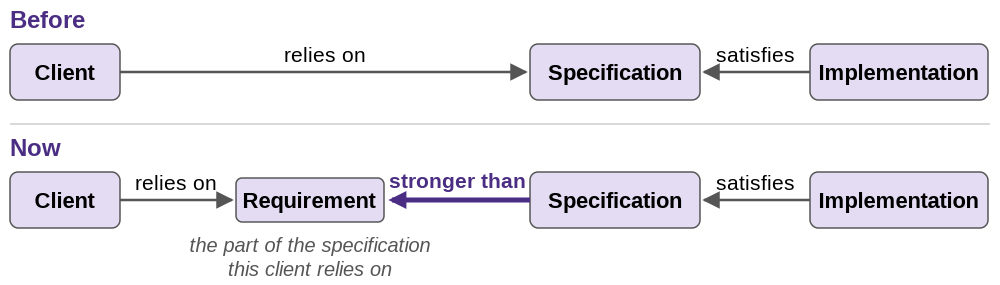
- Before: a client relies on the whole specification
- Now: the specification must be stronger than the client's requirement
What if we want to break a promise?
- Some day v2 should stop answering v1's requests
- and stop keeping
book.txtin v1's form
- and stop keeping
- Removing a promise is not stronger: the rule cannot help
- Some old tab may still rely on it
- How do we remove a promise without breaking a client?
Expand, move the clients, contract
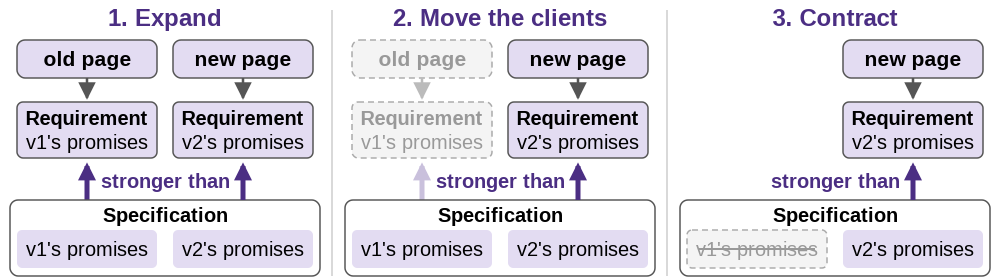
- Expand: add the new promises, and keep the old ones
- Move the clients: announce a date, deprecating the old ones
- Contract: remove the old promises, a weakening, safe only now
Sato, "ParallelChange", martinfowler.com (2014): expand, migrate, and contract
Stored data is a client from the past
- v2 never reads
book.txt, so no request brings back "ada: hello" - That breaks the promise, though
book.txtis still on disk - The file sends no requests, so the rule compares two readers:
- a precondition no stronger: accept every file v1 could have left
- a postcondition no weaker: give back the messages, as v1 did
- v2, keeping v1's requests, meets both, with one more line in
main:
59public static void main(String[] args) throws IOException {
60    books = new Books(Path.of("books"));
61    shared = new SharedBook(Path.of("book.txt"));
Migration
Definition: migration
Migration is converting stored data from the old version's form to the new version's.
- v2 signs each message with a login the visitor cannot choose
- A line of
book.txtis signed with a name typed into a field - So
ada: hellocannot simply move into ada@example.com's book
Whose book gets v1's messages?
- No program can turn "ada" into a login, since v1 never learned one
- So it is a decision
- Each choice changes a specification or breaks a promise:
- one shared book that nobody posts to: v2's specification changes
- ada@example.com's book: anyone could have typed ada
- so it breaks v2's promise
- no book: leave
book.txtunread, and break the promise
- The people who run the guestbook make that choice
- v2's specification has to say which they made
Who reads the server's words?
- v2's page puts
v2after/api/in every request - So the last v2 answers any other path under
/api/with 410, Gone:
80if (path.startsWith("/api/") && !path.startsWith("/api/v2/")) {
81    send(exchange, 410, "text/plain",
82 "this page is out of date; reload it".getBytes(UTF_8));- On v1's page, nobody: its
postthrows, as on v2's 404 - So the code that shows the server's error, like the version,
- has to be in a page from its first release
Two practices
- Upgrade to a stronger specification
- it breaks no client that relies only on the old one
- remove a promise only once no client relies on it
- Version every request and file, from the first release
- and show the server's error on every page
- Semantic versioning: MAJOR not stronger, MINOR stronger
Preston-Werner, Semantic Versioning 2.0.0 (2013)
Coming up
- Tuesday: section on generics, with a project proposal workshop
- project proposal due, 11:59pm
- Wednesday to Friday: no class (Thanksgiving)
- Monday, November 30: deploying, operating, and maintaining apps
- Hand in your half sheet at the door