Lecture 11: More Paxos — Notes
These are notes from the lecture on April 22, 2026. See also the whiteboard descriptions and the whiteboard PDF.
These materials were drafted by AI based on the live whiteboard PDF and audio transcript from the corresponding lecture and then reviewed and edited by course staff. They may contain errors. Please let us know if you spot any.
Recap: Single-Decree Paxos
Single-decree Paxos is a multi-round, two-phase-per-round protocol for making one consensus decision. There are proposers (who propose values), acceptors (who vote), and learners (who count votes and learn the outcome). Each attempt is tagged with a round number (also called a ballot number), pre-allocated so no two proposers ever use the same one.
The messages have two sets of names: the compact form and the descriptive form.
| Compact | Descriptive | Direction |
|---|---|---|
1a(r) |
prepare | proposer → acceptors |
1b(r, summary) |
prepare response or promise | acceptor → proposer |
2a(r, v) |
accept | proposer → acceptors |
2b(r, v) |
accept response | acceptor → learner |
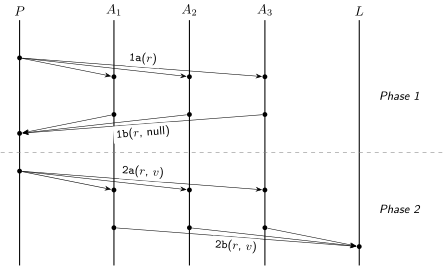
In phase 1 the proposer broadcasts a prepare and collects summaries of what acceptors have
already done. In phase 2 the proposer picks a value (constrained by those summaries) and
broadcasts an accept; acceptors that can do so send accept responses to the learner. A value
is chosen when a majority of acceptors have sent 2b(r, v) for the same r and v.
A typical happy-path run looks like this:
The Non-Null Summary
Last lecture only handled the easy case: a proposer starts a brand-new round with no prior activity, all summaries are null, and it can propose any value it wants.
Now consider the case where an acceptor has already voted in an earlier round. "Voted"
means it sent a 2b message.
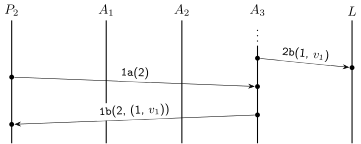
Suppose A_3 previously sent 2b(1, v_1). Then when A_3 gets a 1a(2)
prepare from proposer P_2, it cannot respond with a null summary, since that
would mean it was claiming to have never voted in lower rounds. Instead it
reports its highest prior vote: the round number and value from the
highest-numbered round smaller than the current round in which it voted.
So the summary is either:
- null — "I have never voted in any round smaller than
r." - (r', v') — "The highest round smaller than
rin which I voted wasr', and I voted forv'."
With this in hand, the complete proposer rule for phase 2 is:
- Wait for a majority of
1bresponses. - If all summaries are null, propose any value.
- Otherwise, propose the value
v'from the summary with the highest round numberr'.
One subtlety: can two summaries ever report the same round number with different values? No. Each round number is pre-allocated to exactly one proposer, and that proposer will only ever send one value in phase 2 of that round. So there is no ambiguity when picking the highest round.
Why the Proposer Is Constrained
The proposer is not trying to win an argument. It just needs the system to reach some decision. The algorithm constrains which value it may propose precisely so that it cannot accidentally contradict an earlier decision.
In real-world voting you vote for the candidate you prefer. In Paxos, as was put in lecture,
"you vote for the one you have to." If the algorithm says propose v_1, the proposer
proposes v_1 — it does not matter whether the proposer "wanted" that value.
Two Scenarios
Both scenarios share the same starting state as above: A_3 has already voted for
v_1 in round 1. P_2 then starts round 2 by sending 1a(2) to all acceptors. Each
acceptor replies with 1b(2, ...), but the outcome of phase 2 depends on which replies
P_2 sees first.
Scenario A: the null majority arrives first
A_1 and A_2's 1b(2, null) replies arrive at P_2 before A_3's. P_2 now has a
majority in hand, and every summary in that majority is null, so the algorithm permits
P_2 to propose any value. Below, P_2 opts to propose a fresh value v_2.
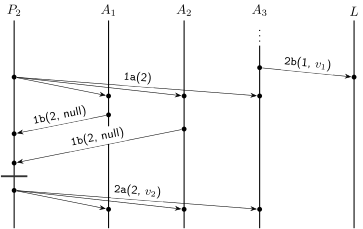
In this scenario, P_2 receives a majority of 1b messages where all the
summaries are null. So P_2 is free to propose any value.
It may seem surprising that A_3 already voted for v_1 in round 1 and yet
P_2 is allowed to propose a different value in a later round. Could round 1
still complete and choose v_1? No. To choose v_1 in round 1, there would
need to be a majority of acceptors with 2b(1, v_1). That requires at least
two out of three. A_3 has one vote; A_1 and A_2 would need to vote too.
But both A_1 and A_2 just sent 1b(2, null), which means two things
simultaneously:
- They never voted in round 1 in the past (null summary).
- They promise never to vote in any round smaller than 2 in the future.
So 2b(1, v_1) from A_2 cannot have happened in the past (because they sent a
null summary indicating htey never voted) and will not happen in the future
(since they promised not to). So there will never be a majority of acceptors who
vote in round 1. The remaining acceptors who could still act in round 1 are in
the minority, so round 1 can never choose anything. It is safe for P_2 to
propose freely.
Scenario B: the non-null summary arrives first
Same setup, but now A_3's reply arrives before A_2's. P_2's phase 1 majority consists
of 1b(2, null) from A_1 and 1b(2, (1, v_1)) from A_3. There is a non-null summary.
The algorithm says: take the highest round number among all non-null summaries (just round 1
here) and propose that value. So P_2 must propose v_1.
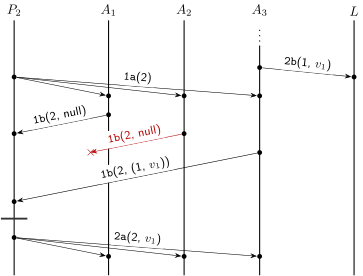
From a global vantage point one could verify that it would actually be safe to
propose any value in this scenario too, for the same reasons as scenario A.
(A_1 and A_2 both sent 1b messages with null summaries.) But P_2 cannot
see the whole picture. It only sees its majority of 1b messages. The rule is
conservative: if any non-null summary shows up, follow it.
Failure Scenario: Dropped 2b Messages
Suppose round 1 goes perfectly: P_1 collects a majority of 1b(1, null), sends
2a(1, v_1), and all three acceptors reply with 2b(1, v_1). But all three 2b messages
get dropped before reaching the learner. The learner never learns anything.
Is v_1 still chosen? Yes. A value is chosen the moment a majority of acceptors send the
2b messages. The learner not receiving them does not undo that fact.
Single-decree Paxos as described in Lamport's paper has no dedicated retransmission
mechanism. Recovery from dropped messages works by starting a fresh round. Any proposer
that notices the system has been quiet can start round 2. When it does, the 1b responses
will contain non-null summaries (since the acceptors voted in round 1), and the algorithm
will constrain the proposer to propose v_1 again. The learner then gets 2b(2, v_1)
messages, collects a majority, and learns the outcome.
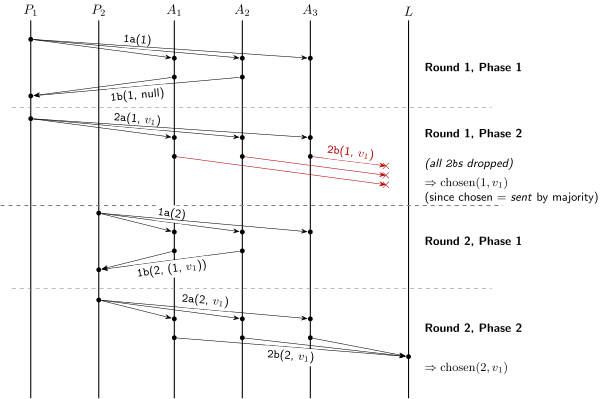
The same value gets chosen a second time. That is fine: the correctness guarantee is that no different value ever gets chosen, not that the same value can only be chosen once. In practice you add retransmission as a performance optimization, and the learner signals everyone to stop once it has a result. But the algorithm is correct without those additions.
The Votes Table
A useful visualization for understanding Paxos: draw a table with acceptors as columns and rounds as rows. Each cell records what that acceptor did in that round:
- ✓ (check) — the acceptor voted (sent
2b) in that round. - ✗ (X) — the acceptor promised not to vote in that round (sent
1bin a higher round, locking out this one). An X is not a "no vote" — there is no such thing as voting no in Paxos. X means "will never vote here." - empty — neither voted nor promised not to vote (the default).
A value is chosen exactly when some row has a majority of check marks.
Here is the table for the two-round scenario where round 1 got a minority vote and round 2 completes:
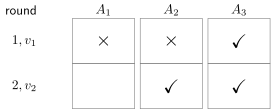
The X entries are what enforce safety. When P_2 collects a majority of 1b(2, ...) from
A_1 and A_2, those two acceptors each get an X in row 1. Now row 1 has a majority of
Xs, which means it can never accumulate a majority of check marks. Round 1 is dead.
The table also makes clear that the same acceptor can vote in multiple rows with different values. That is not a contradiction. It only becomes a problem if two different rows each have a majority of check marks, which the algorithm prevents.
Why Any Two Majorities Overlap
The key mathematical fact underlying all of this: any two majorities of the same set of acceptors share at least one element.
If you have n acceptors and two subsets each of size greater than n/2, they cannot be
disjoint (they would need more than n elements total). So they share at least one acceptor.
This is why the 1b mechanism works. When P_2 collects a majority of prepare responses,
that majority is guaranteed to overlap with any previous majority that voted in phase 2.
The overlapping acceptor reports its vote in its summary, and the algorithm is constrained
to carry that value forward.
Three-Round Scenario
One more scenario. Suppose A_3 voted for v_1 in round 1, and A_2 voted for v_2 in
round 2. Both of these are 2b votes. What values can be proposed in round 3?
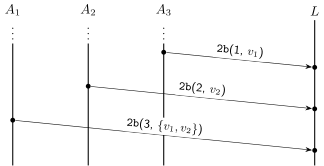
The answer depends on which acceptors respond to the phase 1 prepare for round 3. With only
three acceptors, a majority is two. Every pair of two acceptors includes at least one of
A_2 or A_3, both of whom have prior votes. There is no pair of acceptors who have both
never voted. So P_3 cannot get a null-only majority. It will always see at least one
non-null summary, and it must propose whichever of v_1 or v_2 comes from the highest
round number among the summaries it receives.
With five acceptors the situation is different: two acceptors could vote in round 1 and round 2 respectively, leaving three who have never voted. A later proposer could collect three null summaries and propose freely. So the interaction between the number of acceptors and the number of rounds matters.
What's Next
Next lecture will introduce MultiPaxos, which strings single-decree instances together to fill slots in a replicated log.