1 Overview
We’ve now seen why SAT solvers are useful and how to use them. In today’s lecture, we’ll talk about how they actually work.
2 Improving brute force
To review, the problem is: Given a CNF with n variables, how can you determine whether or not it is satisfiable? The most simple algorithm is to just try every assignment of variables, but there are 2^n assignments to check. For unsatisfiable formulas, this algorithm will always take exponential time!
One way to visualize this brute force algorithm is with a binary tree. Arbitrarily order the variables x_1, x_2, \dots, x_n. Starting at the top of the tree, we decide whether x_1 is true or false, then move on to x_2, and so on until we’ve decided every variable. Once we have picked all the variables, we plug them in to the formula and check if we guessed the right values. If not, we try some new guesses.
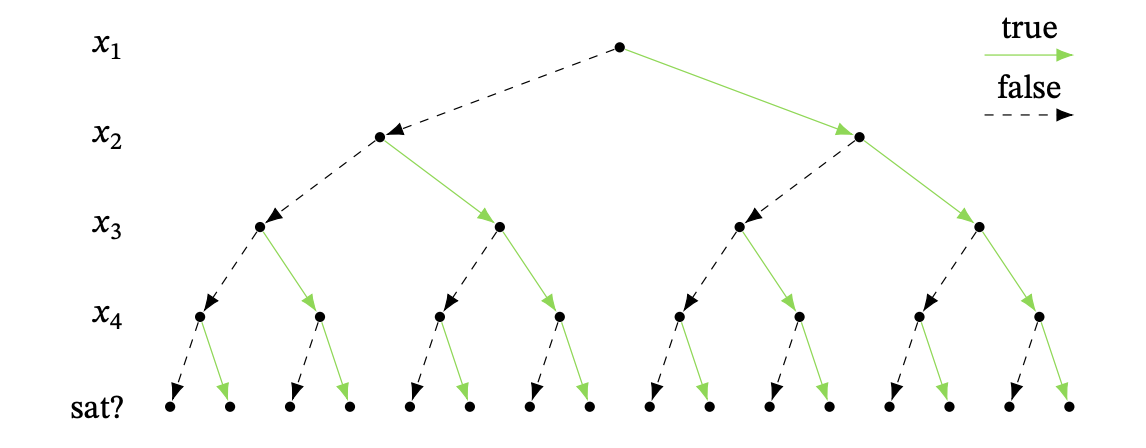
It is kind of like DFS. Once we get to a leaf, we backtrack and follow the next branch that we have not visited yet.
This view of the tree search algorithm immediately suggests a natural way to make it faster. Instead of waiting until all variables have been decided to check whether or not the assignment works, check every time you make an assignment. If you can say that a partial assignment already doesn’t work, you have eliminated an entire subtree!
Suppose our CNF has the clauses:
(x_1 \lor x_2) \qquad (\lnot x_2) \qquad (x_2 \lor x_3)
(x_2 \lor \lnot x_3 \lor x_4) \qquad (\lnot x_3 \lor \lnot x_4)
Suppose that by default, we pick false before true. That means we start by assigning x_1 false and x_2 false. This already contradicts the first clause!
Next, we try setting x_2 true. This contradicts \lnot x_2. So we go back up, having exhausted all options for x_2, and set x_1 true. By default, we first try x_2 false and x_3 false. That contradicts (x_2 \lor x_3), and we continue. In the end, we find that the the formula is unsatisfiable, and we did not have to check any of the assignments in gray below!
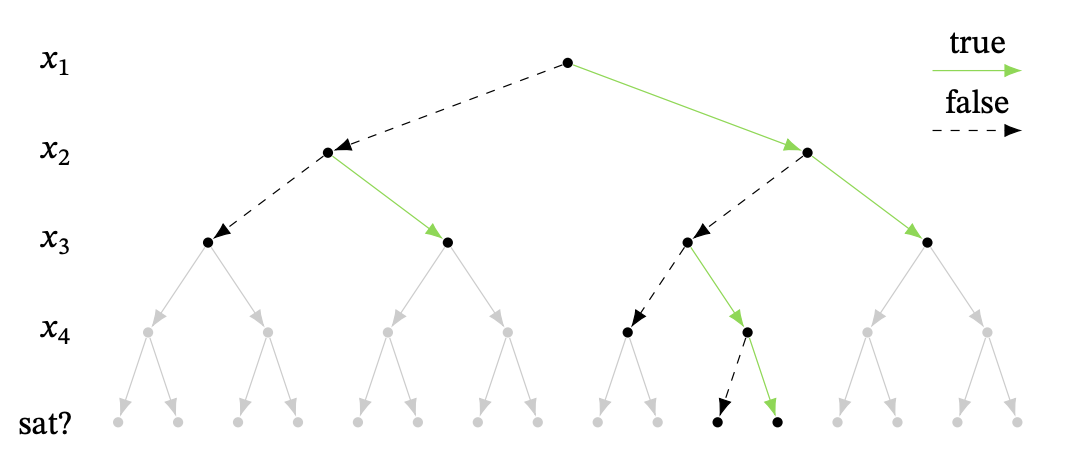
Formally, our algorithm so far is the following:
- Let U = \emptyset be the set of assignments.
- Traverse the tree as follows:
- If U makes any of the clauses
in \Delta false, and there is
still an unexplored branch, revert U to the latest decision for which we
have not yet explored both the true and false branches.
Recursively traverse the subtree from the unexplored branch. If
there are no unexplored branches, return
unsatisfiable
. - If U is consistent with every
clause individually, and there is an unset variable, pick one, set
it to true/false, and add it to U. Recursively traverse the subtree
from this branch. If all variables are already set, return
satisfiable
with U as the satisfying assignment.
Note that although our example used a fixed variable order x_1, \dots, x_n, it would be equally sound algorithm to change the order in each branch. Thus, the formal description above allows you to change the variable order, which will be the case in all of the algorithms for SAT solving that we discuss.
3 What else can be improved?
This was one example of a small improvement that we can make over a brute-force algorithm. In the lecture on Monday, we’ll see a few more small improvements that make a big difference in the real-world running time of this algorithm (though, of course, still worst-case exponential time). Finding the best heuristics to make SAT solvers as efficient as possible remains an open and exciting area of research.