Apps with users
CSE 331: Software Design and Implementation, Autumn 2026
Your job is to deliver code that you know works.
TODO
- Section tomorrow: web app debugging
- Reading 4: due Friday, November 20, 11:59pm
- Project proposal: due Tuesday, November 24, 11:59pm
- More info forthcoming!
Midterm debrief
- A few exams are still being settled
- Median 77%, mean 76%
- Half the class scored between 69% and 85%
- Grades go up on Gradescope once the last exams are in
- If your final is higher, it replaces your midterm
One book for everyone
- Our guestbook with JavaScript in its page keeps one book
- Ada posts
hello; bob opens the page and sees the same message - Every page asks
GET /api/messages, and gets the same answer - The book is shared: anyone can leave a message, and anyone can see it
One book per user
- Each user has a book at an address of their own:
/ada@example.com - Any user who has signed in may read any book and sign it
- The signature is their login, not a name they type
- Only a book's owner may delete a message from it
Where does the program say one?
- List all places where the program assumes there is one guestbook
- The field
book, and its comment:Guestbookkeeps oneBook - The path
/api/messages: nothing in the path says which book - The page's one list: nothing on the page says whose book it is
- The tests: the post names no book, and the read expects the one
Half sheet, question 1 (3 minutes)
Bookis an ADT: a change to how its data is kept can stay inside it- Why is the change from one book to many not contained by the
BookADT?
Why the change reaches everything
- That should be a surprise: an ADT can keep a change inside it
115/** The messages posted so far, oldest first. */
116class Book {
117 private List<String> messages = new ArrayList<String>();Book's representation is its one field,messages- That list says nothing about how many books there are
- Neither does the specification: we could just have more than one
Book
The whole list is on the clients' side
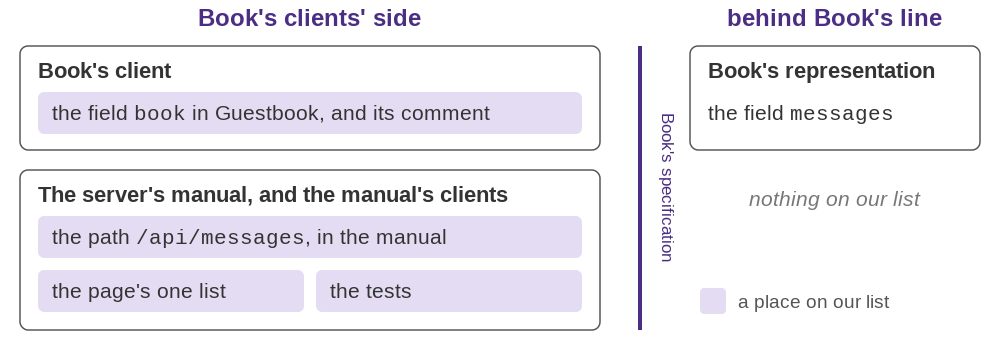
Book's client:Guestbookmade oneBook- The manual promises "the messages posted so far": one sequence
A change to the abstract state
- The server's abstract state changes, to a book for each user
- Data abstraction keeps a client from depending on the representation
- not on the abstract state: the client is meant to depend on that
- Reading 3: hide each decision likely to change inside a module
- No module hides "one book": the manual promises it
- So the redesign writes the new abstract state first
A book for each user
- Something has to keep the books, and each book has to say whose it is
- So two ADTs where there was one:
Books, new, andBook, changed
270/**
271 * @return the book of the user whose login is owner, or an empty
272 *     Optional if that user has no book
273 */
274public Optional<Book> bookOf(String owner) {bookOflooks up a book by its owner's login: there may be none
Book knows its owner
279/** An owner, and the messages posted so far, oldest first. */
280class Book {297public void add(User asker, String message) {- A book is now an owner and a sequence of signed messages
User: a user who has signed in, named by their loginaddsigns the message with the login ofasker, the user posting- The earlier
addsigned with whatever name it was handed
The rest follows
25*   GET /api/books/OWNER/messages
26*                       OWNER's messages, as JSON
27*   POST /api/books/OWNER/messages
28*                       signs OWNER's book with the message the
29* fields send, then OWNER's messages, as JSON- The field holds one
Books, where the earlier guestbook kept oneBook - The book is in the path now:
OWNERstands for a login - The page reads its owner from its own address,
/ada@example.com
Testing: which book is now an input
- Bob signs ada's book
hi ada, then opens his own:
bob, at /ada@example.com
bob, at /bob@example.com
- Which book is now an input to every test: a test has to choose it
Which book, and who says?
- The book: any user may read and sign any book, so the client chooses
- The user who sent it: the earlier guestbook took it from the Name box
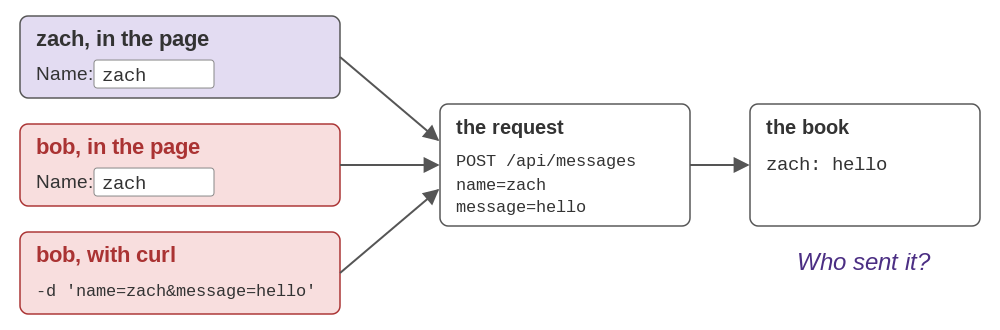
- Anyone can send those fields, but nobody may choose who they are
Authentication
Definition: authentication
Authentication is establishing who sent a request.
- "Establishing": evidence that the sender could not have made up
- The earlier guestbook was told "zach": it took a field's word for it
- "Who" is a user, named by a login such as
ada@example.com - Testing: who is asking is now an input, and one user is not enough
Who is asking?
handleneeds to know who sent every request, and asksUser.from
223public static Optional<User> from(HttpExchange exchange) {- It returns the user who sent the request, or an empty
Optional - No method but
fromreads the header: procedural abstraction - So how
fromfinds out can change, from a header to a cookie, say
Checking passwords yourself
- The basic flow:
- store a slow one-way function of each password, with a salt
- sign in through a form, over HTTPS
- start a session: a long random number, in a cookie
- expire sessions, limit guesses, offer a way back in, ...
- This is hard to get right! So hand the job to someone else:
- an identity provider, or a web framework's session code
Sidebar: Tailscale
- One neat way to be handed who is asking, with no password code
- Tailscale connects devices into a private network, a tailnet
- on sign-in, "an identity provider authenticates the user"
tailscale serve 9331gives the guestbook an address in the tailnet- To each request, Serve adds a header,
Tailscale-User-Login- filled with the requester's login name
- On the slides,
curl -Hsends that header itself, in Serve's place
Who may do what?
- One shared book had no owner: every visitor could do everything
- The third rule: only a book's owner may delete a message from it
Definition: authorization
Authorization is deciding what the user who sent a request may do.
- Authorization comes after authentication, and relies on it
- The rules are the program's own
Client-side authorization checks
36const item = document.createElement("li");
37item.textContent = messages[i] + " ";
38if (me === owner) {
39  const button = document.createElement("button");
40  button.textContent = "Delete";
41  button.onclick = () => remove(i);
42  item.appendChild(button);
43}me: the login the server sent back for/api/meowner: the login in the page's own address- A Delete button only when
meholds the login of the book's owner
In the browser, with both users
- Suppose the page decides alone. The server's
deletetakes no asker:
305public void delete(int index) {
306    messages.remove(index);
307}
ada posts two messages
bob opens ada's book, and posts
Half sheet, question 2 (3 minutes)
- The page draws a Delete button only when
meholds the owner's login - The server's
deletetakes no asker: it deletes for whoever calls it - The page shows bob no Delete button. How can bob still delete ada's message?
Bob, at the console, on ada's book
> me
"bob@example.com"
> me = "ada@example.com"
"ada@example.com"
> show()
undefined
showdraws a Delete button beside each of the three messages- Bob clicks the first: status 200, and ada's
hellois gone - The check ran in bob's browser, on a variable bob can assign
The fix: decide on the server
- Started fresh: ada posts
hello, and bob signs ada's bookhi ada
- 403: the server understood the request, and refuses it
Where does the check live?
- In the handler, we would read every handler that reaches a
Book - Inside
Book.delete, we read onlyBook:
308public void delete(User asker, int index)
309        throws NotOwnerException {
310    if (!asker.equals(owner)) {
311        throw new NotOwnerException(
312            asker.login() + " does not own this book");
313    }
314    messages.remove(index);
315}
Only Book to read
- With the comparison here, the code to read is
Book. Two facts: deletecannot be called without an asker: a call has to pass one- No other method removes a message:
messagesis private: inBook, one line adds, one line removes- and
messages()hands out a copy
- So every delete passes through the comparison
- A handler written next year cannot delete without going through it
Is it right?
124try {
125    book.delete(owner, index);
126} catch (NotOwnerException e) {308public void delete(String asker, int index)
309 throws NotOwnerException {
310 if (!asker.equals(owner)) {
311 throw new NotOwnerException(
312 asker + " does not own this book");
313 }
314 messages.remove(index);- Here
askerandownerare both aString. Is the call right?
javac accepts it, and bob deletes
javacaccepts it, and prints nothing
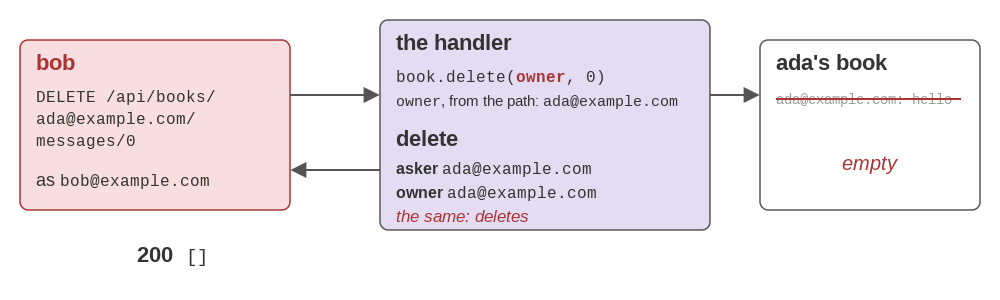
- The handler passed
ownerwhereaskerbelongs - So
deletecompared the owner with the owner: anyone deletes
User, a type of its own
209class User {
210    private final String login;
211    // RI: login is not null, and not empty.
212    // AF(this) = the user whose login is login.
213
214    private User(String login) {
215        this.login = login;
216 }- The constructor is
private: onlyfrom, on a request, makes aUser addanddeletetake aUser. The owner in the path stays aString
The same mistake, in the finished program
125 book.delete(owner, index);$ javac Guestbook.java Guestbook.java:125: error: incompatible types: String cannot be converted to User book.delete(owner, index); ^ ⋮ 1 error
- We turned a coding mistake into a compile-time error.
- More on this on Wednesday, with design patterns!
The same change, in other forms
- A book for each user is today's case of "one becoming many"
- The same change comes in other forms:
- a single-tenant app goes multi-tenant
- a to-do app that kept one list lets each user keep several
- an app for one device per user works on phone and laptop
- an app for one currency, language, or time zone adds a second
- In each, a program written for one of something has to serve many
The ones that are left
- The finished program still assumes one of several things. Find some.
- One owner for each book:
Bookkeeps its owner in one field - One signature on each message: a message is one
String - One book for each user:
opengives one only to a user who has none - One server: a second copy, on a second machine, keeps its own books
- None of these is a bug: the rules asked for none of them to be many
One versus many
- Notice the ones: most were never decided, only assumed
- Write them down: a one a specification states, the next person finds
- Know how to make one into many, later, if it is needed:
- find every place; sort by the ADT's line; write the abstract state first
- let the rest follow; then ask what many brings
- Reasoning: the ADT's line said where the change had to go
- Tools:
Userturned a coding mistake into a compile-time error - Testing: two books, two users, and requests the page never sends
Coming up
- Tuesday: section on web app debugging
- Wednesday and Friday: design patterns
- Friday: Reading 4 due, 11:59pm
- Next Monday: Reading 4 discussion, and upgrading apps
- Next Tuesday: project proposal due, 11:59pm
- Hand in your half sheet at the door