CSE 312 – Section 2 Solutions
Spring 2026
Review of Main Concepts (Counting)
- Binomial Theorem: \(\forall x,y \in \bR , \forall n \in \bbN \): \((x+y)^n=\sum _{k=0}^n \binom {n}{k} x^k y^{n-k}\)
- Principle of Inclusion-Exclusion (PIE): 2 events: \(|A\cup B|=\) \(|A|+|B|-|A\cap B|\)
3 events: \(|A \cup B \cup C|=\) \(|A|+|B|+|C|-|A \cap B|-|A \cap C|-|B \cap C|+|A \cap B \cap C|\)
In general: +singles - doubles + triples - quads + … - Pigeonhole Principle: If there are \(n\) pigeons with \(k\) holes and \(n>k\), then at least one hole contains at least \(2\) (or to be precise, \(\ceil {\frac {n}{k}}\)) pigeons.
- Complementary Counting (Complementing): If asked to find the number of ways to do \(X\), you can: (1) find the total number of ways to do everything and then (2) subtract the number of ways to not do \(X\).
- Stars and Bars The number of ways to distribute n indistinguishable balls into k distinguishable bins is \(\binom {n+k-1}{k-1}=\binom {n+k-1}{n}\).
- Sample Space: The set of all possible outcomes of an experiment, typically denoted \(\Omega \).
- Event: Some subset of the sample space, usually denoted by a capital letter such as \(E \subseteq \Omega \)
- Union: The union of two events \(E\) and \(F\) is denoted \(E\cup F\)
- Intersection: The intersection of two events \(E\) and \(F\) is denoted \(E \cap F\) or \(EF\)
- Mutually Exclusive: Events \(E\) and \(F\) are mutually exclusive iff \(E \cap F=\emptyset \)
- Complement: The complement of an event \(E\) is denoted \(E^C\) or \(\overline {E}\) or \(\neg E\), and is equal to \(\Omega \setminus E\)
- DeMorgan’s Laws: \((E\cup F)^C=E^C \cap F^C\) and \((E \cap F)^C=E^C \cup F^C\)
-
Probability of an event \(E\) denoted \(\Prob {E}\) or \(\Pr (E)\) or \(P(E)\)
Axioms of Probability and their Consequences
- a)
- (Non-negativity) For any event \(E\), \(\Prob {E} \geq \) \(0\)
- b)
- (Normalization) \(\Prob {\Omega }=\) \(1\)
- c)
- (Additivity) If \(E\) and \(F\) are mutually exclusive, then \(\Prob {E\cup F}=\) \(\Prob {E}+\Prob {F}\)
-
Corollaries of these axioms:
- \(\Prob {E}+\Prob {E^C}=\) 1
- If \(E \subseteq F\), \(\Prob {E}\) \(\le \) \(\Prob {F}\)
- \(\Prob {E\cup F}=\) \(\Prob {E}+\Prob {F}-\Prob {E \cap F}\)
-
Equally Likely Outcomes: If every outcome in a finite sample space \(\Omega \) is equally likely, and \(E\) is an event, then \(\Prob {E}=\)\(\dfrac {|E|}{|\Omega |}\).
- Make sure to be consistent when counting \(|E|\) and \(|\Omega |\). Either order matters in both, or order doesn’t matter in both.
Section Plan
Administrivia
- Pset 2 is out and due next Wednesday (April 15). Submit on Gradescope.
- Homework: Use of LaTeX highly encouraged. See website for more information on formatting your solutions to problem sets.
- Read syllabus for late day policy.
Questions about material covered so far?
Problems to be covered in section
- problem 1 (d)(e)(f)(g)
- part (b) of problem 2, similar to problem 2 in Pset2
- problem 4
- problem 10 or 11
- Time permitting, problem 8
Be sure to check out all the remaining problems before you do your homework.
1 Content Review
- a)
- True or False. For any sets \(A\) and \(B\), the following statement is always
true: \(|A \cup B| = |A| + |B|\)
False. In general, if \(A\) and \(B\) are not disjoint, elements in \(A \cap B\) are counted twice in \(|A| + |B|\). By the Principle of Inclusion-Exclusion,

Therefore, the given equality holds only when \(A\) and \(B\) are disjoint.
- b)
- If there are 7 pigeons that each go into one of 3 holes:
- There is at least one hole with exactly 3 pigeons in it.
- There is at least one hole with at least 3 pigeons in it.
- There is exactly one hole with at least 3 pigeons in it.
(b). By the Pigeonhole Principle, there will be at least one hole with at least \(\lceil \frac {7}{3} \rceil = 3\) pigeons in it.
- c)
- \((x+y)^n=\)
- \(\sum _{k=0}^n \binom {n}{k} x^k y^{n-k}\)
- \(\sum _{k=0}^n x^k y^{n-k}\)
- \(\sum _{k=0}^n \binom {n}{k} x^{k}\)
(a). This is the definition of the Binomial Theorem.
- d)
- An event and sample space are, respectively:
- The total set of possible outcomes; A subset of the event space
- A subset of the sample space; The total set of possible outcomes
- Some set of outcomes; Any other set of outcomes.
(b). By definition, the sample space (\(\Omega \)) encompasses all possible outcomes, and an event (\(E\)) is always a subset of the sample space (\(E \subseteq \Omega \)).
- e)
- True or False. It is always true that \(\mathbb {P}(E) = \frac {|E|}{|\Omega |}\).
False. This formula only holds if all outcomes in the sample space \(\Omega \) are equally likely.
- f)
- If \(A\) is the event that I eat an apple today,
- \(\overline {A}\) is the event that I eat a banana today, and \(P(A) + P(\overline {A}) = 0.5\)
- \(\overline {A}\) is the event that I do not eat an apple today, and \(P(A) + P(\overline {A}) = 0\)
- \(\overline {A}\) is the event that I do not eat an apple today, and \(P(A) + P(\overline {A}) = 1\)
(c). \(\overline {A}\) is the complement of event A (the event that A does not happen). Because the sample space probabilities must normalize to 1, the probability of an event plus its complement is always exactly 1.
- g)
- True or False. For any two events \(A\) and \(B\), \(P(A\cup B) > P(A) + P(B)\).
False. The correct inequality is \(P(A\cup B) \leq P(A) + P(B)\). By the property of inclusion-exclusion for probability, \(P(A\cup B) = P(A) + P(B) - P(A\cap B)\). Because probabilities must be non-negative, subtracting \(P(A\cap B)\) means the union can never be strictly greater than the sum of the individual probabilities.
2 Thinking Combinatorially (8 points)
We saw in Lecture 3 that combinatorial proofs can be more elegant than algebraic proofs and also provide insights into an equation that goes beyond algebra.
Our goal in this problem is to develop the skill and intuition for such proofs. To this end, prove each of the following identities using a combinatorial argument
- a)
- Give a combinatorial proof of the following identity: \[n \binom {n-1}{r-1} = \binom {n}{r} r.\] Hint: Consider
two ways to choose a team of size r out of a set of size n and a captain
of the team (who is also one of the team members).
Scenario: We want to count the number of ways to form a team of size \(r\) from a pool of \(n\) people, and designate exactly one of those \(r\) team members as the captain.
-
Left Hand Side (\(n \binom {n-1}{r-1}\)):
- Step 1: Choose the captain first from the total pool of \(n\) people (\(n\) choices).
- Step 2: Choose the remaining \(r-1\) team members from the remaining \(n-1\) people (\(\binom {n-1}{r-1}\) choices).
By the Product Rule, this gives \(n \binom {n-1}{r-1}\) ways.
-
Right Hand Side (\(\binom {n}{r} r\)):
- Step 1: Choose the entire team of \(r\) people from the pool of \(n\) people (\(\binom {n}{r}\) choices).
- Step 2: Choose the captain from within the \(r\) selected team members (\(r\) choices).
By the Product Rule, this gives \(\binom {n}{r} r\) ways.
Conclusion: Since both sides count the exact same scenario, they must be mathematically equal.
-
- b)
- Give a combinatorial proof of \[\binom {a+b}{a}=\displaystyle \sum _{i=0}^a{\binom {a}{i}\binom {b}{i}} \;.\] (Note that \(\binom {a}{b}\) is 0 if \(b > a\).)
Scenario: We want to count the number of ways to choose a team of \(a\) people from a larger pool consisting of \(a\) right-handed people and \(b\) left-handed people (for a total of \(a+b\) people).
- Left Hand Side \(\binom {a+b}{a}\): Choose the team of \(a\) people directly from the entire pool of \(a+b\) people. There are \(\binom {a+b}{a}\) ways to do this.
-
Right Hand Side \(\sum _{i=0}^a{\binom {a}{i}\binom {b}{i}}\): We partition the team selection based on the number of left-handed people on the team, which we will call \(i\). The value of \(i\) can range from \(0\) to \(a\).
- Step 1: Choose \(i\) left-handed people from the pool of \(b\) left-handed people (\(\binom {b}{i}\) ways).
- Step 2: To complete the team of \(a\) people, we must choose \(a-i\) right-handed people from the pool of \(a\) right-handed people (\(\binom {a}{a-i}\) ways). Since choosing \(a-i\) people to be on the team is identical to choosing \(i\) people to exclude from the team, \(\binom {a}{a-i} = \binom {a}{i}\).
Applying the Product Rule, for a specific \(i\), there are \(\binom {a}{i}\binom {b}{i}\) ways to form the team. By the Sum Rule, we sum across all possible values of \(i\) to get \(\sum _{i=0}^a{\binom {a}{i}\binom {b}{i}}\).
Conclusion: Since both sides count the exact same scenario, they are equal.
3 GREED INNIT
Find the number of ways to rearrange the word “INGREDIENT”, such that no two identical letters are adjacent to each other. For example, “INGREEDINT” is invalid because the two E’s are adjacent.
We use the Principle of Inclusion-Exclusion (PIE) and Complementary Counting.
- Let \(\Omega \) be the set of all permutations of “INGREDIENT”. \(|\Omega | = \frac {10!}{2!2!2!}\) (multinomial coefficient, accounting for the indistinguishable 2 I’s, 2 E’s, and 2 N’s).
- Let \(A_I\) be the set of anagrams with two consecutive I’s.
- Let \(A_E\) be the set of anagrams with two consecutive E’s.
- Let \(A_N\) be the set of anagrams with two consecutive N’s.
We want the size of the complement: \(|\Omega \setminus (A_I \cup A_E \cup A_N)| = |\Omega | - |A_I \cup A_E \cup A_N|\).
By PIE: \(|A_I \cup A_E \cup A_N| = |A_I| + |A_E| + |A_N| - (|A_I \cap A_E| + |A_I \cap A_N| + |A_E \cap A_N|) + |A_I \cap A_E \cap A_N|\).
- Singles: \(|A_I| = \frac {9!}{2!2!}\) (treating the two adjacent I’s as a single unit, leaving 9 units to arrange). By symmetry, \(|A_E|\) and \(|A_N|\) are the same size.
- Doubles: \(|A_I \cap A_E| = \frac {8!}{2!}\) (treating the I’s as one unit and the E’s as one unit). All 3 intersections are the same size.
- Triples: \(|A_I \cap A_E \cap A_N| = 7!\) (treating all three pairs as single units).
Putting this together: \(\frac {10!}{2!2!2!}-\left (\binom {3}{1} \cdot \frac {9!}{2!2!} - \binom {3}{2} \cdot \frac {8!}{2!} + \binom {3}{3} \cdot 7! \right )\)
We must place 5 A’s among the 3 B’s such that no A’s are adjacent. Let’s place the B’s down to create "slots" for the A’s: \(\_ \text { B } \_ \text { B } \_ \text { B } \_\) But this means we must place 5 A’s into 4 slots such that no slot contains two A’s. By an application of the Pigeonhole principle (PHP), this is impossible. To wit:
- Pigeons: The 5 A’s.
- Holes: The 4 available slots around the B’s.
Since there are 5 pigeons and only 4 holes, by the PHP at least one hole must contain at least \(\lceil 5/4 \rceil = 2\) A’s. Therefore, at least two A’s would have to be adjacent.
Thus there are 0 ways to arrange the letters without adjacent A’s or B’s.
4 Pigeonhole Practice
For each of the following properties a group of people might possess, either give the minimum number of people that must be in a group to ensure that the property holds, or else indicate that the property need not hold even for arbitrarily large groups of people. In either case, justify your answer.
- (i)
- (2 points) At least 2 people were born on the same day of the year
(ignore year of birth).
We use the Pigeonhole Principle.
- Pigeons: The \(n\) people in the group.
- Holes: The 365 possible days of the year.
- Mapping: Each person is mapped to the day of the year on which they were born.
To guarantee that at least one day contains at least 2 people, we need \[ \left \lceil \frac {n}{365} \right \rceil \ge 2. \] Equivalently, we need \(n > 365\). Therefore, the minimum number of people required is \[ \boxed {366}. \]
- (ii)
- (2 points) At least 2 people were born on April 1.
Answer: The property need not hold, even for arbitrarily large groups.
The Pigeonhole Principle guarantees that some day of the year must be shared once the group is large enough, but it does not guarantee that a specific day is shared.
For example, it is possible to have an arbitrarily large group of people in which everyone was born on April 2. In that case, no one was born on April 1, so the property does not hold.
5 Friendships
Show that in any group of \(n\) people, there are two people who have the same number of friends within the group. (Friendship is bi-directional – i.e., if A is a friend of B, then B is a friend of A – and nobody is a friend of themselves.)
Solve the following two cases separately:
- a)
- Assume that everyone has at least one friend.
We use the Pigeonhole Principle.
- Pigeons: The \(n\) people in the group.
-
Holes: The possible numbers of friends a person can have.
Since everyone has at least one friend, and nobody can be friends with themselves, each person can have anywhere from \(1\) to \(n-1\) friends. Thus, there are \(n-1\) possible values.
- Mapping: Map each person to the number of friends they have.
Thus, we are placing \(n\) pigeons into \(n-1\) holes. By the Pigeonhole Principle, at least two people must be mapped to the same hole. Therefore, at least two people have the same number of friends.
- b)
- Assume that at least one person has no friends.
We again use the Pigeonhole Principle.
- Pigeons: The \(n\) people in the group.
-
Holes: The possible numbers of friends a person can have.
Since at least one person has \(0\) friends, no person can have \(n-1\) friends: if someone were friends with all other \(n-1\) people, then in particular they would be friends with the person who has no friends, which is impossible. Therefore, the possible numbers of friends range from \(0\) to \(n-2\), giving again \(n-1\) possible values.
- Mapping: Map each person to the number of friends they have.
Thus, we are placing \(n\) pigeons into \(n-1\) holes. By the Pigeonhole Principle, at least two people must be mapped to the same hole. Therefore, at least two people have the same number of friends.
6 Powers and divisibility
Prove that there exist two powers of 7 whose difference is divisible by 2003. (You may want to use the Pigeonhole principle and the division theorem.)
Recall the division theorem, which states that for any integer \(a\), there exist unique integers \(q,r\) such that \[ a = 2003q + r \;, \] where \(0 \leq r < 2003\). Notably, there are 2003 possible remainders (values that \(r\) can take).
Consider a sequence of powers: \[ 7^0 \quad ,\quad 7^1 \quad ,\quad 7^2 \quad ,\quad 7^3 \quad ,\quad \ldots \quad ,\quad 7^{2003} \;. \] The above sequence has 2004 elements. For the \(i\)-th member of the sequence (\(7^i\)), we can express it as \(2003q_i + r_i\).
We apply the Pigeonhole Principle:
- Pigeons: The 2004 numbers \(7^0, 7^1,\ldots , 7^{2003}\).
- Holes: The 2003 possible unique remainders (\(0\) through \(2002\)).
- Mapping: Map \(7^i\) to hole \(r_i\), where \(7^i = 2003q_i + r_i\).
By the Pigeonhole Principle, there must exist a pair, say \(7^n\) and \(7^m\) (where \(n > m\)), such that their remainders are equal (\(r_n = r_m\)).
Taking their difference: \[ 7^n - 7^m = (2003q_n + r_n) - (2003q_m + r_m) = 2003(q_n - q_m)\;, \] Because \(2003(q_n - q_m)\) is a multiple of 2003, the difference \(7^n - 7^m\) is divisible by 2003.
7 Dinner Party
At a dinner party, the \(n\) people present are to be seated uniformly spaced around a circular table. Suppose there is a nametag at each place at the table and suppose that nobody sits down at the correct place. Show that it is possible to rotate the table so that at least two people are sitting in the correct place.
We use the Pigeonhole Principle.
Label the seats \(0,1,\dots ,n-1\) clockwise. For each person \(i\), define \(r_i\) to be the number of clockwise rotations needed to move that person to their correct seat.
- Pigeons: The \(n\) people.
- Holes: The possible rotation values \(r_i\). Since no one is initially in the correct seat, we must have \(r_i \neq 0\). Thus, \(r_i \in \{1,2,\dots ,n-1\}\), giving \(n-1\) possible values.
- Mapping: Map each person \(i\) to their required rotation \(r_i\).
Since there are \(n\) people but only \(n-1\) possible rotation values, by the Pigeonhole Principle, there must exist two distinct people \(i\) and \(j\) such that \[ r_i = r_j. \]
If we rotate the table clockwise by this shared amount, both person \(i\) and person \(j\) will be moved to their correct seats simultaneously.
Therefore, it is possible to rotate the table so that at least two people are seated in the correct place.
8 Count the Solutions
-
Consider the following equation: \(a_1 + a_2 + a_3 + a_4 + a_5 + a_6= 70\). A solution to this equation over the nonnegative integers is a choice of a nonnegative integer for each of the variables \(a_1, a_2, a_3, a_4, a_5, a_6\) that satisfies the equation. For example, \(a_1 = 15, a_2 = 3, a_3 = 15, a_4 = 0, a_5 = 7, a_6 = 30\) is a solution. To be different, two solutions have to differ on the value assigned to some \(a_i\). How many different solutions are there to the equation? (Hint: Use the "Stars and Bars" method.)
We use the "Stars and Bars" method (combinations with repetition).
- Stars (\(n\)): Think of the sum total \(70\) as a sequence of \(70\) indistinguishable units (stars).
- Bars (\(k-1\)): We want to split these \(70\) units into \(k=6\) distinct variables (buckets). To split a line into 6 segments, we need to place \(5\) dividers (bars) among the stars.
Because the variables can be nonnegative (including \(0\)), blocks are allowed to be empty, which means bars can be placed adjacent to each other. We are simply choosing the positions for the 5 bars out of the total \(70 + 5\) available slots.
\[\binom {70 + 6 - 1}{6 - 1} = \binom {75}{5} = \boxed {\text {17,259,390}}\]
-
How many different solutions are there if each \(a_i\) must be at least 2?
We use the Stars and Bars method, but must handle the restriction first.
- Step 1: Satisfy the restriction. Let \(a_i' = a_i + 2\). Them it must be that \(a_1' + a_2' + a_3' + a_4' + a_5' + a_6'= 70- 2\cdot 6 = 58\)
-
Step 2: Solve the remaining problem as before
- Stars (\(n\)): The 58 units that we have left to partition among the \(a_i'\) variables
- Bars (\(k-1\)): To divide into \(k=6\) segments, we need \(6 - 1 = 5\) bars.
Thus, we must choose the position of the 5 bars out of the total of \(58+5\) positions. This yields \(\binom {63}{5}\) ways. (Equivalently, \(\binom {63}{58}\)).
9 Balls from an Urn
Say an urn contains one red ball, one blue ball, and one green ball. (Other than for their colors, balls are identical.) Imagine we draw two balls with replacement, i.e., after drawing one ball, with put it back into the urn, before we draw the second one. (In particular, each ball is equally likely to be drawn.)
- a)
- Give a probability space describing the experiment.
Sample Space: \(\Omega = \{B, R, G\}^2\) (all ordered pairs of the three colors).
Since the draws are with replacement and equally likely, \(|\Omega | = 3^2 = 9\).
Probabilities: \(\Prob {\omega } = 1/9\) for all \(\omega \in \Omega \).
- b)
- What is the probability that both balls are red? (Describe the event first,
before you compute its probability.)
The event is \(A = \{RR\}\). Since \(|\Omega | = 9\) and outcomes are equally likely, its probability is: \(\Prob {A} = \frac {|{A}|}{|\Omega |} =\) \(\frac {1}{9}\).
- c)
- What is the probability that at most one ball is red?
This is \(A^c\), the complement of event \(A\) ("both balls are red"). By the corollary of the probability axioms: \(\Prob {A^c} = 1 - \Prob {A} = 1 - \frac {1}{9} =\) \(\frac {8}{9}\).
- d)
- What is the probability that we get at least one green ball?
The event is \(B = \{GR, GB, GG, RG, BG\}\). \(\Prob {B} = \frac {|{B}|}{|\Omega |} = \) \(\frac {5}{9}\).
- e)
- Repeat b)-d) for the case where the balls are drawn without replacement,
i.e., when the first ball is drawn, it is not placed back from the
urn.
The probability space changes. The outcomes \(RR, GG, BB\) are no longer possible. \(\Omega = \{BG, BR, GB, GR, RB, RG\}\). \(|\Omega | = 6\). All remaining elements have equal probability, so \(\Prob {\omega } = 1/6\).
- For b), the event \(A = \{RR\}\) is empty. Therefore, \(\Prob {A} =\) \(0\).
- For c), the complement \(A^c\) encompasses the entire sample space \(\Omega \). Therefore, \(\Prob {A^c} =\) \(1\).
- For d), the event becomes \(B = \{GR, GB, RG, BG\}\). Therefore, \(\Prob {B} = \frac {4}{6} =\) \(\frac {2}{3}\).
10 Spades and Hearts
Given 3 different spades and 3 different hearts, shuffle them uniformly at random.
What is the sample space and how big it is (i.e., what what is its cardinality? Compute \(\Prob {E}\), where \(E\) is the event that the suits of the shuffled cards are in alternating order.
- Sample Space (\(\Omega \)): The set of all possible re-orderings of the 6 distinct cards. \(|\Omega | = 6!\). All shuffles are equally likely.
-
Event (\(E\)): The event that the suits alternate (either SHSHSH or HSHSHS).
- Step 1: Choose the starting suit (2 choices: Spades or Hearts).
- Step 2: Order the 3 distinct spades into their alternating slots (\(3!\) ways).
- Step 3: Order the 3 distinct hearts into their alternating slots (\(3!\) ways).
By the Product Rule, \(|E| = 2 \cdot 3! \cdot 3!\)
Since outcomes are equally likely, we compute the probability: \[\Prob {E} = \frac {|E|}{|\Omega |} = \frac {2\cdot (3!)^2}{6!} = \boxed {\text {0.1}}\]
11 Shuffling Cards
We have a deck of cards with 4 suits, with 13 cards in each. Within each suit, the cards are ordered Ace \(>\) King \(>\) Queen \(>\) Jack \(>\) 10 \(> \cdots >\) 2. Also, suppose we perfectly shuffle the deck (i.e., all possible shuffles are equally likely). What is the probability the first card on the deck is (strictly) larger than the second one?
- Sample Space (\(\Omega \)): All ordered pairs of cards drawn from the deck. \(|\Omega | = 52 \cdot 51 = 2652\). Because it is perfectly shuffled, \(\Prob {\omega } = \frac {1}{2652}\) for all \(\omega \in \Omega \).
-
Event (\(E\)): The event where the first card is strictly larger than the second.
- Step 1: Choose the two distinct values for the cards. There are \(\binom {13}{2} = 78\) ways. The larger value must go to the first card, so there is only 1 way to order them.
- Step 2: Assign suits to the first card (4 choices) and the second card (4 choices). \(4 \cdot 4 = 16\) ways.
By the Product Rule, \(|{E}| = 16 \cdot 78 = 1248\).
Therefore: \[\Prob {E} = \frac {|{E}|}{|{\Omega }|} = \frac {1248}{2652} = \frac {13 \cdot 3 \cdot 2^5}{13 \cdot 3 \cdot 2^2 \cdot 17} = \boxed {\frac {8}{17}} \approx 0.47\]
12 Weighted Die
Consider a weighted die such that
- \(\Prob {1} =\Prob {2}\),
- \(\Prob {3}=\Prob {4}=\Prob {5}=\Prob {6}\), and
- \(\Prob {1} = 3 \cdot \Prob {3}\).
What is the probability that the outcome is 3 or 4?
By the normalization axiom of probability, the sum of probabilities for the sample space must equal 1. \[\sum _{i=1}^{6}{\Prob {i}} = 1\]
We substitute the given equalities to express the entire sum in terms of \(\Prob {3}\): \[1 = \Prob {1} + \Prob {2} + \Prob {3} + \Prob {4} + \Prob {5} + \Prob {6}\] \[1 = (3 \cdot \Prob {3}) + (3 \cdot \Prob {3}) + \Prob {3} + \Prob {3} + \Prob {3} + \Prob {3}\] \[1 = 10 \cdot \Prob {3}\]
Solving algebraically, \(\Prob {3} = 0.1\). Because they are equal, \(\Prob {4} = 0.1\) as well. Since rolling a 3 and rolling a 4 are mutually exclusive events, we use additivity: \[\Prob {3 \text { or } 4} = \Prob {3} + \Prob {4} = 0.1 + 0.1 = \boxed {\text {0.2}}\]
13 Additivity of Probability
Use the additivity of probability to prove the Principle of Inclusion/Exclusion (PIE) for 3 events, i.e., \[ \Prob {A \cup B \cup C} = \Prob {A} + \Prob {B} + \Prob {C} - \Prob {A \cap B} - \Prob {A \cap C} - \Prob {B \cap C} + \Prob {A \cap B \cap C} \;. \]
We can now compute the probabilities of the events associated with the 7 distinct areas of the Venn Diagram:
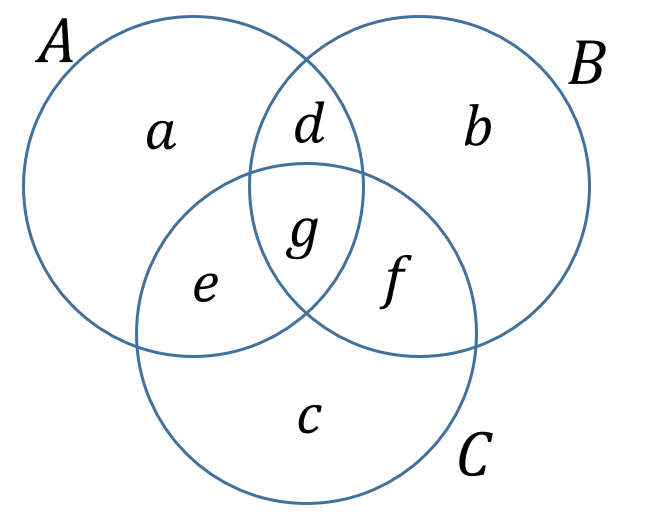
\[ \begin {aligned} a & = \Prob {A \setminus (B \cup C)} \\ b & = \Prob {B \setminus (A \cup C)} \\ c & = \Prob {C \setminus (A \cup B)} \\ d & = \Prob {(A \cap B) \setminus C} \\ e & = \Prob {(A \cap C) \setminus B} \\ f & = \Prob {(B \cap C) \setminus A} \\ g & = \Prob {A \cap B \cap C} \end {aligned} \]
By the additivity of probability for mutually exclusive regions: \[ \Prob {A \cup B \cup C} = a+b + c + d + e + f + g \;. \]
Also, we can build the standard intersections from these regions: \[ d + g = \Prob {A \cap B} \;,\;\;\; e + g = \Prob {A \cap C} \;,\;\;\; f + g = \Prob {B \cap C} \;, \] and the standard sets: \[ a + d + e + g = \Prob {A} \;,\;\;\; b + d + f + g = \Prob {B} \;,\;\;\; c + e + f + g = \Prob {C} \;. \] Now, we algebraically substitute these into the right side of the PIE equation and verify it matches the union: \begin {equation*} \begin {aligned} &(a + d + e + g) + (b + d + f + g ) + (c + e + f + g) - (d+g) - (e + g) - (f + g) + g \\ &= a + b + c + 2d + 2e + 2f + 3g - d - e - f - 3g + g \\ &= a + b + c + d + e + f + g \;. \end {aligned} \end {equation*} Which is exactly \(\Prob {A \cup B \cup C}\).